Pet-Friendly House Cleaning in Raleigh: What It Means and What the ASPCA Says
Pet friendly house cleaning has no official definition. In practice it means following label directions, letting surfaces dry before pets return, and answering your questions about products. The ASPCA says most cleaning products are safe around dogs and cats when used as labeled. No product is automatically pet safe, so ask.
Key takeaways
- There is no official "pet-friendly" standard for cleaning. Practices and product labels matter.
- ASPCA: most cleaning products are safe around dogs and cats when used per label directions.
- Let wet floors, carpets and counters dry before pets return. Birds are extremely sensitive to fumes.
- Ask about products, scents (especially essential oils) and how the visit will work around your pets.
- If a pet may have been exposed to something, call your vet or ASPCA Poison Control at (888) 426-4435.
What does a pet friendly house cleaning service in Raleigh mean?
There is no official standard for a pet friendly house cleaning service, so the phrase describes practices rather than a certification. The ASPCA says most cleaning products are safe around dogs and cats when used according to label directions. Ask any company what it uses and how a visit works around your pets.
You will see "pet-friendly" on many cleaning websites. Nobody audits that phrase. What helps is a company willing to talk through what it uses and how a visit works around animals.
Eco-friendly describes a product; it is not a veterinary approval. If your dog, cat or bird has a health condition, your veterinarian is the right person to ask about products.
What does the ASPCA say about common cleaning products and pets?
The ASPCA says most cleaning products are safe for dogs and cats when used as directed, but some need care. Bleach must be diluted and rinsed, vinegar can irritate if concentrated, essential oils are a concern for cats, and birds are extremely sensitive to fumes. Always follow the label.
The ASPCA Animal Poison Control Center publishes general-information guides on household products. Here is a summary of what it says. It is general information, not a way to assess an exposure.
| Product | What the ASPCA says |
|---|---|
| Bleach | Undiluted bleach can injure the mouth and esophagus. Properly diluted, thoroughly rinsed and aired out, it is not expected to cause harm when cleaning toys or kennels. |
| Vinegar and water | Vinegar is acidic and can upset the stomach. It is not generally an issue if diluted, rinsed and allowed to dry. |
| Enzyme cleaners | Most cause only mild stomach upset; let them dry before pets re-enter. |
| Carpet shampoo | Most can be used in pet households. Let the carpet dry before pets return. |
| Carpet freshener | Keep pets out of the room until you have vacuumed up the powder. |
| Essential oils | Cats are especially sensitive. The ASPCA does not recommend using any in areas pets can reach unless pets are supervised or your veterinarian approves. |
| Birds | Get veterinary advice when using cleaning products around birds, which are extremely sensitive to fumes. |
Our posts on bleach and pets, essential oils and pets and cleaning products for dogs cover each in more detail.
What should you ask a cleaning company about pets?
Ask what products will be used, how long surfaces take to dry, whether anything is scented or contains essential oils, and what the crew needs from you on cleaning day. Also tell the company about birds or other sensitive animals. Get any answer that matters to you in writing before booking.
These questions turn "pet-friendly" into something you can check:
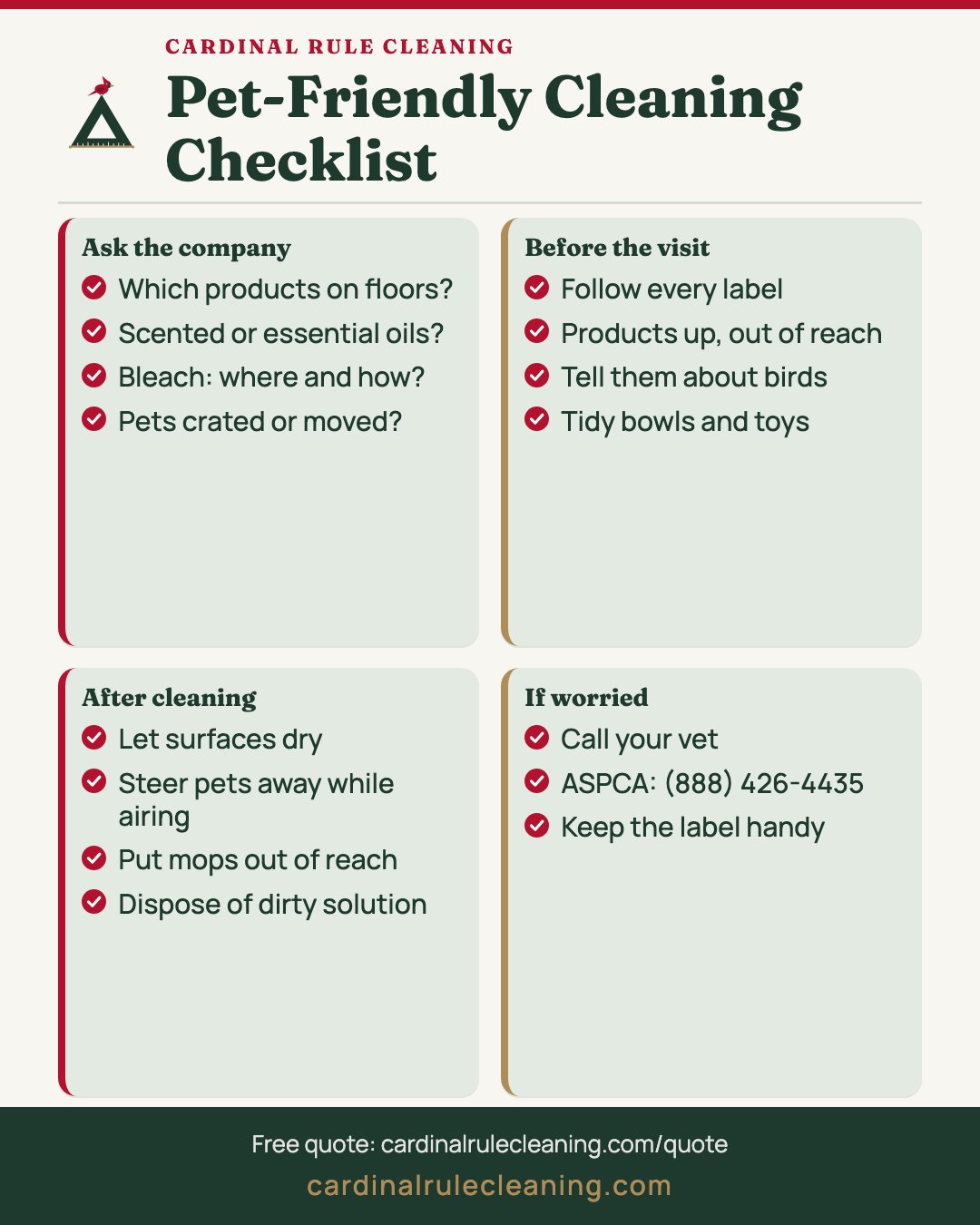
- What products will you use on floors, carpets and counters? The ASPCA says to let carpets and many cleaned areas dry before pets return.
- Do you use scented products or essential oils? The ASPCA is cautious about essential oils, especially for cats.
- Will you use bleach, and where? Ask for details if you have a pet that mouths toys or drinks from floors.
- Do you need pets crated, in another room, or out of the house? This is a company-by-company policy, so ask rather than assume.
- Who should I tell about a pet that bolts, bites or has a medical issue?
For more on day-of logistics, see what to do with your pets when cleaners come and how to prepare for house cleaners.
How can you prepare your home and pets for a cleaning visit?
Keep cleaning products and tools up and out of reach, and if your pet is curious about a freshly cleaned area, steer it to another part of the house while the surfaces air out. The ASPCA also says to dispose of unused or dirty solutions and put away mops where pets cannot go.
The ASPCA's guidance for pet owners translates well to a cleaning day:
- Follow label directions for every product.
- After cleaning, dispose of unused or dirty solutions, and put cleaning tools such as mops somewhere pets cannot reach.
- If your pet seems overly interested in a freshly mopped floor or cleaned counter, guide it to another part of the house while surfaces air out.
- If the bleach or other odor seems strong, the ASPCA suggests opening windows and using fans.
- Keep products up and out of paws' reach, and keep pets out of the area when using any potentially toxic substance.
You can also tidy toys, bowls and bedding before the visit so they are not in the way. That part is a practical tip rather than a rule, so adjust to what your pets need.
How do pet hair and dander change what needs cleaning?
Pets add dander and hair to dust, bedding and soft furniture. AAFA says six out of 10 people in the U.S. are exposed to cat or dog dander, and pets are a main source of indoor allergens. Regular vacuuming and washing washable fabrics help, and recurring cleaning keeps the work manageable.
AAFA lists pets, wall-to-wall carpet, soft furniture, stuffed toys and bedding among the main sources of indoor allergens. It recommends vacuuming once or twice a week and washing bedding in hot water. EPA notes that indoor dust commonly contains pollen, mold spores, pet dander and dust mite droppings.
None of that means a pet household is unclean. It means hair and dander collect on soft surfaces, along baseboards and in vents, so those are good topics for your cleaning scope. Our guides to reducing pet allergens and deep cleaning a house with pets go further.
If anyone in your home has allergies, see house cleaning for allergies in Raleigh.
What should you do if a pet may have been exposed to a product?
Contact your veterinarian or call ASPCA Animal Poison Control at (888) 426-4435 immediately. The ASPCA says its household product guide is general information only and not meant to help assess or manage animal exposures. Do not wait to see whether symptoms appear, and have the product label ready.
The ASPCA states that if you suspect your pet has been exposed to any toxic substance, you should contact your veterinarian or call poison control immediately at (888) 426-4435. Having the product container and label on hand will help the person you speak with. This post is general information and is not veterinary advice.
How do you get a house cleaning quote in Raleigh?
Request a free quote at cardinalrulecleaning.com/quote or call (919) 823-2850. Pricing is quoted by home size and condition. Ask any company about its products and pet policies. Cardinal Rule Cleaning is licensed and insured and serves Raleigh, Durham, Chapel Hill, Cary, Apex, Morrisville, Wake Forest, Holly Springs and Garner.
Ask the questions above before the first visit, including how the company works around pets that are sensitive. Learn about our recurring house cleaning, or request a free quote. For a first reset, compare deep cleaning vs. regular cleaning.
Want this done for you? See our House Cleaning service or request a free quote.
Get your free house cleaning quote
Takes about 60 seconds. No obligation.
Frequently asked questions
Is pet-friendly cleaning a certified label?
No. There is no official certification for a pet-friendly cleaning service. The ASPCA says most cleaning products are safe around dogs and cats when used according to label directions, so the useful test is how a company uses products and answers your questions, not a badge.
Are eco-friendly cleaning products automatically safe for pets?
No. Eco-friendly is a description, not a veterinary approval. The ASPCA, for example, is cautious about essential oils, especially around cats, even though they are often found in natural-sounding products. Check each product's label and ask your veterinarian about any concern.
How long should pets stay away from freshly cleaned floors?
It depends on the product. The ASPCA says to let carpets dry before pets return and to let enzyme cleaners dry. For other products, follow the label directions, and use the ASPCA's advice to guide a curious pet to another part of the house while surfaces air out.
Are birds affected differently by cleaning products?
The ASPCA says to get veterinary advice when using cleaning products around birds, because they are extremely sensitive to fumes. If you have a bird, tell your cleaning company before booking and ask your veterinarian how to handle ventilation and room placement.
Do I have to put my pets away when cleaners come?
That depends on the company and your pets. Ask what your cleaning company needs, and tell them about pets that bolt, bite or are anxious. Our guide on pets when cleaners come lists the practical things to arrange ahead of time.