House Cleaning for Allergies in Raleigh: What Helps and What to Ask
House cleaning for allergies in Raleigh focuses on where dust, dust mites and pet dander collect: bedding, soft furniture, carpet and damp areas. AAFA suggests damp dusting, regular vacuuming and humidity control. A cleaning service can handle recurring work, but this is general information, not medical advice.
Key takeaways
- Dust mites live in nearly every home, no matter how clean, so the goal is reducing exposure, not eliminating it (AAFA).
- Bedrooms, bedding, carpet, soft furniture and damp areas are the main places to focus.
- Damp cloths beat feather dusters, which only move dust around. Weekly vacuuming is a common recommendation.
- Scented products can bother some people. Ask any company which products it uses.
- This post is general information. Talk to your doctor or allergist about symptoms.
What does house cleaning for allergies in Raleigh involve?
It means regularly removing the dust, pet dander and other allergen sources that build up in a home. AAFA says dust mites live in nearly every home no matter how clean, so cleaning reduces exposure rather than ending it. A cleaning service cannot treat allergies; your doctor or allergist can.
Cardinal Rule Cleaning does not make medical claims, and we cannot promise a change in anyone's symptoms. What we can do is share what trusted health sources say about reducing indoor allergen sources, and help you decide what to put in a cleaning scope.
AAFA, the Asthma and Allergy Foundation of America, says any effort you make to reduce dust mites can help, even if you cannot follow every step. It also says the most important step is to avoid dust mites as much as possible, alongside medical treatment. Talk to a doctor about your own situation.
Our house cleaning on a recurring schedule is one way to keep dust from building up. See weekly vs. biweekly cleaning for how frequency works.
Where do indoor allergens collect in a home?
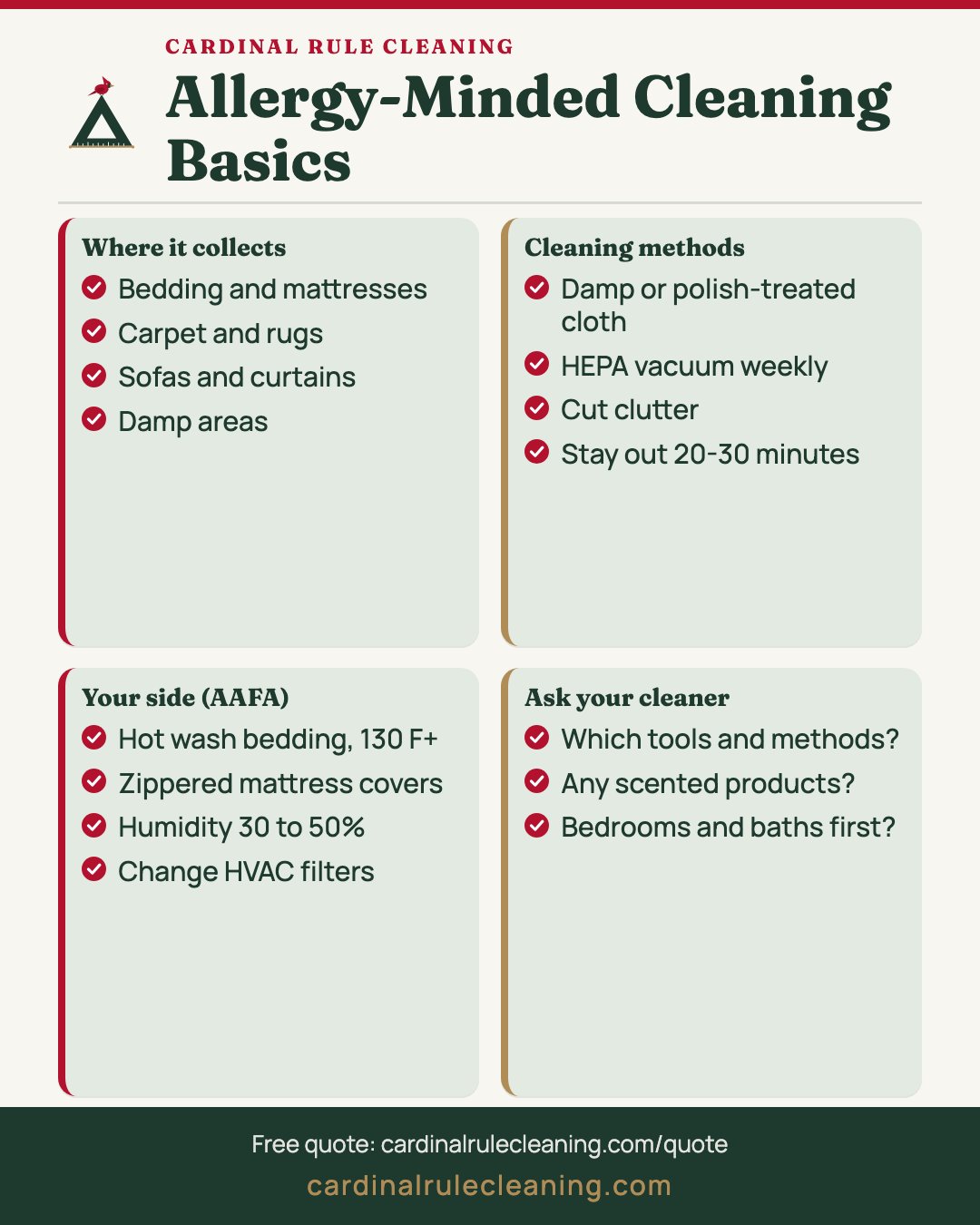
AAFA lists pets, wall-to-wall carpet, soft furniture, stuffed toys, bedding, damp areas, indoor plants and uncovered mattresses and pillows as main sources of indoor allergens. EPA says indoor dust commonly contains pollen, mold spores, pet dander and dust mite and cockroach droppings.
EPA says dust mites feed on human skin flakes and are found in mattresses, pillows, carpets, upholstered furniture, bedcovers, clothes, stuffed toys and other fabric items. AAFA says the bedroom usually has more dust mites than anywhere else in the home.
That gives you a short list of priorities:
- Bedrooms: mattress, pillows, bedding, floors and clutter.
- Soft surfaces: carpets, rugs, sofas, curtains.
- Damp areas: bathrooms and anywhere with moisture, since EPA notes mold can grow where spores land on damp places.
- Pet areas: beds and favorite furniture. See our guide to reducing pet allergens.
Which cleaning methods do AAFA and EPA suggest?
AAFA suggests dusting with a damp or polish-treated cloth, vacuuming regularly with a HEPA-filter vacuum, and keeping surfaces uncluttered. It warns that feather dusters only move dust around and some vacuums leak particles back into the air. Dusting and vacuuming stir up dust, so leave the room afterward.
Here is what the sources say about technique:
- Dust damp, not dry. AAFA recommends a cloth that is damp or treated with polish. It says feather dusters only move dust around.
- Vacuum on a schedule. AAFA recommends a vacuum with a HEPA filter weekly (one page says once or twice a week), but notes vacuuming alone is not enough to remove all dust mites, which live deep inside sofas, mattresses and carpets.
- Reduce clutter. Dust tends to collect on clutter.
- Give dust time to settle. AAFA says dusting and vacuuming stir up dust and recommends staying out of the room for at least 20 to 30 minutes afterward.
- Protect yourself. AAFA suggests having someone without a dust mite allergy clean the bedroom, or wearing an N95 mask when dusting or vacuuming.
When you compare companies, ask which tools and methods they use for dusting and vacuuming. Our guide to reducing dust shows how to do it between visits.
What belongs on your side of the list?
Some allergen control happens outside a cleaning visit. AAFA recommends washing sheets and blankets weekly in water at least 130 degrees Fahrenheit, using zippered allergen-barrier covers on pillows and mattresses, keeping indoor humidity between 30 and 50 percent, and changing HVAC filters. Share the plan with your cleaner.
These steps come from AAFA's dust mite guidance and its indoor allergen guide:
- Wash sheets, blankets and throw rugs weekly in hot water, at least 130 degrees Fahrenheit.
- Cover mattresses and pillows in zippered allergen-barrier covers. AAFA says encasing mattresses works better than air cleaners to reduce allergy symptoms.
- Keep home humidity between 30 and 50 percent. AAFA notes a dehumidifier or air conditioner can help.
- Fix leaks and damp areas to limit mold and dust mites.
- Replace pillows every two years and mattresses every ten, as AAFA suggests.
- Use a quality filter in your central furnace and air conditioner, and change filters often.
Your doctor may have other recommendations. Treat this as general information.
Do cleaning products matter for allergy-conscious households?
They can. AAFA says many cleaning products contain strong scents, chemicals and VOCs that can trigger asthma, and that essential oils can be a trigger too. Eco-friendly is not the same as fragrance-free, so you can ask any company which products it uses.
AAFA notes that homemade recipes using baking soda, vinegar, borax, hydrogen peroxide or dish soap may be less likely to cause asthma symptoms, while essential oils can act as triggers because of their strong scents. It also says vinegar and essential oils are not EPA-registered disinfectants.
EPA's Safer Choice program also offers a fragrance-free label for products. This is educational information. When you request a quote, you can ask any company whether its products are scented or fragrance-free.
Ask directly: which products will be used in my bedroom and bathrooms, and are any of them scented? Our guides to what to ask a cleaner about products and asthma-friendly cleaning tips have more.
Is deep cleaning or recurring cleaning better for allergy concerns?
A deep clean resets built-up dust on baseboards, vents and trim, and recurring cleaning keeps it from returning. Which fits depends on the home's condition. EPA notes that walking, sweeping, dusting and vacuuming can stir dust into the air, so ask how each visit is handled.
Our deep cleaning scope includes baseboards, door frames and trim, ceiling fans and vents, and window sills and tracks, which are places dust settles. After a reset, a recurring schedule helps maintain it. See deep cleaning vs. regular cleaning and how often to deep clean.
Neither one removes dust mites from inside mattresses and sofas, which AAFA says is where much of the population lives. That is why bedding care and covers stay on your list.
How do you get a house cleaning quote in Raleigh?
Request a free quote at cardinalrulecleaning.com/quote or call (919) 823-2850. Pricing is quoted by home size and condition, and the form takes about 60 seconds. Cardinal Rule Cleaning is licensed and insured and serves Raleigh, Durham, Chapel Hill, Cary, Apex, Morrisville, Wake Forest, Holly Springs and Garner.
Cardinal Rule Cleaning is licensed and insured. Tell us about your home and priorities, such as bedrooms, pets or damp areas, and we can discuss scope in the quote. Request a free quote.
Want this done for you? See our House Cleaning service or request a free quote.
Get your free house cleaning quote
Takes about 60 seconds. No obligation.
Frequently asked questions
Can a cleaning service cure my allergies?
No. A cleaning service can remove dust and other allergen sources on a regular schedule, which is part of reducing exposure. AAFA says avoidance is the most important step but that medicines may also be needed. Talk to your doctor or allergist about symptoms and treatment.
Is a HEPA vacuum necessary for allergy-conscious cleaning?
AAFA recommends a vacuum with a HEPA filter weekly to help keep mites and mite waste from returning to the air, and says some poor-quality vacuums put dust into the air. If this matters to you, ask a cleaning company about its equipment before you book.
Why does the bedroom matter most?
AAFA says the bedroom usually has more dust mites than anywhere else in the home, and recommends starting there. Mattresses, pillows and bedding collect skin flakes that mites feed on. Washing bedding in hot water and using allergen-barrier covers are among its top steps.
Do I need to leave the house when cleaners come?
AAFA recommends staying out of the room for at least 20 to 30 minutes after dusting or vacuuming, and suggests leaving the house for several hours after cleaning if you have allergies. Ask your doctor what suits you and discuss timing with your cleaning company.
Are fragrance-free products better for allergies?
AAFA says strong scents in cleaning products can trigger asthma. EPA offers a fragrance-free Safer Choice label for people who prefer unscented products. Scent sensitivity varies, so ask any company which products it uses before you book. Reading each label also helps you compare options.