Essential Oils & Pets: What to Avoid When Cleaning Your Home
Poison-control sources do not endorse any essential oil as a pet-safe cleaning ingredient. The ASPCA says concentrated oils can be a danger to dogs and cats, and cats are especially sensitive. Pet Poison Helpline urges caution with oils, products containing them and diffusers. If you have pets in Raleigh, check ingredient lists and ask your veterinarian first.

Key takeaways
- Neither the ASPCA nor Pet Poison Helpline lists any essential oil as a pet-safe cleaning ingredient. Both urge caution.
- Concentrated oils are the biggest concern, and they should never be applied to a pet.
- Cats are especially sensitive to essential oils, according to the ASPCA.
- Pet Poison Helpline names tea tree, pennyroyal, wintergreen and pine oils as common dog toxicities.
- Check the ingredient list of "natural" cleaners for oils, and call your vet or a poison line if a pet is exposed.
Are there pet safe essential oils for cleaning?
We could not find a poison-control source that names an essential oil as a safe cleaning ingredient for pets. The ASPCA says concentrated oils can absolutely be a danger to dogs and cats, and Pet Poison Helpline says to be cautious with oils, products containing them and diffusers. Treat any claim of pet safe as unverified.
If you searched for a list of "pet safe" essential oils, here is the honest answer: the two main poison-control sources we reviewed do not publish one. Instead:
- The ASPCA says that in their concentrated (100%) form, essential oils "can absolutely be a danger for pets," and that toxicity depends on the oil, the concentration and what it is mixed with.
- Pet Poison Helpline says owners should be cautious using essential oils, products containing essential oils and diffusers, to protect their dog or cat from a toxic risk.
- The ASPCA does not recommend using any essential oils in areas where pets have access, unless the pets are supervised or the use of the oil is approved by your veterinarian.
This is general information from published sources, not veterinary advice. Your own veterinarian knows your animal.
Which essential oils are flagged as risky for dogs and cats?
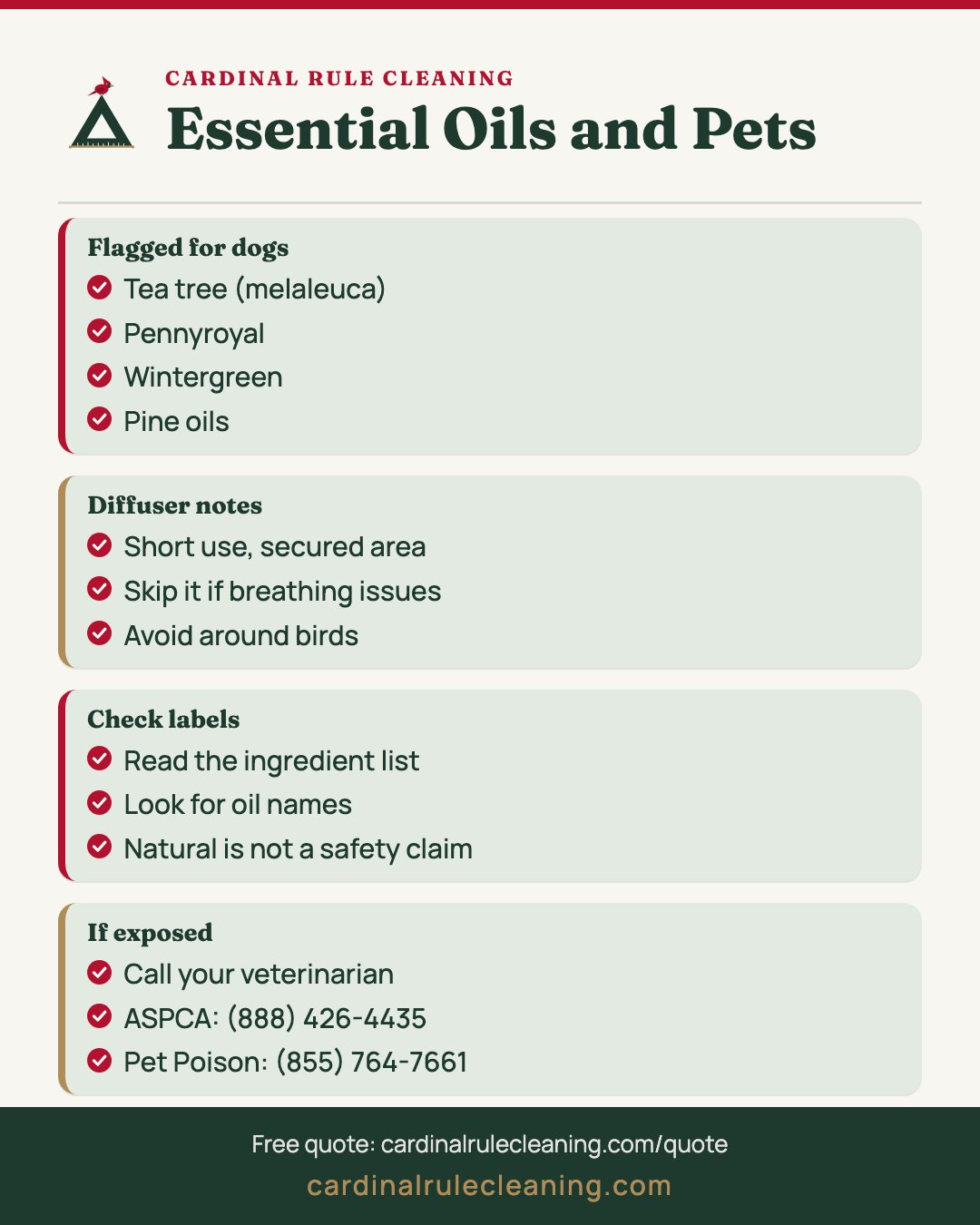
Pet Poison Helpline says the most common essential oil toxicities in dogs involve tea tree (melaleuca), pennyroyal, wintergreen and pine oils. For cats, it says concentrated oils should never be applied directly, and the ASPCA says cats are especially sensitive. Toxicity varies by oil, concentration and formulation.
Pet Poison Helpline's dog article walks through four oils it sees most often:
- Tea tree (melaleuca) oil: most often a problem when concentrated oil is applied to a pet. The article says low concentrations in dog shampoos are not what cause these toxicities.
- Pennyroyal: a known toxin to dogs, and all forms should be avoided in dogs.
- Oil of wintergreen: contains methyl salicylates, related to aspirin.
- Pine oils: the article notes pine oils are used as a natural disinfectant, deodorizer and in household cleaning products.
That last point is why this topic belongs in a cleaning article. Oils show up in cleaners and fresheners, not just in diffusers.
The ASPCA adds that effects of ingesting significant amounts of essential oils in cats can include gastrointestinal upset, central nervous system depression and even liver damage, and that the variability in concentration, formulation and quality makes it best never to apply oils directly to a pet.
Are essential oil diffusers a problem for pets?
The ASPCA says using a diffuser for a short time in a secured area your pet cannot access is not likely to be an issue, but pets with a history of breathing problems may be better off without one, and birds are very sensitive. Place diffusers where pets cannot knock them over.
The ASPCA's Animal Poison Control Center gave a measured answer to "should I return my diffuser?" Not necessarily. Its guidance:
- A short period of use in a secured area that your dog or cat cannot access is not likely to be an issue.
- If your pet has a history of breathing problems, it may be best to avoid one altogether.
- Pets have a much better sense of smell than we do, so something that seems light to us may be overwhelming to them.
- Keep the diffuser where a pet cannot knock it over and be exposed to the oil.
- With birds, it is best to avoid using an essential oil diffuser in your house at all, because their respiratory tracts are very sensitive.
Pet Poison Helpline's broader advice for a home with a cat or dog is prevention first: it describes prevention as the best medicine for essential oil toxicity.
How can you spot essential oils in cleaning products?
Read the ingredient list or label for oil names, such as tea tree, pine or wintergreen, and for fragrance words. A natural claim alone is not enough: the American Academy of Pediatrics notes natural products can still contain ingredients that cause health problems. When unsure, ask the manufacturer or your veterinarian.
- Look at the ingredient list, not the front label. Plant-based marketing does not tell you which oils are inside.
- Look for oil names flagged above: tea tree or melaleuca, pine, wintergreen, pennyroyal.
- Check for "fragrance" or scent claims. A product can smell like an oil without listing it by name. EPA's fragrance-free Safer Choice mark exists for people who prefer products without fragrance; see our post on the fragrance-free label.
- Contact the manufacturer or vet. The ASPCA suggests this if you have questions about selecting or applying a product.
See also cleaning products and dogs and what eco-friendly cleaning means.
What should you do if a pet is exposed to essential oils?
Contact your veterinarian or a poison hotline right away. The ASPCA Animal Poison Control Center is (888) 426-4435 and Pet Poison Helpline is (855) 764-7661. Pet Poison Helpline also says induced vomiting is not recommended with oil products, because of the aspiration risk, so do not try to treat the pet yourself.
- ASPCA Animal Poison Control: (888) 426-4435
- Pet Poison Helpline: (855) 764-7661
The ASPCA lists signs after concentrated oil exposure that can include unsteadiness on the feet, depression and, in severe cases, low body temperature, and after ingestion you may also see vomiting and diarrhea. Pet Poison Helpline describes aspiration (oil getting into the lungs) as a particular concern, and says it does not recommend inducing vomiting with oil products and that most of these exposures need immediate veterinary care.
Do not use this article to decide whether your pet needs help. Make the call.
What should you tell a cleaning company about scents and pets?
Ask any provider which products and scents it uses in your home, whether any contain essential oils or added fragrance, and whether you can read the labels. Labels and ingredient lists are the clearest way to compare. Tell the company which pets live in your home, since cats and birds are especially sensitive.
Scent preferences are easy to mention up front and hard to fix afterward. Useful things to ask any provider:
- Which products will you use, and may I read the labels?
- Do any contain essential oils or added fragrance?
- Can you skip air fresheners, diffusers or scented sprays in my home?
- Where should my pets be during the visit?
Cardinal Rule Cleaning provides premium house cleaning in Raleigh, Durham, Chapel Hill, Cary, Apex, Morrisville, Wake Forest, Holly Springs and Garner. We are licensed and insured, and we price by quote. When you request a free quote, you can ask any company which products it uses. For household prep, see pets when cleaners come.
Want this done for you? See our House Cleaning service or request a free quote.
Get your free house cleaning quote
Takes about 60 seconds. No obligation.
Frequently asked questions
Are essential oils toxic to dogs?
Some can be. Pet Poison Helpline says the most common essential oil toxicities in dogs involve tea tree (melaleuca), pennyroyal, wintergreen and pine oils. The ASPCA says toxicity varies by oil, concentration and what it is mixed with. Never apply oils directly to a pet.
Are essential oils safe around cats?
Pet Poison Helpline says concentrated essential oils should never be applied directly to cats. The ASPCA says cats are especially sensitive to essential oils. Both urge caution with oils and diffusers where cats live, and recommend asking your veterinarian before using any in your home.
Is it okay to use an essential oil diffuser with pets?
The ASPCA says short-term use in a secured area your pet cannot access is not likely to be an issue. It suggests avoiding one if your pet has a history of breathing problems, and avoiding diffusers entirely with birds. Keep it out of reach.
Does a natural cleaner mean pet safe?
No. The American Academy of Pediatrics notes green or natural products may still contain ingredients that cause health problems, and the ASPCA flags essential oils among household products to approach with care. Check the ingredient list and ask your veterinarian before relying on a natural claim.
How do I raise scent concerns with a cleaning company?
Ask any provider whether its products contain essential oils or added fragrance, and let it know about your pets before the first visit. Reading labels and ingredient lists helps you compare, and the ASPCA says to contact the manufacturer or your vet if you have questions about a product.