Non-Toxic House Cleaning in Raleigh: What It Means and What to Ask Before You Hire
Non-toxic house cleaning has no single legal definition, so judge it by questions, not slogans. The FTC says a non-toxic claim needs scientific evidence that a product is safe for people and the environment. Ask what products are used, what the labels say, whether they are scented, and when disinfectants are needed.
Key takeaways
- "Non-toxic" is a marketing claim, not a certification. Ask the company what it is based on.
- Ask which products are used in kitchens, bathrooms and on floors, and ask to see the labels.
- A third-party label such as EPA Safer Choice is checkable. A general word like "green" is not.
- Scents, ventilation and disinfectants matter as much as the product name.
- When you request a quote, you can ask any company which products it uses.
What does a non toxic house cleaning service in Raleigh really mean?
There is no single legal definition of a non toxic house cleaning service. The FTC says marketers who claim a product is non-toxic need competent and reliable scientific evidence that it is safe for both people and the environment. Treat the phrase as a claim to question, not a guarantee.
The FTC's Green Guides also say marketers should not make broad, unqualified claims like "green" or "eco-friendly," because broad claims are hard to substantiate. Good claims are specific.
That is useful when you shop. A company that can tell you what it uses and why gives you something to check. A company that only says "natural" does not.
Our guide to eco-friendly cleaning covers the definition. This page covers what to ask.
What should you ask a Raleigh cleaning company about its products?
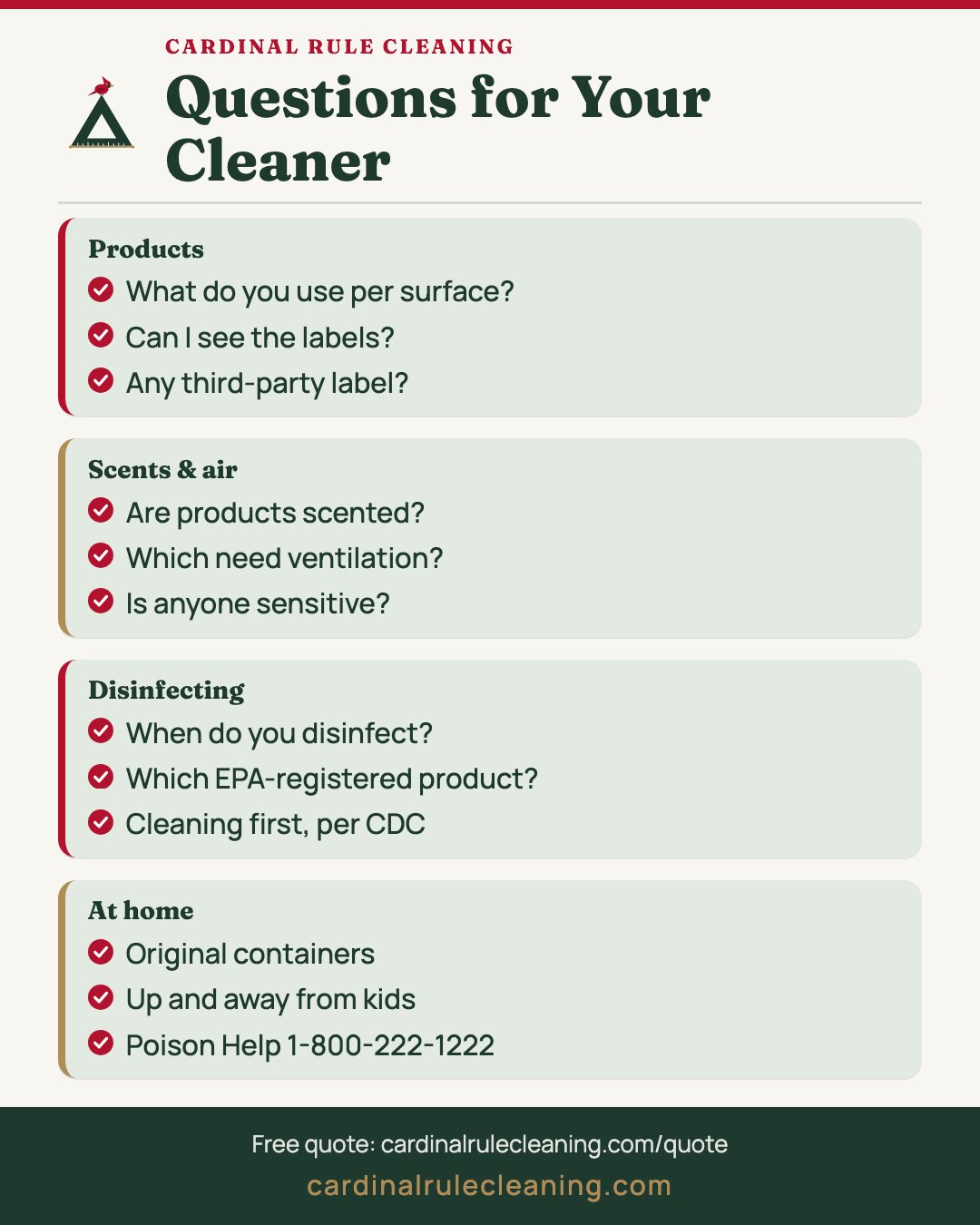
Ask which products are used in the kitchen, bathrooms and on floors, and whether you can see the labels. Ask if any carry a third-party label, whether they are scented, and when the crew would use a disinfectant. A clear answer to each is a good sign.
Bring this list to your first call:
- What do you use for kitchens, bathrooms and floors? Different surfaces often get different products.
- Can I see the labels? OSHA says chemical manufacturers prepare labels and safety data sheets, and employers with hazardous chemicals must have them for exposed workers. A professional company should be comfortable talking about its products.
- Does any product carry a third-party label? EPA's Safer Choice label is one you can verify (more below).
- Are the products scented? If anyone in the home reacts to fragrance, say so.
- When do you disinfect, and with what? More on that below.
- How do you handle a product I want you to avoid? Ask before booking, not on cleaning day.
Write down the answers and compare them between companies. Our guide to choosing a cleaning company in Raleigh covers the other questions to ask.
What does the EPA Safer Choice label tell you?
The Safer Choice label means EPA reviewed every ingredient in a product against human health and environmental criteria, and the product met performance, pH and packaging standards. Participation is voluntary. The label applies to individual products, such as sprays and detergents, not to cleaning companies.
EPA says its Safer Choice program reviews all chemical ingredients, regardless of their percentage in the product. The program also checks product performance, pH, packaging and volatile organic compound (VOC) content. EPA states that nearly 2,000 products currently qualify, including products for homes and for facilities such as offices.
Two cautions. First, the label applies to products. Second, disinfectants are handled separately: EPA's Design for the Environment program allows its logo on qualifying disinfectant labels, which is a different program.
This section is education only. If you want a labeled product in your home, ask any cleaning company directly and check the bottle. See what EPA Safer Choice is and how to find Safer Choice products.
Do scents and ventilation matter more than the product name?
They can. EPA says many cleaning and disinfecting products emit VOCs, and concentrations of many VOCs are higher indoors than outdoors. AAFA adds that strong scents and VOCs in some cleaning products can trigger asthma. Follow product labels and ventilate the space while you clean.
EPA's indoor air page says organic chemicals are widely used as ingredients in household products, including many cleaning and disinfecting products, and concentrations of many VOCs are consistently higher indoors, up to ten times higher, than outdoors. Its advice is plain: follow label instructions, and if a label says to use the product in a well-ventilated area, open windows or use an exhaust fan.
AAFA, the Asthma and Allergy Foundation of America, says many cleaning products contain strong scents, chemicals and VOCs that can trigger asthma. It also notes that essential oils can be an asthma trigger because of their strong scents. A plant-based label on a bottle does not settle the question for a sensitive household.
EPA also offers a separate Safer Choice fragrance-free label for people who prefer products without fragrance. If scent is your concern, ask for specifics. Our posts on cleaning products and indoor air quality and house cleaning for allergies go deeper.
Does a non-toxic home need disinfectants at every visit?
Usually not. CDC says cleaning alone removes most harmful viruses or bacteria from surfaces, and in most situations cleaning regularly is enough. It recommends disinfecting when someone is sick or at higher risk of getting sick. Ask a company when it would disinfect, and which product it would use.
CDC's guidance for homes separates three steps. Cleaning uses soap or detergent to remove germs and dirt. Sanitizing reduces the remaining germs. Disinfecting kills viruses and bacteria left after cleaning. CDC says to clean first, because dirt can make it harder for chemicals to reach germs.
When disinfecting, CDC says to use an EPA-registered disinfecting product and follow its label. That is a question worth asking: "If you disinfect, what do you use and where?" Our explainers on sanitizing vs. disinfecting and disinfecting without bleach show the options.
CDC also notes that some cleaning and disinfection products can trigger asthma, so a routine that leans on constant disinfecting is not automatically better.
How do you keep products safe at home between visits?
Store cleaning products up and away, out of children's reach and sight, in their original containers. Safe Kids Worldwide recommends this, and the Consumer Product Safety Commission says household cleaners should be locked up or kept out of reach. Save the Poison Help number, 1-800-222-1222, in your phone.
Whatever a cleaning company uses, products you keep at home need care too. Safe Kids Worldwide's tips include keeping household cleaning products in their original containers, looking for child-resistant containers, and reading and following product labels. CPSC adds that medications and household cleaners should be locked up and kept out of reach of children, because even small amounts can be dangerous.
For pets, the ASPCA says most cleaning products are safe around dogs and cats when used according to label directions, and notes that birds are extremely sensitive to fumes. See our guide to pet-friendly house cleaning in Raleigh.
How do you request a quote from a Raleigh cleaning company?
When you request a quote, you can ask any company which products it uses. Cardinal Rule Cleaning offers a free quote at cardinalrulecleaning.com/quote (about 60 seconds) or (919) 823-2850, priced by home size and condition. It is licensed and insured and serves Raleigh, Durham, Chapel Hill, Cary, Apex, Morrisville, Wake Forest, Holly Springs and Garner.
Our house cleaning is offered on recurring schedules, and we also do deep cleaning. Request a free quote.
Want this done for you? See our House Cleaning service or request a free quote.
Get your free house cleaning quote
Takes about 60 seconds. No obligation.
Frequently asked questions
Is "non-toxic" cleaning regulated?
Not as a simple label. The FTC's Green Guides say a marketer claiming a product is non-toxic needs competent and reliable scientific evidence that it is safe for both people and the environment. That is why asking what a company bases the claim on is more useful than trusting the word.
Is eco-friendly the same as non-toxic?
No. The FTC cautions against broad, unqualified claims like eco-friendly, and a non-toxic claim needs its own evidence. Neither word is a third-party certification. Ask for specifics, such as which products are used and whether any carry a label like EPA Safer Choice.
Can I ask a cleaning company to use a product I choose?
You can ask, but ask before booking. Whether a company will use a client's product is that company's policy, so get the answer in writing if it matters to you. Our post on whether cleaners bring supplies covers the basics of that question.
Do I need disinfectant if I want a low-chemical home?
Often not. CDC says cleaning alone removes most harmful viruses or bacteria, and regular cleaning is enough in most situations. CDC recommends disinfecting when someone is sick or at higher risk. If you disinfect, use an EPA-registered product and follow the label.
Where can I find EPA Safer Choice products?
EPA's Safer Choice website lists products that carry the label, including products for homes and for facilities. You can also look for the label on the bottle itself. The label means EPA reviewed the formula; it does not mean EPA endorses a particular company or cleaning service.