Safer Choice Cleaning Service Certification: What It Is and Who Can Get It
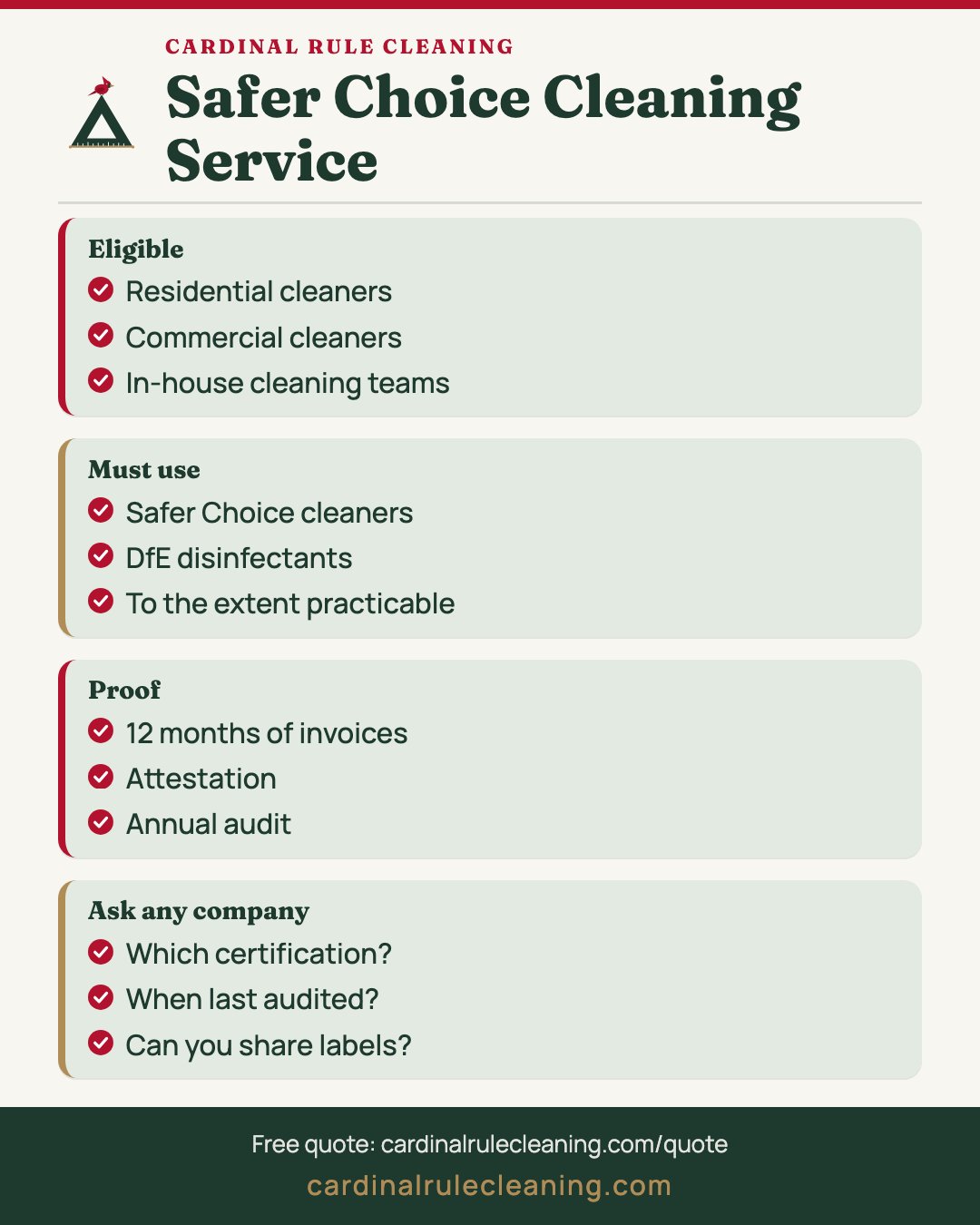
A Safer Choice cleaning service is a residential, commercial or in-house cleaning provider certified under EPA's Cleaning Service Certification. The provider must use Safer Choice-certified products for cleaning and DfE-certified products for disinfecting to the maximum extent practicable, shown by purchase records and annual audits.
Key takeaways
- EPA's Safer Choice Standard includes a separate Cleaning Service Certification with its own logo.
- Residential cleaners, commercial cleaners and in-house cleaning teams are eligible.
- Providers must use Safer Choice cleaners and DfE disinfectants to the maximum extent practicable.
- Certification runs on one-year partnership agreements, with annual audits and invoices as proof.
- If a company says it is certified, you can ask when it was last audited and which products it buys.
What is a Safer Choice cleaning service?
It is a cleaning provider certified under the Cleaning Service Certification in EPA's Safer Choice Standard. EPA says the certification covers organizations that use cleaners, detergents, disinfectants and related products as part of their primary operations, and it distinguishes providers using Safer Choice-certified products for cleaning and DfE-certified products for disinfecting.
Most people know Safer Choice as a label on bottles. EPA's Standard also describes a certification for the people who clean. The stated purpose is to provide a safer and healthier environment for home cleaners and custodial workers, as well as for the users and inhabitants of homes and buildings.
EPA also says the certification should improve the marketability of a certified provider's services by helping it project an image of sustainability. For the product label itself, see what EPA Safer Choice is.
Who is eligible for Safer Choice cleaning service certification?
According to the August 2024 Standard, eligible providers must offer cleaning as part of their routine operations. Listed eligible types are residential cleaners, commercial cleaners, and facility managers, owners or government entities with in-house cleaning services. EPA says the eligible candidate is the entity that purchases the products.
The Standard says that at the time of publication these types may apply:
- Residential cleaners
- Commercial cleaners
- Facility managers, facility owners or government entities with in-house cleaning services
EPA also reserves the right to enter or not enter service sectors. If it has not entered a sector, it will not certify a service in that sector.
What must a certified cleaning service do?
It must use Safer Choice-certified products for cleaning and DfE-certified products for disinfecting, in product classes where those products exist, to the maximum extent practicable. EPA can grant case-by-case exceptions, for example when a certified product is not reasonably available. At each annual audit, certified providers also attest they give employees information on certified products and best practices.
| Requirement | Detail (per the Standard) |
|---|---|
| Product use | Safer Choice products to clean, DfE products to disinfect, to the maximum extent practicable |
| Exceptions | Case-by-case, up to a year, if no certified product is reasonably available; renewable yearly |
| Application | Prepared and submitted through a Safer Choice-qualified Cleaning Service Certification (CSC) profiler |
| Proof | Purchase invoices or equivalent documentation from the last 12 months, plus an attestation |
| Term | The signed application becomes a one-year partnership agreement |
| Audit | Annual audit through a CSC profiler; may be done remotely |
To understand the DfE side, see Safer Choice vs DfE.
How does a certified provider show the certification?
EPA's Standard says certified providers may display the Safer Choice Service Certification logo on their website, advertisements, uniforms, equipment and facilities they clean. They should use it only while actively certified, meaning they have been audited within the past year. If a company uses the logo, you can ask for details of its certification.
The Standard asks that the logo be used without modification and displayed only while a provider is actively certified. If a company says it is certified, you can ask when it was last audited.
Is Safer Choice certification the same as Green Seal?
No. Green Seal is a separate nonprofit. Its GS-42 standard covers commercial and institutional cleaning services and explicitly does not cover residential buildings. EPA's Safer Choice Cleaning Service Certification lists residential cleaners among eligible providers. They are different programs with different requirements, so ask which one a company means.
Green Seal says GS-42 establishes requirements for cleaning service providers of commercial, public and institutional buildings, including training, communications and purchasing. Its scope statement says it does not cover residential buildings.
We compare the product-side programs in Safer Choice vs Green Seal.
What should you ask a cleaning company in Raleigh about green claims?
Ask whether the company holds any third-party certification and which one, what it uses for cleaning and disinfecting, and whether labels can be shared. Ask for the answer in writing. A certification is one signal; clear scope, licensing, insurance and a written quote matter too.
- Do you hold any third-party certification? Which one, and when was your last audit?
- What do you use for everyday cleaning and for disinfecting?
- Can you share product labels?
- Is a written scope and quote available?
Cardinal Rule Cleaning is a licensed and insured residential cleaning company serving Raleigh, Durham, Chapel Hill, Cary, Apex, Morrisville, Wake Forest, Holly Springs and Garner. Explore our house cleaning service, read how to choose a cleaning company, or request a free quote.
Want this done for you? See our House Cleaning service or request a free quote.
Get your free house cleaning quote
Takes about 60 seconds. No obligation.
Frequently asked questions
Does EPA certify cleaning companies?
Yes, EPA's Safer Choice Standard describes a Cleaning Service Certification for providers that use Safer Choice-certified cleaning products and DfE-certified disinfectants to the maximum extent practicable. The product label, by contrast, applies only to the finished product, not the company or service.
Are house cleaners eligible, or only commercial ones?
Both. The August 2024 Standard lists residential cleaners, commercial cleaners, and facility managers, owners or government entities with in-house cleaning services as eligible. Green Seal's separate GS-42 standard, a different program from a different nonprofit, covers commercial and institutional buildings and states it does not cover residential ones.
How long does the certification last?
EPA says the signed application becomes a partnership agreement with a one-year term, and an approved annual audit extends it for another year. Providers should display the logo only while actively certified, meaning they have undergone an audit within one year or less, according to the Standard.
What proof must a cleaning company provide?
Purchase invoices, receipts or equivalent documentation from the previous 12 months showing use of Safer Choice-certified cleaning products and DfE-certified disinfecting products to the maximum extent practicable, plus a signed attestation of that product use. The application is prepared and sent through a Safer Choice-qualified CSC profiler.
Can I ask a cleaning company about its certification?
Yes. If a company says it is certified, you can ask which certification it holds, when it was last audited, and what it uses for cleaning and for disinfecting. EPA's Standard says the logo should be used only while a provider is actively certified, meaning audited within the past year.