What Is Eco-Friendly Cleaning? What the Label Does and Doesn't Tell You
Eco-friendly cleaning usually means using products and methods meant to be gentler on people and the environment. But in Raleigh and everywhere else, "eco-friendly" is a marketing phrase, not a certification. Its real meaning comes from specifics: third-party labels, ingredient information and what a company can actually back up.
Key takeaways
- "Eco-friendly" is a marketing phrase, not a certification. The FTC's Green Guides say unqualified general environmental claims are difficult to interpret.
- Third-party programs such as EPA Safer Choice, Green Seal and UL ECOLOGO publish the criteria behind their labels. The word "eco-friendly" alone publishes none.
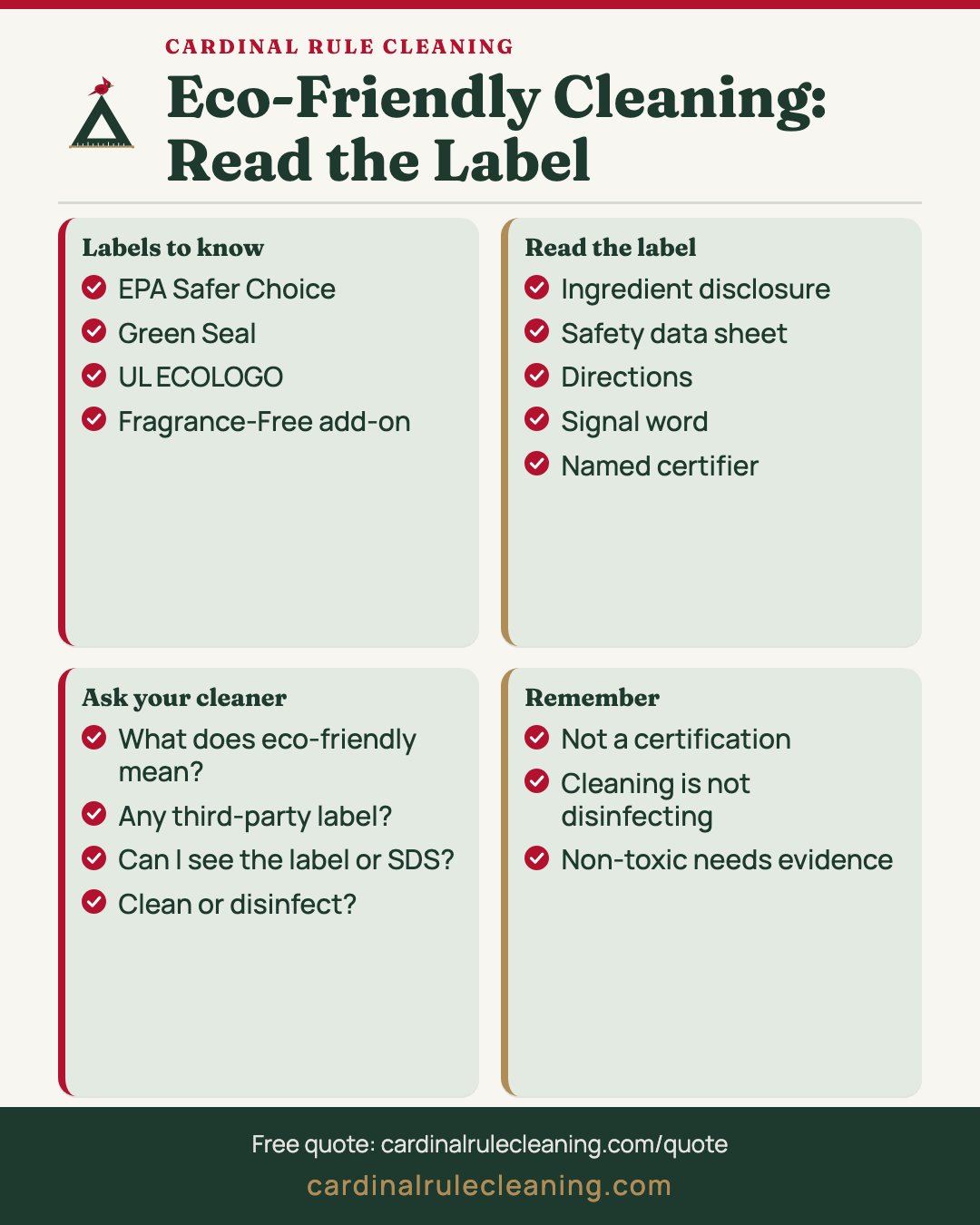
- Check the label for ingredient disclosure, a safety data sheet, directions and the name of any certifier.
- Cleaning and disinfecting are different jobs. EPA regulates cleaning products only if they sanitize or disinfect.
- Ask any cleaning company what "eco-friendly" means for their products and whether they can show you the label.
What is eco-friendly cleaning?
Eco-friendly cleaning is a common label for cleaning with products and methods meant to be easier on human health and the environment. There is no single legal definition behind the phrase. A university sustainability page describes the goal as "cleaning to protect health without harming the environment," which is a plain-language goal, not a standard.
People use "eco-friendly," "green" and "environmentally friendly" almost interchangeably. In everyday use they point at one idea: cleaning in a way that is gentler on the people in a home and on the environment.
The University of Connecticut's sustainability office describes green cleaning as "cleaning to protect health without harming the environment." That is a university's description of the goal, not a legal test.
No source we reviewed gives "eco-friendly" a fixed, regulated definition. So the phrase tells you what a company is aiming for. It does not, on its own, tell you what is in the bottle.
At Cardinal Rule Cleaning, we use eco-friendly cleaning products as part of our house cleaning service. This article is general information about the term. It does not make claims about any certification, and it is not a promise about any product.
Is "eco-friendly" a certification or just a marketing term?
It is a marketing term. The FTC's Green Guides, 16 CFR Part 260, say unqualified general environmental benefit claims are difficult to interpret and likely convey a wide range of meanings. A third-party label, by contrast, comes with criteria published by the program behind it.
The FTC's Green Guides do not define "eco-friendly." They set out how the Commission views environmental marketing claims and when those claims can mislead. Here is what the rule text says, quoted from the Cornell Law School copy of 16 CFR Part 260:
- Section 260.4(a): "It is deceptive to misrepresent, directly or by implication, that a product, package, or service offers a general environmental benefit."
- Section 260.4(b): "Unqualified general environmental benefit claims are difficult to interpret and likely convey a wide range of meanings." The same paragraph adds that marketers "should not make unqualified general environmental benefit claims."
The rule even uses the phrase as an example. It says the brand name "Eco-friendly" likely conveys that a product has far-reaching environmental benefits, and that because a marketer is unlikely to substantiate that, such a brand name is deceptive. It also says a claim like "Eco-friendly: made with recycled materials" would not be deceptive if the specific statement is clear and prominent and can be substantiated, among other conditions.
One note: the Guides are described in section 260.1 as the FTC's "current views about environmental claims." They "do not confer any rights on any person," but the Commission "can take action under the FTC Act if a marketer makes an environmental claim inconsistent with the guides." We are quoting rule text, not giving legal advice.
Section 260.6(d) adds that a certification or seal likely conveys a general environmental benefit if it does not convey the basis for the certification or seal.
Takeaway: "Made with recycled materials" can be checked. "Eco-friendly" alone cannot.
What do Safer Choice, Green Seal and UL ECOLOGO certify?
Each is a third-party program with published criteria. EPA's Safer Choice standard sets the requirements products and ingredients must meet to earn its label. Green Seal's household standard covers cleaners for routine home use. UL ECOLOGO certification for cleaning products is based on the UL 2700 standard.
These labels are different from a marketing word because there is a standard behind each one. Here is what each organization says on its own pages.
| Label | What the program says |
|---|---|
| EPA Safer Choice | EPA says Safer Choice "helps consumers, businesses, and purchasers find products that perform and contain ingredients that are safer for human health and the environment." Its standard "identifies the requirements products and their ingredients must meet to earn the Safer Choice label or the DfE logo." EPA says the program evaluates each ingredient in a formulation against its criteria documents. |
| Green Seal (GS-8, household) | Green Seal says its standard covers "all-purpose, glass, bathroom, carpet, and biologically-active" products for routine cleaning of residential settings. It states that certification is awarded only by Green Seal or, with its written permission, by a third-party program conducting on-site audits. The page also says the standard does not include antimicrobial pesticide products, such as those making claims as sterilizers, disinfectants, or sanitizers. |
| UL ECOLOGO | UL says its certification for cleaning products "is based on UL 2700, the Standard for Sustainability for Cleaning and Cleaning Related Products." Its page lists added criteria, including prohibited ingredients such as PFAS and microplastics. |
We have not reviewed the full technical standards, so we are not describing how each program tests performance. Green Seal's own page notes that its standard "neither modifies nor supersedes laws and regulations." A label is a program's seal of approval, not a law.
Also note that these programs certify specific products. A cleaning company saying it is "eco-friendly" does not mean every product it uses carries one of these labels. Ask which products, and check the official product listing for the one in question.
How do you read a cleaning product label?
Look past the front-of-bottle wording. An older UCSF fact sheet advises checking for full ingredient disclosure, looking up the safety data sheet if ingredients are not listed, reading the directions, and noting the signal word. It also warns that "green" and "environmentally friendly" have no legal meaning on a label.
A University of California San Francisco fact sheet on reading cleaning product labels is an older publication, so treat it as general advice and check current guidance too. Its main points are still a practical checklist:
- Don't buy on the front-of-bottle word. The fact sheet says terms like "green" and "environmentally friendly" "have no legal meaning and are not a good reason to buy a product."
- Look for ingredient disclosure. It notes there are "no requirements for manufacturers to list ingredients for cleaning products," so a company that lists them all gives you more to work with.
- Find the safety data sheet (SDS). If ingredients are not on the label, the fact sheet says to look up the SDS.
- Read the directions. How long to leave a product on a surface, what surfaces it suits and whether to rinse are all spelled out there.
- Check the signal word. Signal words on the label indicate how hazardous a product is, though the fact sheet notes they do not tell you about long-term hazards.
- Look for a named certifier. The fact sheet lists Green Seal, UL ECOLOGO and EPA's Safer Choice Program as programs that certify safer cleaning products.
Is eco-friendly the same as non-toxic or fragrance-free?
No. Each phrase is its own claim. The FTC says "non-toxic" claims should be clearly and prominently qualified to the extent necessary to avoid deception. EPA describes an additional Fragrance-Free label for products that already qualify for Safer Choice. An eco-friendly product is not automatically non-toxic or fragrance-free.
These words get used as if they were synonyms. They are not.
- Non-toxic. FTC section 260.10(a) says it is deceptive to misrepresent that a product is non-toxic. Section 260.10(b) says a non-toxic claim likely conveys that the product is non-toxic "both for humans and for the environment generally." The rule gives a cleaning product advertised as "essentially non-toxic" as an example of a claim that likely conveys no risk to humans or the environment, including household pets.
- Fragrance-free. EPA's Safer Choice standard describes an additional Fragrance-Free label/logo. It is available only to products that already qualify for the Safer Choice label or DfE logo, and only "after an EPA review to confirm that the product contains no fragrance materials."
None of the programs we reviewed describes a certified cleaner as "non-toxic." So treat "non-toxic" as a claim that needs its own evidence, not as a bonus that comes with an eco-friendly label.
For the same reason, we are careful here: we use eco-friendly cleaning products, and this article does not say they are non-toxic, plant-based or fragrance-free. If a specific product matters to you, such as for allergies or pets, ask about it directly when you request a quote.
Does eco-friendly cleaning disinfect?
Not by itself. EPA explains that cleaning removes dirt and organic matter from surfaces using soap or detergents, while disinfecting kills viruses and bacteria using chemicals. EPA regulates cleaning products only if they sanitize or disinfect. Eco-friendly products are cleaners, so ask separately if you need a surface disinfected.
This is the point most people miss. EPA's page on the difference between cleaning, sanitizing and disinfecting lays out three separate jobs:
| Job | What EPA says |
|---|---|
| Cleaning | "Cleaning removes dirt and organic matter from surfaces using soap or detergents." |
| Sanitizing | Kills bacteria on surfaces using chemicals. EPA notes it is not intended to kill viruses. |
| Disinfecting | "Disinfecting kills viruses and bacteria on surfaces using chemicals." |
EPA also states that it regulates cleaning products "only if they sanitize or disinfect."
What this means for a home: an eco-friendly cleaning product is a cleaner. A thorough cleaning visit removes dirt, grime and buildup, which is what regular house cleaning is for. It is not the same as disinfecting a surface. If you need disinfection for a specific reason, ask any company, including us, exactly what they will do and with what.
Whether green products clean as well as conventional ones is a separate question. We cover it in is green cleaning effective.
What should you ask a cleaning company about eco-friendly products?
Ask what "eco-friendly" means for their products, which products they use at your home, whether any carry a third-party label, and whether you can see the label or safety data sheet. Also ask what each product is meant to do, and whether it cleans or disinfects. Specific answers beat the bare word.
You can learn a lot from a few direct questions. These work for any company in the Triangle:
- "What does eco-friendly mean for the products you use?" A clear answer names specifics. A vague answer repeats the word.
- "Do any of your products carry a third-party label, like Safer Choice, Green Seal or ECOLOGO?" If yes, ask which products, then check the official listing for those products.
- "Can I see the label or safety data sheet?" This is the same label-reading checklist from above.
- "Do you clean, sanitize or disinfect?" These are different jobs. Ask for what you need.
- "Are you licensed and insured?" It belongs on every list. Cardinal Rule Cleaning is licensed and insured.
More on vetting a company in how to choose a cleaning company in Raleigh.
We serve Raleigh, Durham, Chapel Hill, Cary, Apex, Morrisville, Wake Forest, Holly Springs and Garner. You get a clear price up front, and you can request a free quote in about 60 seconds. Our house cleaning options include weekly, every other week and monthly visits.
This post is general information, not medical, legal or product-safety advice. Check the official sources linked below for the details that matter to you.
Want this done for you? See our House Cleaning service or request a free quote.
Get your free house cleaning quote
Takes about 60 seconds. No obligation.
Frequently asked questions
Is "eco-friendly" a legal term on cleaning products?
No source we reviewed gives it a fixed legal definition. The FTC's Green Guides treat it as a claim that must not mislead, and say unqualified general environmental claims are hard to interpret. An older UCSF fact sheet says terms like "green" have no legal meaning on a label.
Does a Safer Choice, Green Seal or ECOLOGO label mean a product is safe?
Those labels mean a product was reviewed against a published standard by that program. Green Seal says its household standard means a general-purpose household cleaner is safer for human health and the environment compared to conventional alternatives. Still read the directions and label before you buy.
Do cleaning companies have to list their ingredients?
An older UCSF fact sheet says there are no requirements for manufacturers to list ingredients for cleaning products. Disinfectants and sanitizers must list their active ingredients. Green Seal's household standard requires disclosing added fragrances. If you want details, ask for the label or safety data sheet.
Can an eco-friendly cleaner replace a disinfectant?
Not on its own. EPA says cleaning removes dirt and organic matter, while disinfecting kills viruses and bacteria using chemicals. EPA regulates cleaning products only if they sanitize or disinfect. If you need disinfection, ask a company what product and process they use for that specific purpose.
Does Cardinal Rule Cleaning use eco-friendly products?
Yes, we use eco-friendly cleaning products. This article is general information about the term, and it does not claim any certification or make claims about specific products. If a product detail matters to you, mention it when you request a free quote.