EPA Safer Choice vs Green Seal: What Each Label Means for Cleaning Products
EPA Safer Choice is a voluntary U.S. government label that reviews every ingredient, performance, pH and packaging. Green Seal is an independent nonprofit that certifies products, services and companies against its own standards. Both are third-party labels worth checking when you compare cleaning products in Raleigh, but neither replaces reading the product label.
Key takeaways
- Safer Choice is run by the EPA. Green Seal is a nonprofit. Both are voluntary labels.
- Safer Choice reviews every ingredient, regardless of its percentage in the product.
- Green Seal certifies products, services and companies, and its process includes a site visit.
- The American Academy of Pediatrics lists both among logos that point to less toxic household products.
- A label is a starting point: you still read directions and keep products away from children and pets.
What is the difference between EPA Safer Choice and Green Seal?
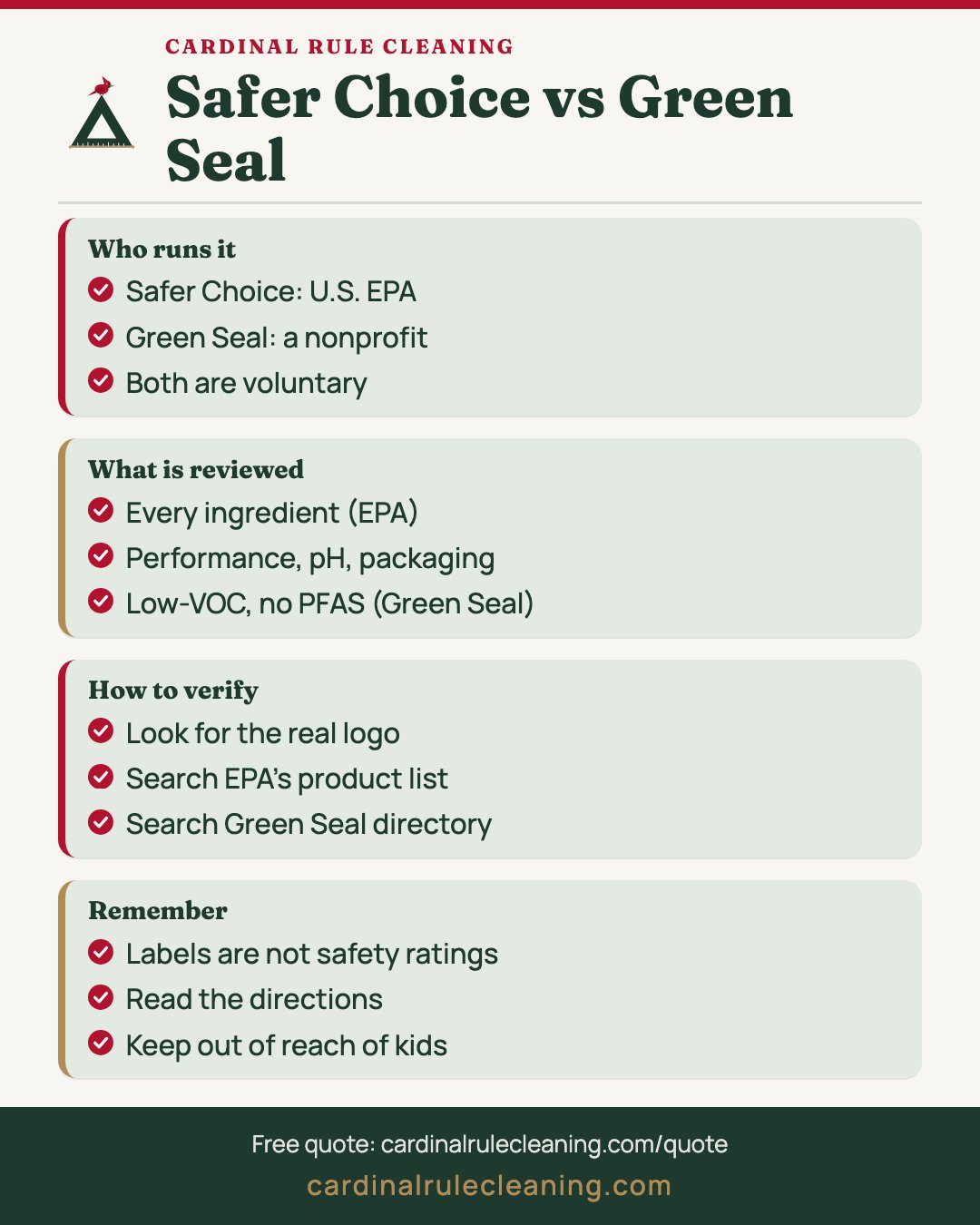
Safer Choice is a program of the U.S. Environmental Protection Agency. Green Seal is a nonprofit that sets its own standards and certifies products, services and companies. Both are voluntary and both use outside review, but they have different owners, different standards and different directories for checking a product.
If you are comparing cleaning products, or comparing the people who bring them into your home, these two labels come up most. They are not the same thing, and neither one is a promise that a product is harmless.
| EPA Safer Choice | Green Seal | |
|---|---|---|
| Who runs it | U.S. EPA, a Pollution Prevention program | Green Seal, a nonprofit |
| Participation | Voluntary | Companies apply for certification |
| What it covers | Products with safer chemical ingredients | Products, services and companies |
| Household cleaning standard | Safer Choice Standard | GS-8 for household cleaning products |
| Checking process | Annual audits after certification | Review, site visit, ongoing monitoring |
The sections below explain each column using the programs' own pages. For the basics of the EPA program on its own, see our guide to what EPA Safer Choice means.
What does the EPA Safer Choice label mean?
According to the EPA, Safer Choice products have passed a review of every chemical ingredient, plus performance, pH, packaging and volatile organic compound (VOC) limits. Participation is voluntary, and EPA conducts annual audits once a product qualifies. EPA says nearly 2,000 products currently qualify to carry the label.
EPA describes the label as a way to find products with safer chemical ingredients that still perform. Here is what its Safer Choice page says goes into the review:
- Every ingredient is reviewed, regardless of its percentage in the product, against human health and environmental criteria that include carcinogenicity, reproductive and developmental toxicity, aquatic toxicity and persistence.
- Performance: products must perform comparably to conventional ones.
- pH: labeled products must meet pH standards that minimize the potential for skin and eye irritation or injury.
- VOCs: content is restricted to minimize indoor air pollution.
- Packaging is reviewed against the standard.
EPA also offers optional variants: a fragrance-free label, a label for business and institutional products, and a certified-for-outdoor-use feature. We cover the fragrance-free mark in its own post.
What does Green Seal certification cover?
Green Seal describes itself as a nonprofit that sets science-based standards and offers certification of products, services and companies. For cleaning products, its site lists standards such as GS-8 for household use and GS-37 for industrial and institutional use. Certified products are described as low-VOC and made without PFAS or harmful chemicals.
Green Seal's cleaning page lists three claims for certified products: made without harmful chemicals, low-VOC, and made without PFAS. The household standard (GS-8) covers all-purpose, glass, bathroom, carpet and enzymatic cleaners meant for routine cleaning of residential settings. The institutional standard (GS-37) covers the equivalent products for offices, institutions, warehouses and industrial facilities.
Green Seal's certification process, as it describes it, runs in steps: prescreen, application, review, a site visit to verify practices, and then certification, with periodic monitoring afterward.
One detail worth knowing: the foreword to the GS-8 standard states that provisions for safety are not included in the standard because regulatory agencies supervise them. That is a reminder that an ecolabel and a safety rating are different things.
Is Safer Choice or Green Seal better for home cleaning products?
The sources we reviewed do not rank one above the other. The American Academy of Pediatrics lists both Safer Choice and Green Seal Certified, along with other logos, as programs that label products as less toxic for home use. The better choice is whichever certified product fits the job and your household.
We did not find a source that declares either label the winner, and we are not going to invent one. What the sources do say:
- The American Academy of Pediatrics names "Safer Choice" and "Green Seal Certified" among logos that indicate a product is less toxic for home use, alongside "Made Safe" and "EWG Verified."
- AAP also warns that a product labeled "green" or "natural" may still have ingredients that can cause health problems. That is why third-party labels matter more than marketing words.
Practical tip: pick by product category. If you need a particular type of cleaner, search both directories and compare what is certified in that category. Our guide to what eco-friendly cleaning means covers the marketing terms that carry no certification at all.
How can you verify a Safer Choice or Green Seal claim?
Search the program's own directory instead of trusting packaging or a sales page. EPA publishes a searchable list of products that meet the Safer Choice Standard, and Green Seal maintains a certified products directory. If a product or a company claims either label, you should be able to find it listed.
- Look for the actual logo on the package, not just words like "green," "natural" or "eco."
- Search EPA's list of products that meet the Safer Choice Standard.
- For Green Seal, search the certified directory on greenseal.org.
- Confirm the exact product name matches, not just the brand.
- Read the usage directions anyway. Neither label replaces them.
You can do the same when you hire help. Ask a cleaning company which products it uses and whether any carry a certification you can look up. For more on that conversation, see how to choose a cleaning company in Raleigh.
Does a cleaning company need Safer Choice or Green Seal certification?
Both labels are voluntary, so no cleaning company is required to hold either one. If a company mentions Safer Choice or Green Seal, ask which product or service is covered and look it up in the program's own directory. Nothing in this article implies EPA or Green Seal endorses any particular company.
This guide is educational: it explains two labels so you can read them with confidence when you shop or hire.
When you request a free quote from any company, you can ask which products it uses and whether any carry a certification you can look up. Cardinal Rule Cleaning is a licensed and insured premium residential cleaning company serving the Triangle, with recurring house cleaning, deep cleaning, move-in and move-out cleaning, and office cleaning, priced by quote.
Related reading: is green cleaning effective and non-toxic house cleaning: what it means and what to ask.
Want this done for you? See our House Cleaning service or request a free quote.
Get your free house cleaning quote
Takes about 60 seconds. No obligation.
Frequently asked questions
Is Safer Choice the same as Green Seal?
No. Safer Choice is an EPA program, while Green Seal is an independent nonprofit with its own standards and certification process. Both are voluntary third-party labels, but each has its own criteria and its own directory. A product can carry one, both, or neither, so check each program separately.
Do these labels mean a product is safe for pets or babies?
No. A label shows a product met a program's standard, not that it is harmless to everyone. Green Seal's own GS-8 foreword says safety provisions are left to regulatory agencies. Follow the directions and keep products away from children and pets. See our posts on dogs and babies.
Does Safer Choice cover disinfectants?
Disinfectants are handled separately. EPA's Design for the Environment pesticide program allows a DfE logo on qualifying disinfectant labels, and EPA notes that disinfectants are pesticides, so read the precautionary language before use. Our post on Safer Choice versus DfE disinfectants explains the split.
Is a product labeled natural the same as certified?
No. The American Academy of Pediatrics notes that a product labeled green or natural may still contain ingredients that can cause health problems. Certification means an outside program reviewed the product against a published standard. Look for the logo, then confirm the product in the directory.
Can a cleaning company be certified too?
Green Seal says it offers certification of products, services and companies. The EPA pages we reviewed describe the Safer Choice label for products. If a company claims a certification, ask for the certificate or listing so you can verify it yourself.