How to Deep Clean a House With Pets: A Pet-Owner Checklist
To deep clean a house with pets, start with the pet's own items (bowls, beds, toys), then tackle the places hair and dander settle: fabric furniture, carpets, bedding, baseboards and floors. Treat odor spots with the right cleaner, keep pets away until surfaces dry, and follow every product label.
Key takeaways
- Start with pet items: the CDC says to clean them as often as you clean your own.
- Dander clings to walls, fabric, carpets and bedding, so vacuum and wash soft items first and finish with floors.
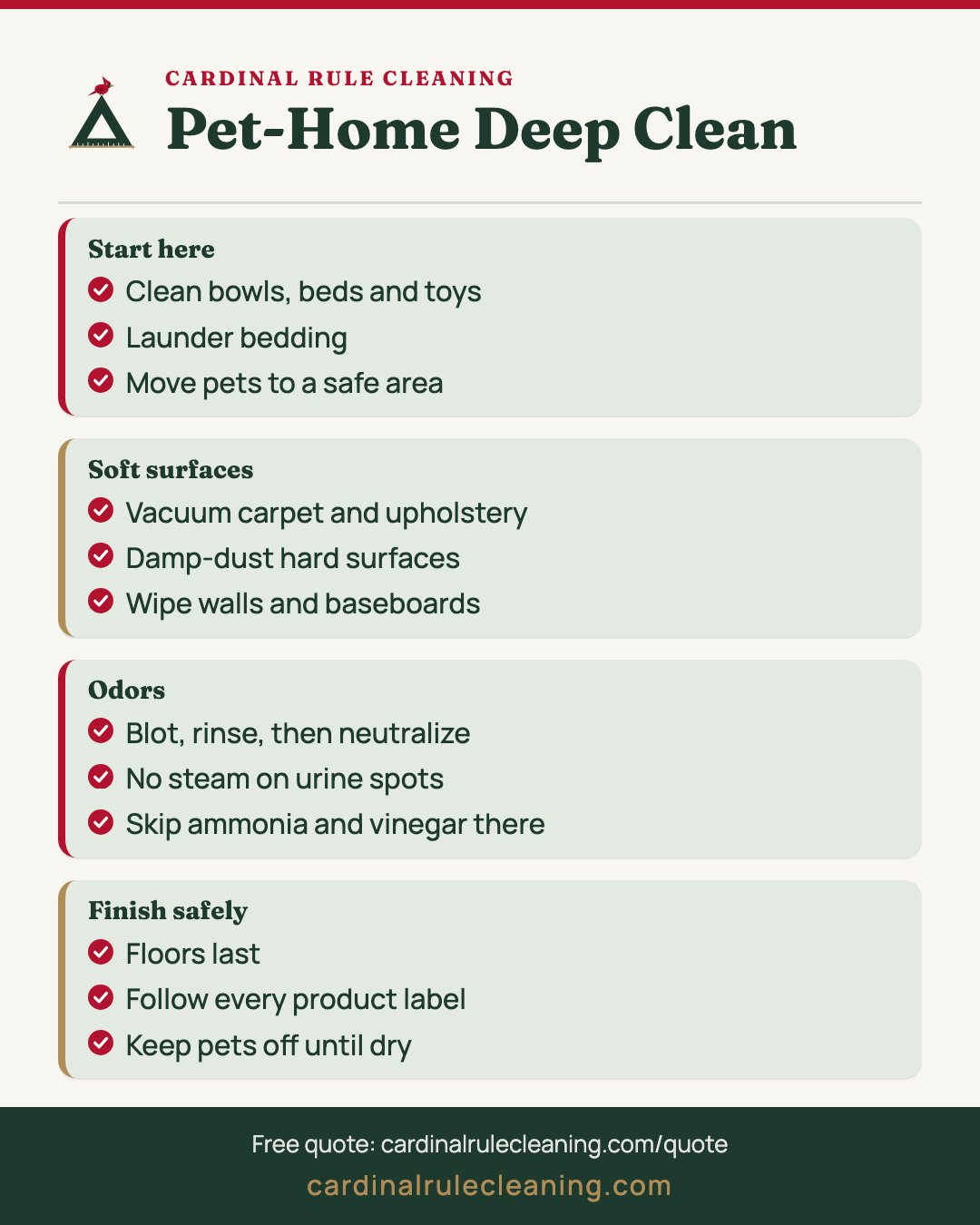
- Blot urine, rinse, and use a pet odor neutralizer. Avoid steam cleaners, ammonia and vinegar on urine spots, per Humane World for Animals.
- The ASPCA says most cleaning products are safe around dogs and cats when used as labeled. Keep pets out until surfaces dry.
- Inside-oven and similar extras are add-ons to ask about in a quote, not assumptions.
How do you deep clean a house with pets?
Work in this order: pet items first, then fabric and soft surfaces, then walls and baseboards, then floors, with odor spots treated along the way. Follow every product label, and keep pets away from freshly cleaned surfaces until they are dry, as the ASPCA advises.
A pet home needs the same deep clean steps as any other, plus a few extras. Use this order so you are not undoing your own work:
- Move pets and their items to a safe area. Wash or clean pet items.
- Strip and launder bedding and washable fabric.
- Vacuum carpets and fabric-covered furniture, then dust hard surfaces with a damp cloth.
- Wipe walls, baseboards and trim where dander can settle.
- Treat any odor spots (see below).
- Clean hard floors last, using the method that suits the material.
Finishing with floors is a general cleaning habit rather than a pet-specific rule. The EPA's routine list for biological contaminants, which include pet allergens, covers the same ground: vacuum carpets and fabric furniture, dust hard surfaces with a damp cloth, damp-mop floors and wash household linens. For the general version of this job, see our deep cleaning checklist.
What should be on a pet-focused deep cleaning checklist?
Include pet items, bedding, soft furnishings, hard floors, baseboards and walls, entryways, odor spots and the HVAC filter. The CDC says to clean pet items as often as your own. AAFA says allergens cling to walls, carpets and fabric furniture, and advises changing filters often.
| Area | Pet-specific step | Source |
|---|---|---|
| Bowls, toys, crates | Clean as often as your own items, following any package instructions; cleaning is usually enough, with disinfecting as an extra step. | CDC |
| Pet beds and blankets | Wash often. For soiled washables, add baking soda to the detergent, then wash again with an enzymatic cleaner if odor remains. | AAFA, Humane World |
| Carpet and fabric furniture | Vacuum routinely; allergens cling to carpet and upholstery for months. | EPA, AAFA |
| Walls and baseboards | Dust with a damp cloth; allergens can cling to walls. | AAFA, EPA |
| Hard floors | Vacuum or sweep first; damp-mop where appropriate. Wood floors: no wet or steam mops. | EPA, NWFA |
| Entryway | Doormats, shoes off, wipe pet feet. | EPA |
| HVAC filter | Change filters often. | AAFA |
For hardwood specifically, see our guide to cleaning wood floors naturally.
How do you get pet hair and dander off furniture and floors?
Vacuum carpets and fabric-covered furniture routinely, dust hard surfaces with a damp cloth, and damp-mop floors, as the EPA suggests. AAFA advises a quality vacuum, since poor ones can put dust back in the air, and notes that dusting and vacuuming can stir settled allergens back into the air.
Hair is easy to see. Dander is not. AAFA explains that pet allergies come from proteins in dander, saliva and urine, and that hair and fur collect dander. So removing hair removes part of the problem, not all of it.
- Soft surfaces: vacuum upholstery, rugs and carpet. AAFA says to wash and change your animal's favorite furniture and toys often.
- Hard surfaces: dust with a damp cloth (EPA). AAFA says damp or polish-treated cloths, and notes that dusting and vacuuming can stir settled allergens back into the air.
- Vents: AAFA suggests covering vents with dense material like cheesecloth, and changing filters often.
If anyone in the household has allergies or asthma, our guide to reducing pet allergens at home covers AAFA and EPA steps in more depth.
How do you remove pet odors and urine stains?
Blot as much as you can, rinse with cool water, and use a pet odor neutralizer once the area is clean. Humane World for Animals advises against steam cleaners, which can set the stain and odor, and against ammonia or vinegar on urine, since strong smells may encourage a pet to mark the spot again.
Humane World for Animals gives these steps for new stains:
- Soak up as much urine as possible. Stand on a thick layer of paper towels covered with newspaper for about a minute, and repeat until the area is barely damp.
- Rinse the spot with clean, cool water and blot dry.
- Once the area is clean, use a high-quality pet odor neutralizer.
For set stains, it suggests renting a carpet cleaner, and says to avoid steam cleaners. For machine-washable items, add a one-pound box of baking soda to your regular detergent and wash as usual. If you can still see or smell the soiling, wash again with an enzymatic cleaner, which it says breaks down pet waste odors.
To find old, dried messes, Humane World says to sniff around, inspect closely, or use a black light and outline the spots with chalk. If urine has soaked into carpet padding, portions of carpet and padding may need replacement. If accidents are frequent, it recommends a veterinary check.
Which cleaning products are safe to use around pets?
The ASPCA says most cleaning products are safe around dogs and cats when used as labeled, while birds are extremely sensitive to fumes and veterinary advice is wise. Follow label directions, keep products out of reach, keep pets away from freshly cleaned areas until dry, and avoid essential oils around cats.
This is general information from the ASPCA, not veterinary advice.
- Follow labels. The ASPCA says most cleaning agents can be used safely in homes as long as label recommendations are followed.
- Let surfaces dry. For carpet shampoo, allow the carpet to dry before pets return. If a pet seems interested in a freshly mopped area, guide it elsewhere while it airs out.
- Be careful with bleach and vinegar. The ASPCA says properly diluted bleach, thoroughly rinsed and aired out, is not expected to cause harm on pet cages and toys. Vinegar and water is generally fine if diluted, rinsed and dried, but concentrated vinegar can irritate.
- Essential oils. The ASPCA says cats are especially sensitive and does not recommend using essential oils where pets have access unless supervised or vet-approved.
- Emergency. If you suspect exposure, the ASPCA says to contact your veterinarian or call poison control at (888) 426-4435.
More detail: cleaning products safe for dogs, is bleach safe around pets and essential oils and cleaning around pets.
Should you hire a professional for a pet-household deep clean?
It can make sense if the job is big or time is short. Cardinal Rule's deep cleaning covers items like baseboards and trim, ceiling fans and vents, window sills and tracks, under movable furniture, and tile and grout. For anything pet-specific, ask your questions before booking and request a written scope in your quote.
Our deep cleaning service page lists tile and grout, soap scum and hard-water buildup, baseboards, door frames and trim, ceiling fans and vents, the inside of the microwave, under movable furniture, window sills and tracks, cabinet fronts, switch plates, and the stovetop and range hood exterior. Several of these are places pet hair and dander settle.
Pets are individual, so it helps to ask any cleaner a few things before the visit, and to get the answers in writing:
- How are pets handled during the visit, and what should I do with them?
- Are pet-hair-heavy areas, like upholstery, included or an add-on?
- Are inside-oven or other interior extras included or add-ons?
Our post on pets when cleaners come has more. For a quote based on your home's size and condition, use the free quote form. For upkeep afterward, recurring house cleaning is an option.
Want this done for you? See our Deep Cleaning service or request a free quote.
Get your free deep cleaning quote
Takes about 60 seconds. No obligation.
Frequently asked questions
How often should I deep clean a house with pets?
The sources do not give one schedule. The CDC says to clean pet items as often as your own, and the EPA and AAFA describe routine tasks such as vacuuming and damp dusting. Households with allergies or asthma may need more, so adjust to your home.
Can I disinfect pet items with bleach?
The CDC lists bleach solution among the methods for pet items without cleaning instructions, and says to follow the disinfectant's label. The ASPCA says properly diluted, rinsed and aired-out bleach is not expected to cause harm on cages and toys. Cleaning is usually enough for most pet items, says the CDC.
Do I need to remove pets during a deep clean?
The ASPCA suggests keeping pets away from freshly cleaned or mopped areas until they dry, and out of the area when using potentially toxic substances. Whirlpool and the ASPCA also advise moving pet birds, which are very sensitive to fumes. Ask any cleaner how they handle pets.
Does steam cleaning remove pet odors?
Humane World for Animals advises against steam cleaners on urine odors in carpet or upholstery, saying the heat can permanently set the stain and odor by bonding the protein into man-made fibers. It suggests blotting, rinsing and a pet odor neutralizer instead.
Are litter boxes part of a deep clean?
Handle with extra care. The CDC says cat feces can carry the parasite that causes toxoplasmosis, which is a concern for people with weakened immune systems and for pregnant women, and gives specific precautions. If that applies to you, read the CDC page and ask your doctor.