Sanitize vs Disinfect: What's the Difference Between Clean, Sanitize and Disinfect?
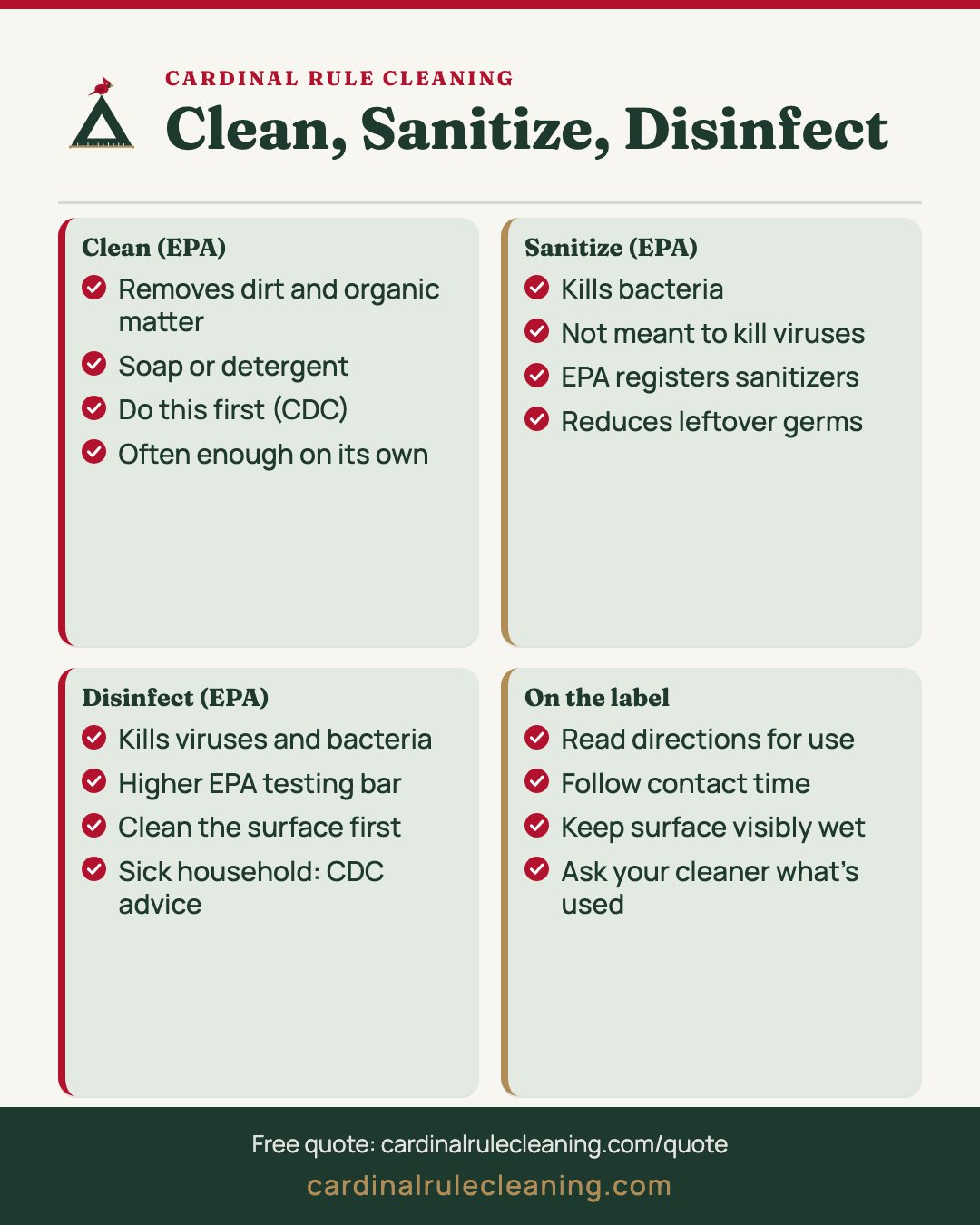
Per EPA, cleaning removes dirt and organic matter with soap or detergent, sanitizing uses chemicals to kill bacteria but is not intended to kill viruses, and disinfecting uses chemicals to kill viruses and bacteria. Disinfectants must clear a higher EPA testing bar than sanitizers. CDC says to clean first.
Key takeaways
- Cleaning removes dirt; sanitizing kills bacteria; disinfecting kills viruses and bacteria (EPA).
- Clean first. CDC says dirt can make it harder for chemicals to reach and kill germs.
- CDC says cleaning alone removes most germs, and disinfecting at home is likely not needed unless someone is sick.
- Always follow the label, especially contact time, meaning how long the surface must stay wet.
- If a cleaner offers to disinfect, ask which EPA-registered product and what the label says.
What is the difference between sanitize and disinfect?
EPA says sanitizing kills bacteria on surfaces using chemicals but is not intended to kill viruses, while disinfecting kills viruses and bacteria. EPA also says disinfectants must clear a higher bar in testing than sanitizers. CDC describes sanitizing as reducing the germs that remain after cleaning.
Both products are regulated by EPA as antimicrobial pesticides, and both are different from simple cleaning. EPA's side-by-side comparison:
| Action | What it does (EPA) | Does EPA regulate it? |
|---|---|---|
| Cleaning | Removes dirt and organic matter using soap or detergent | Only if the product claims to sanitize or disinfect |
| Sanitizing | Kills bacteria using chemicals; not intended to kill viruses | Yes, EPA registers sanitizers |
| Disinfecting | Kills viruses and bacteria using chemicals | Yes, EPA registers disinfectants |
EPA adds that surface disinfectants are subject to more rigorous testing and must clear a higher bar for effectiveness than sanitizing products. Many products are registered as both because they were tested both ways. Hand sanitizer is a separate category regulated by the FDA.
Is cleaning enough, or do you need to sanitize or disinfect?
For most homes, CDC says cleaning with soap or detergent removes most harmful viruses and bacteria from surfaces, and that disinfecting is likely not needed unless someone is sick or a sick person recently visited. CDC also says to disinfect if someone has a weakened immune system.
This is where many people over-do it. CDC's guidance says that in most situations, cleaning regularly is enough to prevent the spread of germs. Cleaning with a household cleaner containing soap or detergent removes germs and dirt, and cleaning alone removes most harmful viruses or bacteria from surfaces.
CDC suggests adding disinfection when:
- Someone in the home is sick or a sick person has recently visited.
- Someone is at higher risk of getting sick because of a weakened immune system, such as from immune-suppressing drugs or certain conditions.
CDC also says daily sanitizing may not be necessary if surfaces and objects are cleaned carefully after use. For ordinary upkeep, that means the routine in our deep cleaning versus regular cleaning guide is usually the main event, not a daily chemical step.
Why do you clean before you sanitize or disinfect?
CDC says to clean surfaces first because impurities like dirt may make it harder for sanitizing or disinfecting chemicals to reach and kill germs. Clean with soap and water or an appropriate cleaning product, then sanitize or disinfect if needed. Skipping the cleaning step can reduce the chemical's effectiveness.
The order matters, and it is the same everywhere you look. CDC says surfaces should be cleaned before they are sanitized or disinfected, and to clean first and then sanitize or disinfect if needed. For disinfecting specifically, it says to clean the surface with soap and water first.
AAFA, a nonprofit patient organization, says the same: to properly sanitize a surface, clean first to remove germs, dirt and residue, then disinfect to kill remaining germs.
A simple order of work for a high-touch surface like a doorknob or light switch:
- Wipe with soap and water or an appropriate cleaner.
- Only if needed, apply an EPA-registered product according to its label.
- Let it stay wet for the full contact time.
What does contact time mean on a disinfectant label?
Contact time is how long the surface must remain visibly wet with the product for it to work. EPA says to always follow label directions and pay close attention to it. If the surface dries before the time is up, EPA says to apply more product.
EPA's page on registered disinfectants explains that the Directions for Use section covers where a product can be used, how to apply or dilute it, and how long it takes to work. That last item is the contact time.
EPA gives an example: if the label has a contact time of 10 minutes for a particular pathogen, the surface should remain visibly wet for at least 10 minutes. If it is no longer wet after 5 minutes, more product should be applied.
EPA also notes that if a product's label does not include disinfection directions for a certain pathogen, EPA has not reviewed any data on whether it is safe and effective that way. And it reminds users that disinfectants are pesticides that can be harmful, so read the precautions before use.
What should you consider before using disinfectants at home?
Consider who is in the home. CDC notes that some cleaning and disinfection products can trigger asthma, and AAFA says people with asthma should avoid bleach where possible. Ventilate, follow the label and keep the products away from children and pets. Ask your doctor if you are unsure.
More chemical does not always mean better. CDC's disinfecting guidance includes a caution that some cleaning and disinfection products can trigger asthma. AAFA says bleach is a common asthma trigger and that people with asthma should avoid using it or being around where it is used when possible.
That is one reason to disinfect only when it is warranted. Our posts on disinfecting without bleach and asthma-friendly cleaning habits go further. And EPA's guidance for household products in general applies: increase ventilation, follow label directions and never mix products unless the label says to.
What should you ask a cleaning service about disinfecting?
Ask directly rather than assume. Questions to raise include whether disinfecting is part of the service, which EPA-registered product would be used, and whether the label's contact time will be followed. Ask any cleaner for specifics, and get the scope in writing.
Many people hear "clean" and assume "disinfected." They are different, as the EPA table above shows. So before you book any service, ask:
- Is disinfecting included, or is the visit cleaning only?
- If disinfecting is offered, which EPA-registered product is used, and can I see the EPA registration number?
- Will the label's contact time be followed on each surface?
- Which surfaces are covered, such as bathrooms and high-touch spots?
Cardinal Rule Cleaning provides recurring house cleaning, deep cleaning, move-in and move-out cleaning, and office cleaning across Raleigh and the Triangle. If disinfecting matters to your household, tell us when you request a free quote, and ask for the scope in writing. Pricing is quoted by home size and condition.
Want this done for you? See our House Cleaning service or request a free quote.
Get your free house cleaning quote
Takes about 60 seconds. No obligation.
Frequently asked questions
Is sanitizing the same as disinfecting?
No. EPA says sanitizing kills bacteria on surfaces and is not intended to kill viruses, while disinfecting kills viruses and bacteria. EPA also says disinfectants must clear a higher bar for effectiveness in testing than sanitizers, though many products are registered for both.
Does cleaning kill germs?
CDC says cleaning with soap or detergent removes germs and dirt, and that cleaning alone removes most harmful viruses or bacteria from surfaces. It adds that in most situations regular cleaning is enough, and disinfecting is likely not needed unless someone is sick.
Do I need to disinfect my home every day?
CDC says disinfecting at home is likely not needed unless someone is sick or a sick person recently visited. It also says daily sanitizing may not be necessary if surfaces and objects are cleaned carefully after use. Higher-risk households should follow their doctor's guidance.
Does EPA regulate cleaning products?
EPA says it regulates cleaning products only if they sanitize or disinfect. Products that make those claims are registered as antimicrobial pesticides, and EPA approves the label language. Plain cleaners that make no germ-killing claims are not regulated by EPA this way.
Can I use hand sanitizer on surfaces?
EPA's comparison lists hand sanitizer as a product that kills pathogens on skin, regulated by the FDA rather than EPA. Surface sanitizers and disinfectants are separate EPA-registered products meant for surfaces, not skin. Use each only as its label directs, and never swap one for another.