Safer Choice vs Design for the Environment (DfE): Cleaners vs Disinfectants
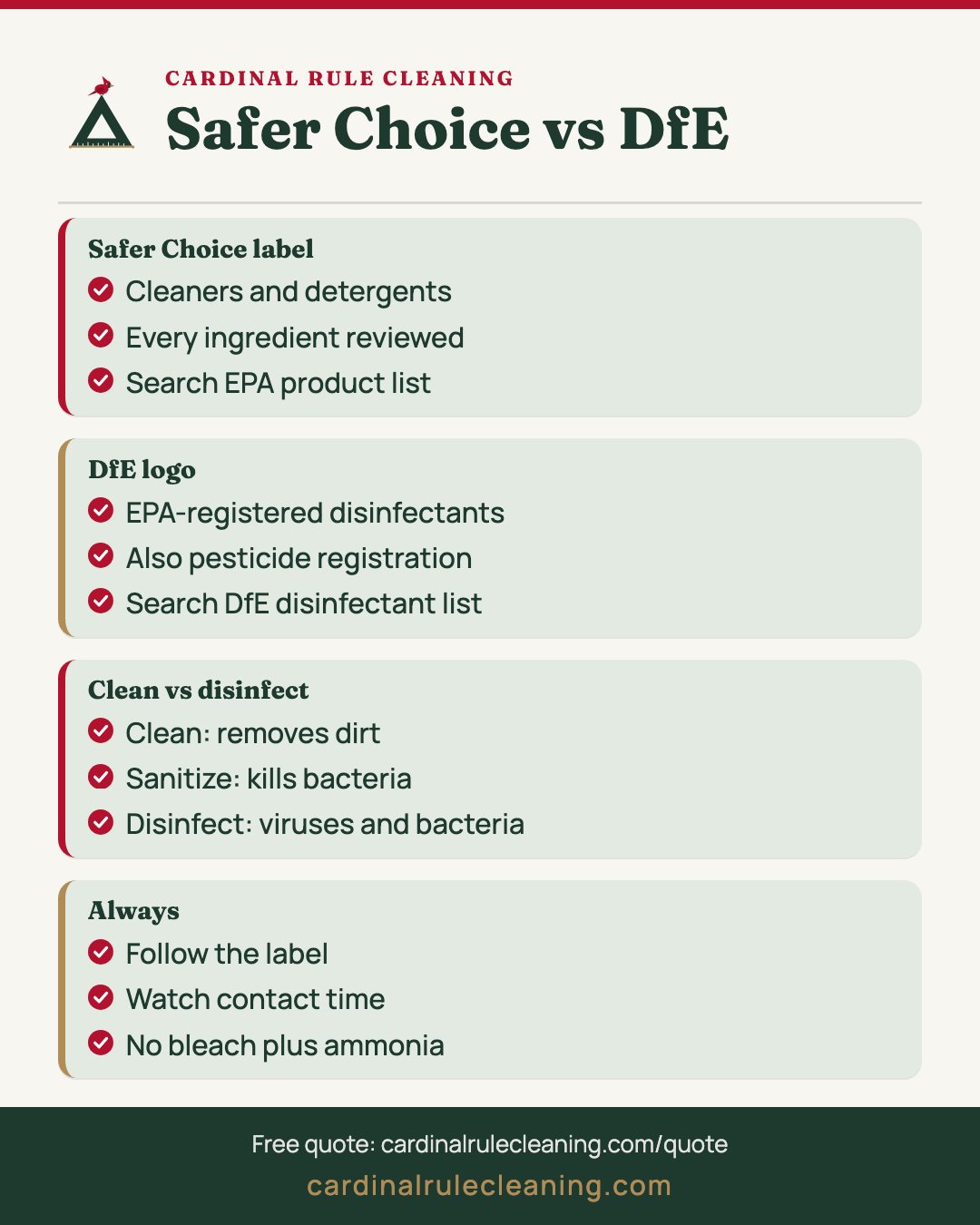
Safer Choice and Design for the Environment (DfE) are two EPA marks held to the same standard. The Safer Choice label is for products like cleaners and detergents. The DfE logo is for EPA-registered antimicrobial products, such as disinfectants and sanitizers, which must also meet pesticide registration rules.
Key takeaways
- Safer Choice labels cleaners and detergents; the DfE logo labels EPA-registered disinfectants and sanitizers.
- EPA says both marks require the same stringent requirements, and both come from the same Standard.
- Disinfectants must also pass pesticide registration, including EPA-reviewed lab data for germ-killing claims.
- Cleaning removes dirt; disinfecting kills viruses and bacteria. They are different steps.
- Always follow the label directions, including contact time, and never combine bleach and ammonia.
What is the difference between Safer Choice and Design for the Environment?
Safer Choice is EPA's label for chemical-based products like cleaners and detergents. The Design for the Environment (DfE) logo covers EPA-registered antimicrobial products, meaning disinfectants and sanitizers. Both are tied to the same EPA Safer Choice and DfE Standard. Which mark you see depends on what the product claims to do.
| Safer Choice label | DfE logo | |
|---|---|---|
| Covers | Detergents, cleaners and other formulated chemical products | EPA-registered antimicrobial products, like disinfectants and sanitizers |
| Extra requirement | Meets the Standard | Must also meet pesticide registration requirements under FIFRA |
| Where to look | EPA product search | DfE-certified disinfectants list |
For background on the cleaner label, see what EPA Safer Choice is.
Why do disinfectants get a different mark?
At EPA, products that kill viruses and bacteria on surfaces are registered as antimicrobial pesticides. A DfE-certified disinfectant must meet the pesticide registration process and the DfE standard. Germ-killing claims are allowed only when lab testing data submitted to EPA shows the product works.
EPA explains that sanitizers and disinfectants are two types of antimicrobial pesticide. EPA regulates cleaning products only if they sanitize or disinfect. Because they are registered as pesticides, they follow the Federal Insecticide, Fungicide, and Rodenticide Act (FIFRA).
For DfE, EPA says certified products must:
- stay within a certain pH range to minimize skin and eye irritation;
- exclude ingredients that might pose long-term health risks, such as potential to cause cancer;
- consider how quickly chemicals break down and how they affect fish and aquatic life;
- have every chemical ingredient reviewed, even impurities or low amounts;
- demonstrate germ-killing efficacy through laboratory data approved by EPA.
Are cleaning, sanitizing and disinfecting the same?
No. EPA says cleaning removes dirt and organic matter with soap or detergent. Sanitizing kills bacteria on surfaces and is not intended to kill viruses. Disinfecting kills viruses and bacteria. Disinfectants clear a higher testing bar than sanitizers, and the label sets a contact time.
| Action | What EPA says it does |
|---|---|
| Cleaning | Removes dirt and organic matter using soap or detergents |
| Sanitizing | Kills bacteria on surfaces using chemicals; not intended to kill viruses |
| Disinfecting | Kills viruses and bacteria on surfaces using chemicals |
EPA adds that surface disinfectants face more rigorous testing than sanitizers. It also says to follow the label and pay close attention to the contact time, which is how long the surface must remain wet.
For household guidance, our posts on sanitizing vs disinfecting and disinfecting without bleach go deeper.
How do you look up each mark?
For cleaners and detergents, search EPA's Safer Choice product list. For disinfectants and sanitizers, use EPA's DfE-Certified Disinfectants list, which can be filtered by active ingredient, product type and home or business use, and shows contact time. EPA says inclusion on the DfE list is not an endorsement.
Steps are in how to find Safer Choice products. In short: search the Safer Choice list for the cleaner, and the DfE list for the disinfectant. The DfE list page also has a filter for disinfectants for use against the coronavirus SARS-CoV-2 and notes that inclusion does not constitute an endorsement by EPA.
How did the two programs get their names and logos?
Design for the Environment began in the early 1990s as an EPA initiative. A safer-product label started in the mid-2000s. In February 2015 the Safer Choice label replaced the DfE product label for cleaners, while the DfE logo stayed in use for antimicrobial products and was redesigned in May 2022.
EPA's history page walks through this: the DfE program began in the early 1990s; its focus shifted to safer chemicals in the late 1990s; a safer-product label started in the mid-2000s; the Safer Choice label replaced the DfE product label in 2015; and the DfE logo, still used for antimicrobial products, was modernized in May 2022. In August 2024 EPA finalized an update to the combined Safer Choice and DfE Standard, its first update in nearly a decade.
That is why older articles may still call cleaners "DfE-labeled."
What does this mean for cleaning your home in Raleigh?
Match the tool to the job. Use a cleaner for everyday dirt, and reach for a disinfectant only where you decide you need to kill germs, following its label and contact time. Never combine bleach and ammonia. Ask any cleaning company how it handles disinfecting before you book.
- Most days: cleaning removes dirt and organic matter.
- Specific needs: if you decide to disinfect, choose an EPA-registered product, follow the label and watch the contact time.
- Never combine bleach and ammonia: EPA notes that combining bleach and ammonia generates toxic chloramine gas.
Ask about disinfecting when you request a free quote, or learn about our house cleaning service. For checking a cleaning company, see how to choose a cleaning company.
Want this done for you? See our House Cleaning service or request a free quote.
Get your free house cleaning quote
Takes about 60 seconds. No obligation.
Frequently asked questions
Is a DfE disinfectant the same as a Safer Choice cleaner?
No. They share an EPA Standard, but a DfE disinfectant is also a registered pesticide product that has to demonstrate germ-killing efficacy, while a Safer Choice cleaner is a cleaning product. EPA says the same stringent requirements apply to whichever mark a product carries.
Does DfE mean a disinfectant is harmless?
No. EPA says DfE products meet its criteria for efficacy and effects on human health and the environment, and they are registered as antimicrobial pesticides. Use them as the label directs, including the contact time, and do not assume any product is risk-free.
Can I use a Safer Choice cleaner to disinfect?
Not unless the label says it disinfects. EPA says cleaning removes dirt and organic matter using soap or detergents, while products that sanitize or disinfect are registered by EPA as antimicrobial pesticides. If you need to disinfect, choose a registered product and follow its label.
What is contact time?
EPA defines contact time as how long the surface must remain wet with the product. EPA tells users to pay close attention to it and follow the label directions. Contact time also appears as a column on EPA's DfE-certified disinfectants list, so you can compare products.
Is the DfE logo still used?
Yes. EPA says the DfE logo, redesigned in May 2022, is still in use for DfE-certified antimicrobial products such as sanitizers and disinfectants. The Safer Choice label replaced the older DfE product label for cleaning products in February 2015, according to EPA's history page.