Are Cleaning Products Safe for Dogs? What to Check Before You Clean
The ASPCA says most cleaning products are safe to use around dogs and cats when used according to label directions. The risk comes from misuse, concentrated products, ingestion and fumes. In a Raleigh home with dogs, read the label, keep dogs out of the room while you clean, and let surfaces dry. This is general information, not veterinary advice.
Key takeaways
- The ASPCA says most cleaning products are safe around dogs and cats when used per label directions.
- Pet Poison Helpline flags bleach, hydrogen peroxide, quats, phenols and isopropyl alcohol as products to handle with care.
- Keep dogs out of the room while cleaning and until surfaces have dried.
- "Natural" or "eco-friendly" is not a pet-safety guarantee, so check ingredients too.
- If a dog is exposed, call your veterinarian, ASPCA Poison Control or Pet Poison Helpline right away.
Are cleaning products safe for dogs?
The ASPCA says most cleaning products are safe to use around dogs and cats as long as they are used per labeled directions. That condition matters. Concentrated products, swallowed liquid, licked wet floors and strong fumes are where trouble starts. General information only: ask your veterinarian about your own dog.
Dogs explore with their noses, paws and mouths. They walk through a wet floor, then lick their feet. They drink from a mop bucket. That behavior, more than any single product, is why the ASPCA keeps repeating the same advice: follow the label, keep products up and out of paws' reach, and keep pets out of the area when you use anything potentially toxic.
The ASPCA's Animal Poison Control Center also says that if your dog seems overly interested in a freshly mopped area or cleaned counter, guide the dog to another part of the house while surfaces air out. For questions about choosing or applying a product, it suggests contacting your veterinarian or the manufacturer before you clean.
This post is general information from published sources. It is not medical or veterinary advice.
Which cleaning products need extra care around dogs?
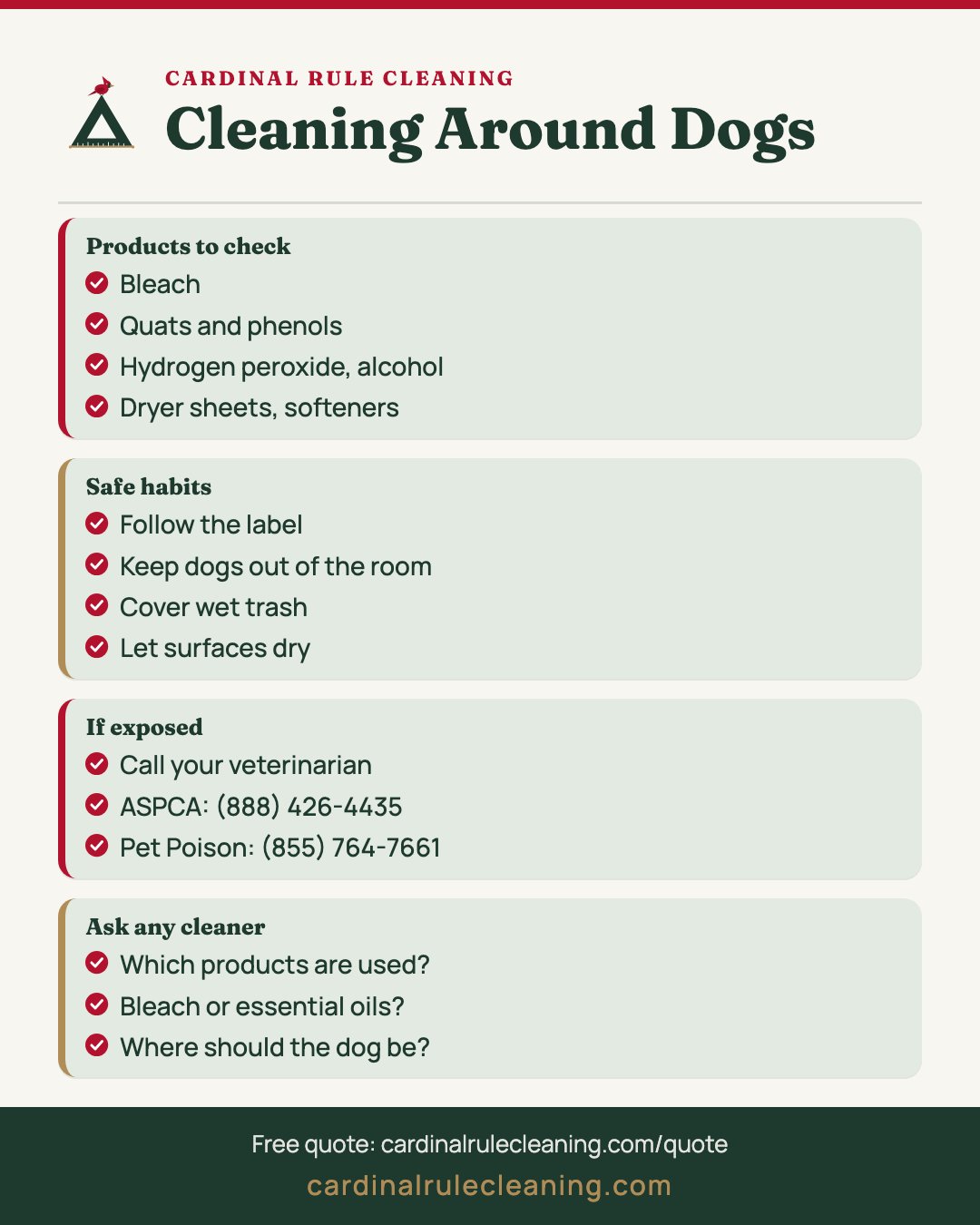
Pet Poison Helpline lists bleach, hydrogen peroxide, quaternary ammonium compounds (quats), phenols and isopropyl alcohol as common cleaners that can hurt pets. The ASPCA adds dryer sheets, fabric softeners and laundry pods. Concentration, contact route and amount all matter, so read the label on anything you use.
Here is what the two organizations say, in plain terms:
- Bleach: small exposures, such as walking through a puddle, can irritate skin. Dogs may then lick it off. Concentrated or "ultra" bleach can be corrosive. See our guide on bleach and pets.
- Quaternary ammonium compounds (quats): found in some disinfecting wipes and sprays, they can cause corrosive injury to any tissue they touch, according to Pet Poison Helpline.
- Phenols: found in some toilet bowl and all-purpose sprays, and can be corrosive to skin, eyes and lungs.
- Hydrogen peroxide and isopropyl alcohol: both are listed among household cleaning risks. Pet Poison Helpline says rubbing alcohol is twice as toxic as ethanol to dogs.
- Dryer sheets and fabric softeners: the ASPCA says most contain cationic detergents that can cause chemical burns and ulcers in the mouth, esophagus and stomach.
- Laundry pods and liquid detergent: can cause stomach upset and irritation, and in some cases serious symptoms.
- Vinegar: the ASPCA says a vinegar and water solution is generally fine once diluted, rinsed and dry, but undiluted vinegar can irritate.
Essential oils deserve their own caution; see essential oils and pets.
How do you clean safely in a home with dogs?
Pet Poison Helpline suggests keeping pets out of the room while you clean, especially with an open mop bucket, and throwing wet paper towels into covered trash cans. The ASPCA adds: dispose of used solution, store mops where pets cannot reach, and let carpet and enzyme cleaners dry before dogs return.
- Read the label first and follow the directions exactly. EPA also says that if a label calls for a well-ventilated area, open windows or use an exhaust fan.
- Move the dog out of the room, and close the door if you can. For bathrooms, Pet Poison Helpline says keep doors closed and windows open.
- Contain spills. It recommends crating pets or securing the area so a spill is not stepped in or licked.
- Dispose of wet materials such as paper towels or used wipes in a covered trash can.
- Empty and put away buckets, mops and cleaning tools where the dog cannot reach them (ASPCA).
- Let it dry. The ASPCA says carpet cleaning products can generally be used in pet households, but the carpet should dry before pets return, and enzyme-based cleaners should dry before pets enter.
For a home-prep checklist before a visit, see how to prepare for house cleaners and what to do with pets when cleaners come.
Does a natural or eco-friendly label mean a cleaner is safe for dogs?
No. Natural and eco-friendly are marketing terms, not pet-safety ratings. The American Academy of Pediatrics notes that a green or natural product may still contain ingredients that cause health problems, and the ASPCA flags natural options such as vinegar and essential oils as irritants in some forms. Check ingredients, not just claims.
This is where many pet owners get tripped up. A bottle can call itself "plant-based" and still contain an ingredient your dog should not lick or breathe. Two examples from the ASPCA: vinegar can cause stomach upset and irritation if swallowed concentrated, and essential oils can be dangerous to pets, especially cats.
Third-party labels such as EPA Safer Choice tell you a product met a program's standard. They are useful, but they are not a veterinary clearance for your dog. Our post on Safer Choice vs Green Seal explains what those labels do and do not cover. For the broader topic, see what eco-friendly cleaning means.
What should you do if your dog is exposed to a cleaning product?
Contact your veterinarian or a poison hotline right away. The ASPCA Animal Poison Control Center number is (888) 426-4435, and Pet Poison Helpline lists (855) 764-7661. Both organizations say to call immediately if you suspect exposure. Keep the product label handy so you can read out the name and ingredients when you call.
- ASPCA Animal Poison Control: (888) 426-4435
- Pet Poison Helpline: (855) 764-7661, available 24/7
Both organizations say to call immediately if you suspect exposure. The ASPCA's household products page is explicit that its guide is for general information only and is not intended to help assess or manage animal exposures or time-sensitive medical issues. Pet Poison Helpline adds that eye exposure to bleach can be an emergency for people and pets, and that rinsing paws thoroughly matters after a small skin exposure.
Do not try to treat the dog at home based on a blog post, including this one. Make the call, read them the label, and follow their instructions.
What should you ask a cleaning company when you have dogs?
Ask which products they use, whether any contain bleach, quats, phenols or essential oils, and how the dog should be kept during the visit. Tell them about every pet. A good provider will answer plainly. Ask to see product labels, since a product description is not a pet-safety rating.
Hiring help does not remove your role in protecting your dog. It does let you set expectations in advance. Questions worth asking any provider:
- Which products will be used in my home, and can I see the labels?
- Do any contain bleach, disinfectant sprays, or essential oils?
- Where should my dog be during the visit, and when can the dog return to cleaned rooms?
- How are mops, buckets and wet wipes handled before they leave?
Cardinal Rule Cleaning provides premium house cleaning in Raleigh, Durham, Chapel Hill, Cary, Apex, Morrisville, Wake Forest, Holly Springs and Garner. We are licensed and insured, and we price by quote. Mention your pets when you request a free quote. More on pet households: pet-friendly house cleaning in Raleigh.
Want this done for you? See our House Cleaning service or request a free quote.
Get your free house cleaning quote
Takes about 60 seconds. No obligation.
Frequently asked questions
Can I mop with the dog in the house?
Pet Poison Helpline recommends keeping pets out of the room while cleaning, especially with an open mop bucket. The ASPCA says to guide a curious dog elsewhere while floors dry, and to empty solutions and put mops away. Read the label, since directions vary by product.
Is vinegar and water safe for dogs?
The ASPCA says vinegar is acidic and can irritate, but is generally not an issue when diluted, rinsed and allowed to dry before use around pets. Concentrated vinegar can cause stomach upset and irritation. Keep dogs away until the surface is dry.
Are dryer sheets dangerous to dogs?
The ASPCA says most dryer sheets and fabric softeners contain cationic detergents that can cause chemical burns and ulcers in a pet's mouth, esophagus and stomach, and sheets can cause an intestinal blockage if swallowed. Store them where dogs cannot reach, including used sheets in the trash.
Who do I call if my dog licked a cleaner?
Call your veterinarian, ASPCA Animal Poison Control at (888) 426-4435 or Pet Poison Helpline at (855) 764-7661 immediately. Both organizations advise contacting them as soon as you suspect exposure. Keep the product label nearby, since this article cannot assess any specific exposure.
How do I tell Cardinal Rule Cleaning about my dog?
Mention your dog when you request a free quote or call (919) 823-2850. With any provider, ask to see product labels, ask whether any products contain bleach or essential oils, and ask where your dog should be during the visit and when the dog can return to cleaned rooms.