Safer Choice Fragrance-Free Label: What It Means
The Safer Choice fragrance-free label means a product meets EPA's full Safer Choice Standard and has also been verified to contain no fragrance materials or chemicals that mask scent. EPA says this differs from "unscented," which generally means a product may contain chemicals that neutralize or mask other ingredients' odors.

Key takeaways
- Fragrance-free is a companion certification: the product must first qualify for the Safer Choice label.
- EPA says fragrance-free means no fragrance materials or masking scents; unscented may still contain masking chemicals.
- Standard Safer Choice products may contain fragrances, but only ones that meet EPA's fragrance criteria.
- You can filter EPA's product search with a fragrance-free check box.
- Some people are sensitive to fragrance materials, so ask any cleaning company which products it uses.
What does the Safer Choice fragrance-free label mean?
It means two things, per EPA. First, the product meets the Safer Choice Standard, EPA's strict safety criteria for human health and the environment. Second, it has been verified to be free of chemicals that impart or mask a scent. The label helps people with allergy or sensitization concerns identify such products.
EPA describes the fragrance-free certification as a companion to the main Safer Choice label. If a product qualifies for the label and uses no fragrance materials, EPA lets the manufacturer add a "fragrance-free" notation to the label.
EPA's fact sheet notes that some people are sensitive to fragrance materials in cleaning, personal care and other products and may experience allergy-like responses when they come into contact with them. If that sounds like your household, our allergy-friendly house cleaning guide is a good next read. This is general information, not medical advice.
What is the difference between fragrance-free and unscented?
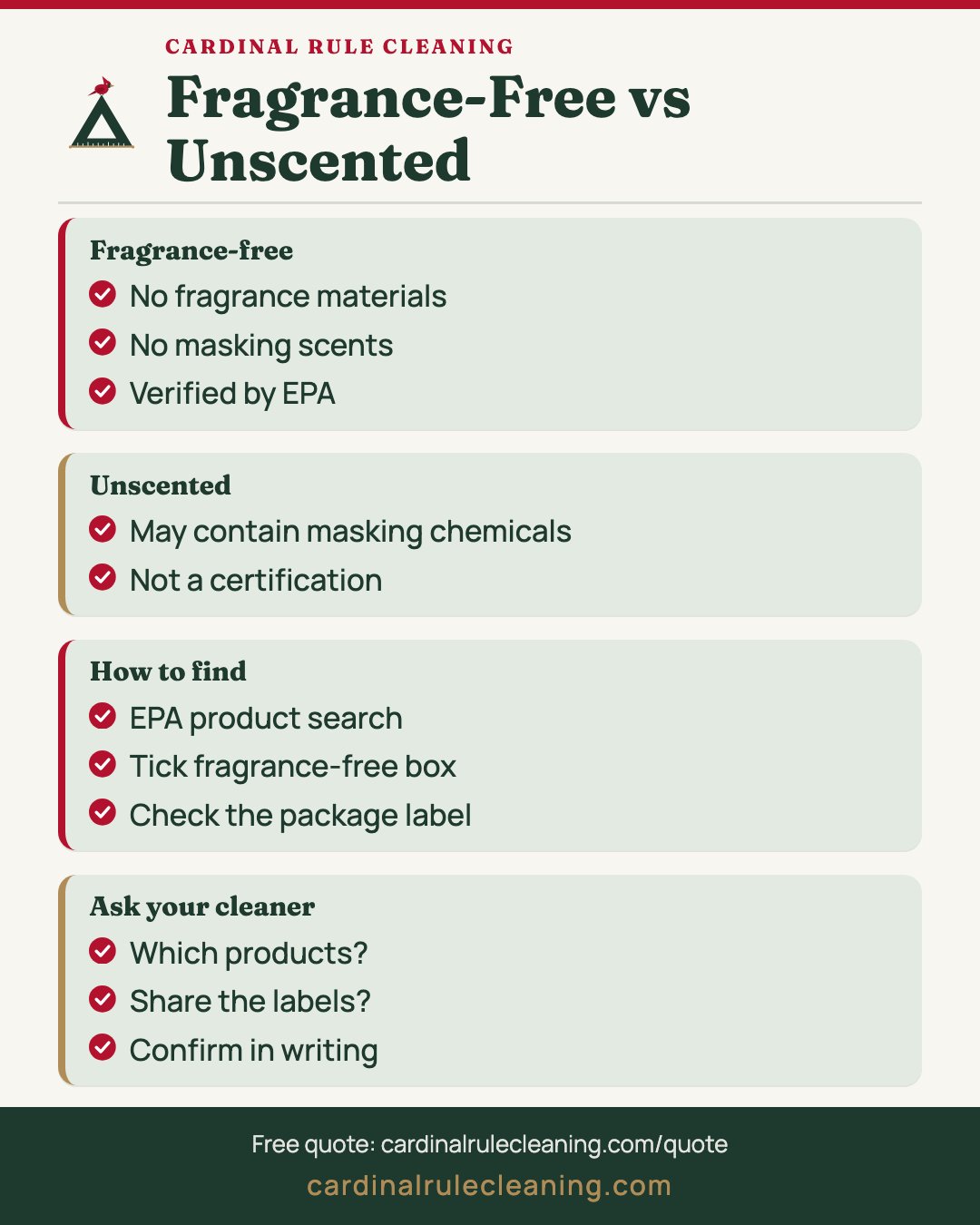
EPA says fragrance-free means fragrance materials or masking scents are not used in the product. Unscented generally means the product may contain chemicals that neutralize or mask the odors of other ingredients. So an unscented cleaner may still contain scent-related chemicals, while a fragrance-free one has been checked for them.
| Term | What EPA says |
|---|---|
| Fragrance-free | Fragrance materials or masking scents are not used in the product |
| Unscented | Generally, the product may contain chemicals that neutralize or mask the odors of other ingredients |
EPA's fact sheet adds that the terms can both appear on packaging, so it is important to understand the difference when you are looking for products without fragrances.
Can a regular Safer Choice product contain fragrance?
Yes. EPA says fragrances that meet the Safer Choice Criteria for Fragrances can be used in Safer Choice-certified products. Listed carcinogens, mutagens, reproductive or developmental toxicants, persistent bioaccumulative and toxic compounds, and listed respiratory sensitizers are not allowed, and dermal sensitizers must be disclosed.
That means the standard Safer Choice mark does not tell you a product is scent-free. Only the Fragrance-Free version does. EPA also says all ingredients, including fragrances, must be listed on the product or on an easy-access website, so you can check what is in it.
For the full picture of the program, see what EPA Safer Choice is.
How do you find fragrance-free Safer Choice products?
Use EPA's product search page and tick the fragrance-free box under "Show only." EPA says that filter shows products it has verified meet its fragrance-free criteria. Then confirm the fragrance-free version of the label on the package, since it differs from the standard mark.
- Open EPA's Safer Choice product search.
- Tick Fragrance-free products.
- Optionally pick home or business use and a product type.
- Check the package for the fragrance-free label.
More steps are in how to find Safer Choice products. For disinfectants, EPA says the Fragrance-Free label or logo can also appear on products that qualify for the DfE logo, and the Standard sets the same no-fragrance-material test.
What are the limits of the fragrance-free label?
The label speaks to fragrance ingredients in one certified product. It does not cover a cleaning service or other products already in your home. EPA also says chemicals with dual functionality, including use as a fragrance, are not allowed in fragrance-free products, and an EPA review must confirm the product contains no fragrance materials.
Per the Standard, to qualify for the fragrance-free label a product first meets all requirements and then gets an EPA review confirming it has no fragrance materials. Chemicals with dual functionality, including use as a fragrance, are not allowed.
The label covers a product. It does not describe a cleaning service, the other products someone might bring, or products already in your house. See Safer Choice cleaning service certification for how EPA treats services.
What should you ask a cleaning company about fragrance?
Ask which products would be used in each room, whether product labels or ingredient information can be shared, and what the company can do if you need fragrance-free. Ask for the answer in writing, because a fragrance-free request is a specific one and wording like "unscented" does not mean the same thing.
The right questions to ask any company:
- Can you describe what you use in each room?
- Can you share the product labels or ingredient information?
- If I need fragrance-free, what can you do for my home?
- Can you confirm that in writing?
Ready to compare options? Request a free quote from Cardinal Rule Cleaning, which is licensed and insured and gives you a clear price up front. Learn more about our house cleaning service, or read a general guide to non-toxic house cleaning.
Want this done for you? See our House Cleaning service or request a free quote.
Get your free house cleaning quote
Takes about 60 seconds. No obligation.
Frequently asked questions
Is fragrance-free the same as unscented?
No. EPA says fragrance-free means fragrance materials or masking scents are not used. Unscented generally means a product may contain chemicals that neutralize or mask other ingredients' odors. Look for the specific fragrance-free label or notation if you want products without fragrance materials.
Does every Safer Choice product have fragrance?
No. Fragrances are allowed if they meet EPA's criteria, but many products carry no fragrance. EPA's search has a fragrance-free check box so you can narrow the list to products it has verified, and ingredients must be listed on the product or a website.
Is the fragrance-free label a separate certification?
It is a companion certification. EPA says a product must qualify for the Safer Choice label first, then pass an EPA review confirming no fragrance materials. A product cannot hold the fragrance-free notation without also meeting the full Standard, which includes ingredient, performance, pH and packaging review.
Are essential oils fragrance-free?
Not necessarily. EPA says chemicals with dual functionality, including use as a fragrance, are not allowed in fragrance-free products. We did not find EPA guidance naming specific oils, so check the ingredient list and the label itself, and ask the manufacturer if anything is unclear.
Does fragrance-free prove a product is safe for allergies?
No. EPA says some people are sensitive to fragrance materials and the label helps them identify products verified to be fragrance-free. It is general information, not a medical claim or a guarantee against reactions. Talk with your doctor about allergy or sensitization concerns, and read each product label.