How to Reduce Pet Allergens in Your Home
To reduce pet allergens at home, remove them where they collect. The Asthma and Allergy Foundation of America advises keeping pets out of the bedroom, choosing bare floors over wall-to-wall carpet, vacuuming once or twice a week, washing pet and human bedding often, and dusting with a damp cloth. Filtration only supplements these steps.
Key takeaways
- Pet allergies are triggered by proteins in dander, saliva and urine, not by hair itself, according to AAFA.
- Allergens are sticky and settle on furniture, walls, carpets and bedding, where they can stay at high levels for months.
- Keep pets out of the bedroom, favor bare floors, vacuum once or twice a week, and dust with a damp cloth.
- Air cleaners and HVAC filters can help as a supplement, but the EPA says they do not replace source control and ventilation.
- This is general information, not medical advice. Talk with a board-certified allergist about your own symptoms.
Where do pet allergens come from, and where do they hide?
Pet allergies are a reaction to proteins in a pet's dander (dead skin cells), saliva and urine, says AAFA, not to the hair itself. Hair and fur collect dander. These allergens are sticky, settle on furniture, walls, carpets and bedding, and can stay at high levels for several months.
The Asthma and Allergy Foundation of America (AAFA) explains that the hair, fur or feathers collect dander and can also carry other allergens such as dust mites, mold and pollen. A few points matter for cleaning:
- Cat and dog allergens are everywhere. AAFA says they can be found even in places where pets have never been, because people carry them on clothing.
- Allergens may cling to walls, fabric furniture, carpets, pillows and clothing, and may remain at high levels for several months.
- Once settled, they can be stirred back into the air by dusting, vacuuming and other household activity.
- AAFA notes pet dander can remain in a home for up to 6 months after a pet is gone.
The takeaway: reducing allergens is about managing surfaces and soft furnishings, not just removing visible hair.
What are the best ways to reduce pet allergens at home?
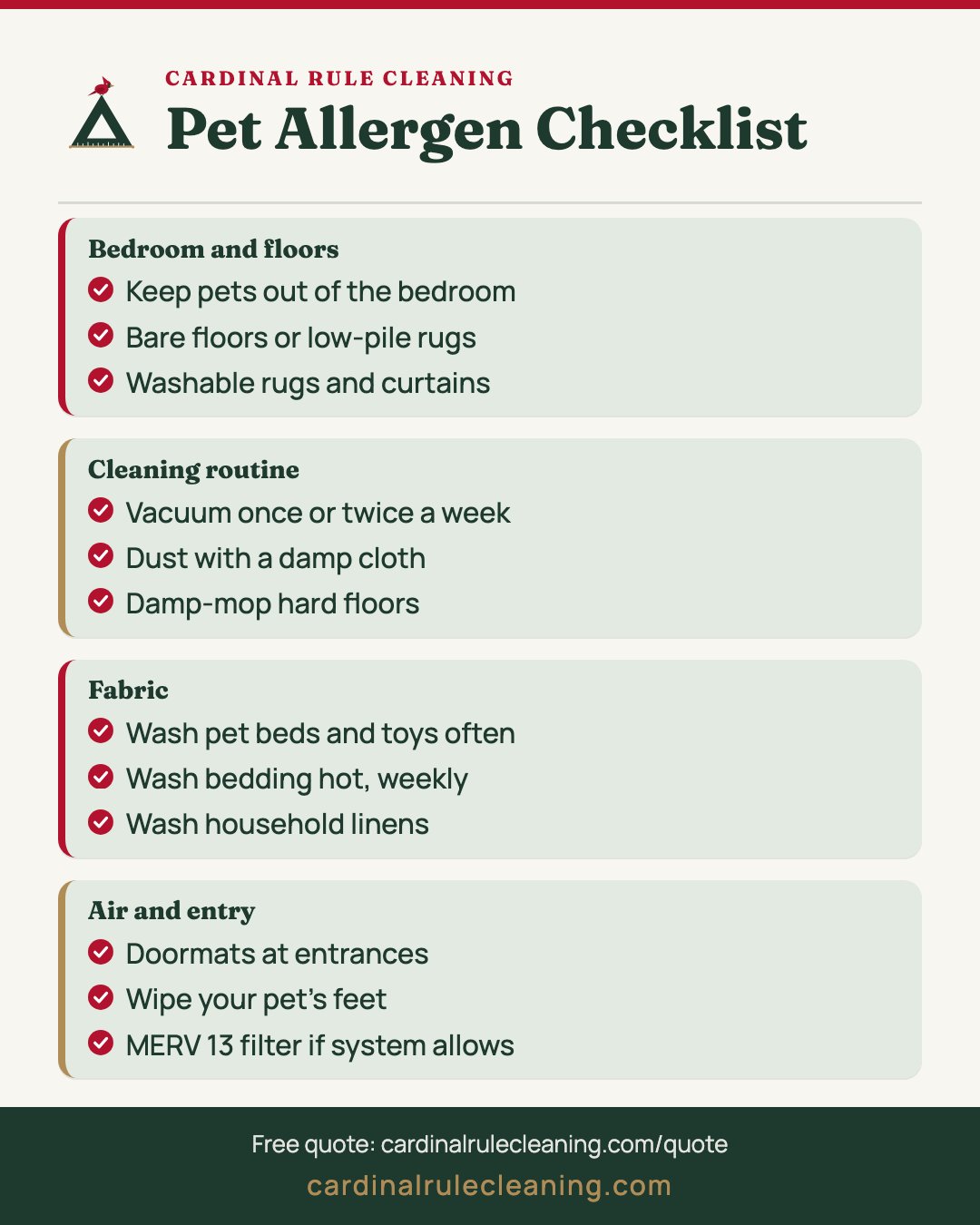
Focus on bedrooms, floors, fabric and filters. AAFA recommends keeping pets out of the bedroom, bare floors or low-pile carpets, washable rugs and curtains, frequent washing of pet bedding and toys, and cleaning with damp cloths. The EPA adds doormats and wiping your pet's feet before they come indoors.
Here is the practical list, taken from AAFA and the EPA:
- Make the bedroom a pet-free zone. AAFA says to keep pets out of the bedroom, and to close bedroom doors when you are not home. Bare floors and walls are best there, since you spend about one-third of your time in the bedroom.
- Choose bare floors where you can. AAFA says to avoid wall-to-wall carpet if possible. If you must have carpet, use low-pile carpet or throw rugs you can wash.
- Swap heavy fabric for washable. AAFA suggests replacing heavy drapes and blinds with roll-down shades or washable curtains, and avoiding overstuffed fabric furniture.
- Wash what your pet loves. AAFA says to wash and change your animal's favorite furniture and toys often, because animal allergens are sticky.
- Stop dirt at the door. The EPA says doormats, leaving shoes at the door, and wiping your pet's feet before they come inside can reduce tracked-in allergens.
- Cover vents. AAFA suggests covering vents with dense material like cheesecloth.
For wood floors specifically, see how to clean wood floors naturally.
How often should you vacuum and dust with a pet in the house?
AAFA says to vacuum once or twice a week with a quality vacuum, because poor-quality vacuums can put dust back into the air, and to dust with a cloth that is damp or treated with polish. The EPA also lists damp-mopping floors and washing household linens as routine steps.
Cleaning stirs up allergens, so how you clean matters as much as how often. AAFA and the EPA give these tips:
- Vacuum once or twice a week. AAFA says to look for vacuums tested to keep allergens from going back into the air.
- Dust damp. Use a damp cloth or one treated with polish (AAFA). The EPA says to dust hard surfaces with a damp cloth.
- Damp-mop floors and wash linens. Both are on the EPA's routine list, which also includes vacuuming carpets and fabric-covered furniture.
- Protect yourself. AAFA says people with allergies should wear a mask during housework, and leave the house for several hours afterward.
The EPA adds that people with allergies or asthma may need to clean more often or more extensively.
Do air cleaners and HVAC filters help with pet allergens?
They can help as a supplement. The EPA says filtration should support, not replace, source control and ventilation, and that studies of portable HEPA air cleaners show possible improvements in allergy or asthma symptoms, though not always major ones. For HVAC systems, it suggests a filter rated MERV 13 or as high as your system allows.
AAFA says air cleaning devices might help, but the best way to improve air quality is to get rid of the sources of allergens and irritants. The EPA's guidance is similar.
| Option | What the EPA says |
|---|---|
| Portable air cleaner | Choose a clean air delivery rate (CADR) large enough for the room. Portable cleaners often achieve high CADR with HEPA filters. Higher fan speeds and longer run times filter more air. |
| Furnace or HVAC filter | Filters work only when the system is running. If upgrading, choose at least MERV 13, or as high as your system can handle, and ask an HVAC technician if unsure. |
| Allergy relief | Multiple studies with portable HEPA cleaners found improvements in one or more symptoms, but not always major, and not in all symptoms. |
The EPA does not certify or recommend specific brands or models. AAFA also advises changing filters often, keeping windows and doors closed in high pollen seasons, and using dehumidifiers to reduce mold and dust mites.
Is there such a thing as a hypoallergenic pet?
AAFA says no. All dogs and cats can cause allergy symptoms, and a truly non-allergic dog or cat does not exist. Some people tolerate certain breeds better than others, since animals differ in which proteins they shed. AAFA suggests fostering a pet first to see if you react.
The label "hypoallergenic" can sound reassuring, but AAFA is direct about it. You can be allergic to an animal's skin cells, urine or saliva, which carry different proteins. Some animal dander has fewer allergenic proteins, which may lead to fewer or no symptoms for some people, but that is not the same as allergy-proof.
AAFA also notes that bathing and brushing pets often may reduce symptoms. If you have an allergy, it says to avoid doing the grooming yourself, or to wear a mask if you must. Long-haired pets can also bring pollen inside during high pollen seasons like spring and fall.
When should you see an allergist, and where does a cleaning routine fit?
See a board-certified allergist if you suspect a pet allergy, since AAFA says allergy testing is the best way to find out what you react to. A cleaning routine helps manage the home, but it does not replace medical advice. Recurring house cleaning can take care of dusting, vacuuming and floors on a schedule.
This post is general information drawn from AAFA and the EPA, not medical advice. AAFA says that if you have moderate to severe allergies, it is best to see a board-certified allergist, who can test and build a plan for you.
On the cleaning side, the routine above is steady work: vacuuming, damp dusting, laundering, floors. A recurring house cleaning visit can handle that rhythm, and our guide to weekly vs biweekly cleaning can help you choose a frequency. When you request a quote, you can ask any company which products it uses. For related reading, see how to deep clean a house with pets and allergy-friendly house cleaning.
Want this done for you? See our House Cleaning service or request a free quote.
Get your free house cleaning quote
Takes about 60 seconds. No obligation.
Frequently asked questions
Can you get rid of pet allergens completely?
Not completely. AAFA says cat and dog allergens are everywhere and can cling to walls, fabric furniture, carpets and clothing, and it can be challenging to manage symptoms with a severe allergy. The goal is reduction, using the steps in this guide and advice from your allergist.
Does vacuuming make pet allergies worse?
It can stir allergens into the air if done with a poor-quality vacuum. AAFA says to vacuum once or twice a week but to look for vacuums tested to keep allergens from going back into the air, and to wear a mask and leave the house for several hours afterward.
Should pets be banned from the bedroom?
AAFA recommends keeping pets out of the bedroom and closing bedroom doors when you are not home, since you spend about a third of your time there. This is general guidance. Your own allergist can tell you what suits your situation.
How often should I wash pet bedding?
AAFA says to wash and change your animal's favorite furniture and toys often, but gives no exact interval for pets. For people's bedding, it advises washing weekly in water 130 degrees Fahrenheit or hotter to control dust mites. Check the care label on pet items first.
Do air purifiers remove pet dander?
They can filter some of it. The EPA says portable HEPA air cleaners and MERV 13 HVAC filters can remove airborne particles, but filtration should supplement source control and ventilation. It says improvements in allergy symptoms are possible, not guaranteed.