Asthma-Friendly Cleaning: Habits That Help Reduce Triggers at Home
Asthma friendly cleaning means reducing triggers like dust mites, mold, pests and pet dander while limiting strong scents and chemical irritants. AAFA and EPA suggest unscented liquid or gel cleaners, ventilation, damp dusting, weekly vacuuming and prompt moisture control. This is general information, so work with your doctor on your own triggers.
Key takeaways
- Cleaning can stir up dust or add irritants, so how you clean matters as much as how often.
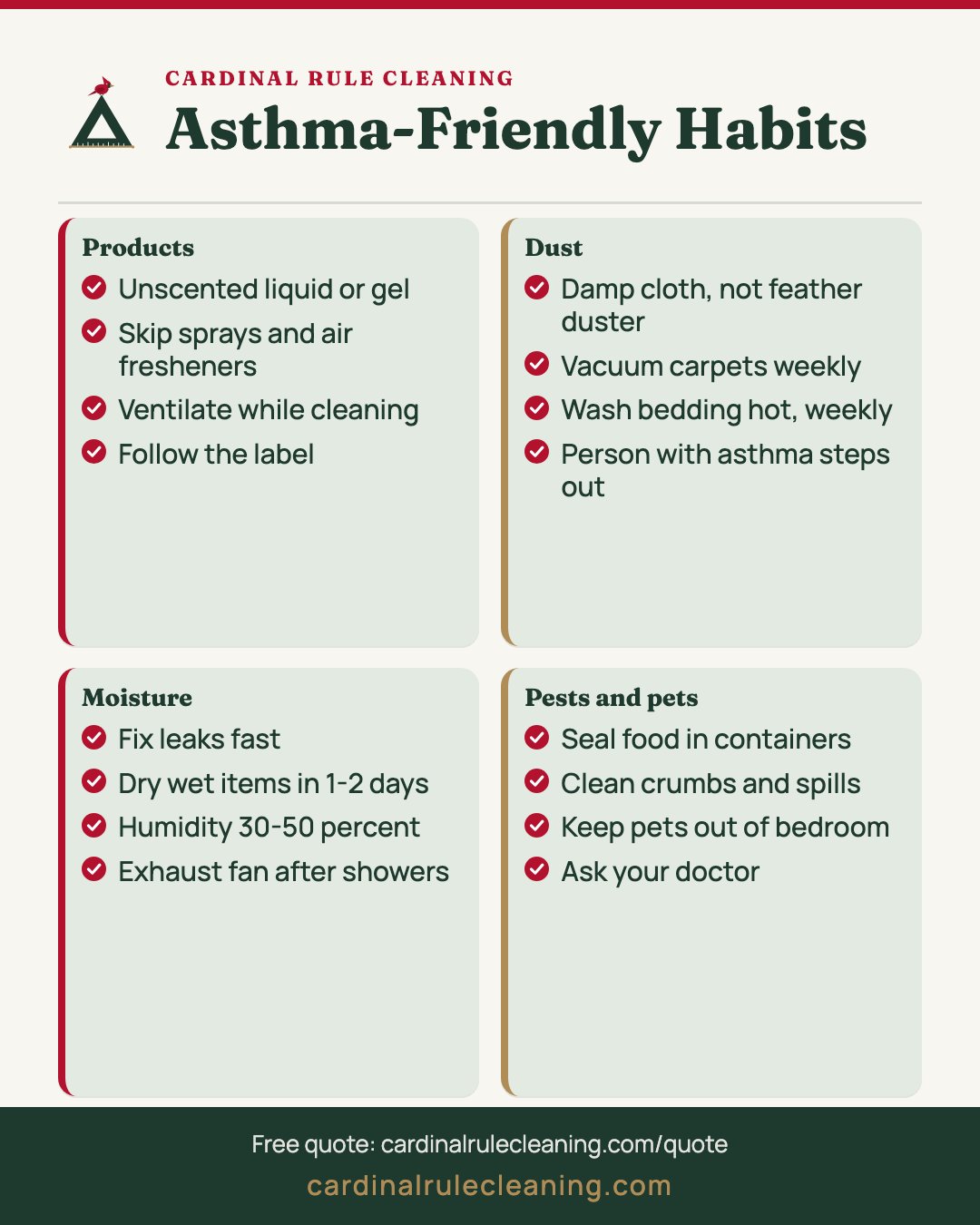
- EPA says some cleaners, air fresheners and similar products can make asthma worse; ventilate and follow the label.
- AAFA suggests unscented liquid or gel cleaners over sprays, damp cloths for dust and weekly vacuuming.
- Moisture control and prompt mold cleanup are core steps, per EPA and CDC.
- Eco-friendly or natural does not automatically mean asthma-safe, so ask about scent and products.
What does asthma friendly cleaning actually mean?
Asthma friendly cleaning is a routine built around triggers. EPA names dust mites, mold, pests, pet dander and chemical irritants as common ones. The goal is to reduce those exposures without creating new ones, such as strong scents or stirred-up dust. Your doctor helps identify your own triggers.
Triggers are things that can cause asthma symptoms or make asthma worse, and EPA notes that you may react to just one or to several. It also says indoor allergens and irritants play a significant role in asthma attacks because Americans spend up to 90 percent of their time indoors. EPA's advice is to work with a doctor to identify your triggers and build a treatment plan.
AAFA adds that how you clean is part of asthma control, and that a multi-part cleaning plan works best. That plan has two sides: remove triggers such as dust, mold and pests, and avoid adding irritants from the cleaning itself.
Everything below is general information from EPA, CDC and AAFA. It is not medical advice, and it is not a claim about any cleaning service, including ours.
Which cleaning products can bother asthma?
EPA lists cleaners, air fresheners, paints, adhesives, pesticides and cosmetics as products that may make asthma worse. AAFA says many cleaning products contain strong scents, chemicals and volatile organic compounds that can trigger asthma, and that bleach and essential oils can also be triggers.
EPA says chemical irritants are found in some household products and that asthma may be worse around products such as cleaners, paints, adhesives, pesticides, cosmetics or air fresheners. If a certain product seems to make asthma worse, EPA suggests trying a different one.
AAFA is more specific about cleaning:
- Many cleaning products contain strong scents, chemicals and volatile organic compounds (VOCs) that can trigger asthma.
- Some products may remove allergens yet still irritate the lungs.
- Bleach is a common asthma trigger, and people with asthma should avoid using it or being near it when possible.
- Essential oils can be an asthma trigger because of their strong scents, and they release VOCs.
- Homemade recipes with baking soda, vinegar, borax, hydrogen peroxide or dish soap may be less likely to cause symptoms. Soap and warm water are effective for many general cleaning jobs.
Our guide to cleaning products and indoor air quality explains VOCs in more detail.
How should you use the products you do need?
EPA's advice is to keep the person with asthma away, open windows or doors or use an exhaust fan, and follow the label. AAFA adds choosing liquid or gel cleaners over sprays, picking unscented products when possible, wearing a mask and gloves, and changing clothes afterward.
You cannot always skip a product. Here is what EPA and AAFA recommend when you must use one:
- Keep the person with asthma out of the area. EPA says to make sure your child is not around. AAFA says to have someone without asthma clean if possible.
- Ventilate. Open windows and doors or use an exhaust fan (EPA), and run fans while you clean (AAFA).
- Read the label. EPA says to always follow the instructions on the product label.
- Choose the form. AAFA suggests liquid or gel cleaners instead of commercial sprays, and unscented products when possible.
- Protect yourself. AAFA suggests a face mask and gloves (latex-free if you are allergic to latex).
- Clean up after yourself. AAFA suggests changing your clothes and showering after cleaning.
If bleach is unavoidable, AAFA says to mix it in the right proportion, wear a mask and gloves, use it in a well-ventilated room, and never mix bleach with ammonia.
How do you cut dust, dust mites and pet dander?
EPA recommends weekly hot-water washing of bedding, dust-proof mattress and pillow covers, weekly vacuuming of carpets and furniture, and dusting with a damp cloth. AAFA warns that feather dusters and leaky vacuums can spread particles, so a person with asthma should leave the room while vacuuming.
EPA says every home has dust mites, which feed on skin flakes and live in mattresses, pillows, carpets, upholstered furniture, bedcovers and fabric items. It lists these steps for house dust that may contain asthma triggers:
- Wash bedding in hot water once a week and dry it completely.
- Use dust-proof covers on pillows and mattresses.
- Vacuum carpets and furniture every week, and dust often with a damp cloth.
- Choose washable stuffed toys.
- Use a vacuum with a HEPA filter on carpet and fabric furniture, and have people with asthma or allergies leave the area being vacuumed.
AAFA notes that feather dusters only move dust around and that some vacuums leak air and put particles back into the room. It also suggests reducing clutter that collects dust and running the bathroom exhaust fan 15 to 20 minutes after a shower.
For pets, EPA says proteins in skin flakes, urine, saliva and hair can trigger asthma in people with an animal allergy. Its listed steps include keeping pets out of the bedroom and off furniture, and vacuuming when the person with asthma is not around. See also our posts on reducing pet allergens and reducing dust naturally.
How do mold, moisture and pests fit in?
CDC says breathing mold can trigger an asthma attack whether or not you are allergic, and it grows in damp areas like kitchens and bathrooms. EPA says to fix leaks, dry wet items within one to two days, keep humidity around 30 to 50 percent, and keep food sealed and crumbs cleaned up.
Mold. CDC says indoor mold grows in damp areas such as kitchens, bathrooms and basements, or where water damage has occurred. EPA's steps include:
- Clean mold on hard surfaces with soap and water, and let the area dry completely.
- Use exhaust fans or open a window when showering, cooking or washing dishes.
- Fix water leaks as soon as possible.
- Dry damp or wet things completely within one to two days.
- Keep indoor humidity ideally between 30 and 50 percent relative humidity. Hygrometers sold at hardware stores can measure it.
AAFA's version: remove mold at first sight with soap, warm water and a brush, and have someone without asthma do it.
Pests. EPA says droppings or body parts of cockroaches and other pests can trigger asthma. It suggests keeping counters, sinks, tables and floors clean and free of clutter, cleaning up dishes, crumbs and spills right away, storing food in airtight containers and sealing cracks around cabinets. EPA also cautions that pesticides can harm people, so it recommends pest methods that pose less risk.
What should you ask if someone else cleans for you?
AAFA suggests having someone without asthma do the cleaning if possible. If you hire help, ask in advance which products are used, whether they are scented, and how vacuuming and dusting are done. These are questions to raise in a quote, not a promise about any company's results.
Hiring help can keep a person with asthma out of the dust and product fumes, which matches AAFA's suggestion. But no cleaning service can promise to change anyone's asthma, and we do not claim that. What you can do is ask good questions up front:
- Which products will be used, and are any of them scented?
- Can the visit be scheduled when the person with asthma is out of the house, with windows open for airflow?
- How is dust removed: damp cloths or dry dusters? How is the vacuum filtered?
- Can you request that certain products, such as bleach, are not used?
When you request a quote, you can ask any company which products it uses. Cardinal Rule Cleaning is licensed and insured and serves Raleigh, Durham, Chapel Hill, Cary, Apex, Morrisville, Wake Forest, Holly Springs and Garner. Our house cleaning is quoted by home size and condition. Our eco-friendly cleaning guide explains what the term does and does not mean.
Want this done for you? See our House Cleaning service or request a free quote.
Get your free house cleaning quote
Takes about 60 seconds. No obligation.
Frequently asked questions
Can cleaning products trigger asthma?
Yes, they can. EPA says asthma may be worse around products such as cleaners, paints, adhesives, pesticides, cosmetics or air fresheners. AAFA adds that strong scents and VOCs in many cleaning products can trigger symptoms. If a product seems to bother you, EPA suggests trying a different one.
Is vinegar a good asthma-friendly cleaner?
AAFA says homemade recipes using baking soda, vinegar, borax, hydrogen peroxide or dish soap may be less likely to cause asthma symptoms, though it also notes vinegar is not an EPA-registered disinfectant. Our post on what not to clean with vinegar covers surfaces it can damage.
How often should you vacuum if someone has asthma?
EPA says to vacuum carpets and furniture every week and to use a HEPA-filter vacuum on carpet and fabric furniture. Both EPA and AAFA say the person with asthma should be out of the area while vacuuming, since some vacuums release particles back into the air.
What humidity level helps prevent mold?
EPA recommends keeping indoor relative humidity ideally between 30 and 50 percent. It says hygrometers sold at local hardware stores can measure humidity. It also advises fixing leaks quickly and drying wet items completely within one to two days to keep mold from growing.
Does Safer Choice mean a product is safe for asthma?
Not necessarily. AAFA points readers to EPA's Safer Choice list as a way to find products reviewed for health and the environment, but it does not say the label guarantees no reaction. Individual sensitivity varies, so check with your doctor and watch how you respond.