Is Green Cleaning as Effective as Regular Cleaning?
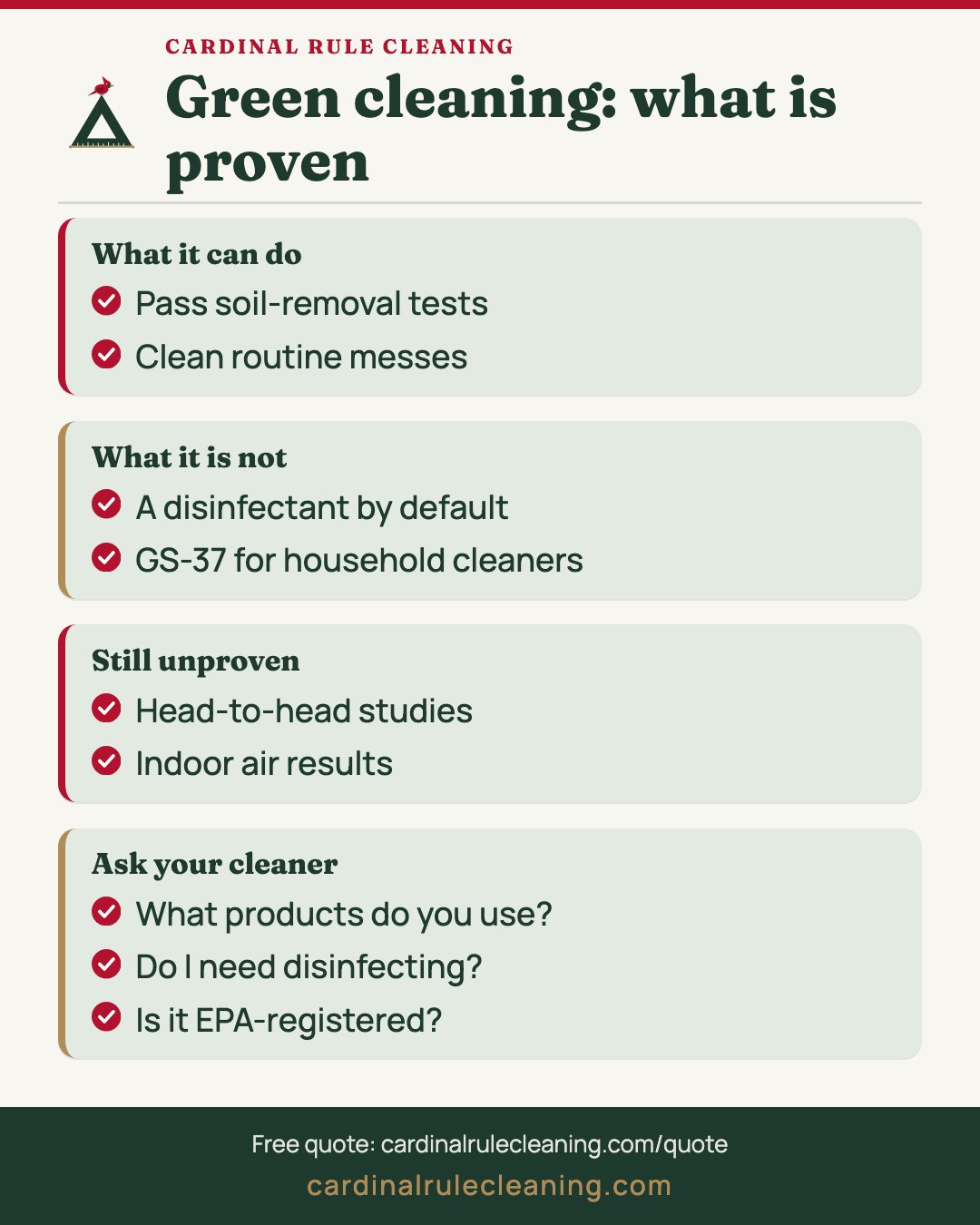
For everyday cleaning, certified green products are held to performance tests, so green cleaning can be effective. EPA's Safer Choice standard requires all-purpose cleaners to remove at least 80% of particulate or greasy test soil, or perform comparably to a conventional, nationally recognized product. We found no head-to-head study, and green cleaners are not disinfectants.
Key takeaways
- EPA's Safer Choice standard says all-purpose cleaners must remove at least 80% of the particulate or greasy soils in a test, or perform comparably to a conventional, nationally recognized product.
- Cleaning removes dirt. Disinfecting kills germs. A green cleaner is not a disinfectant unless it is EPA-registered as one.
- We did not find a head-to-head study of certified green all-purpose cleaners against conventional ones, so we cannot promise identical results.
- Indoor-air research is mixed: green products can also release compounds of concern, and this is general information, not medical advice.
- If you need disinfecting, ask any cleaner about EPA-registered disinfectants and how they are used.
Is green cleaning as effective as regular cleaning?
For routine cleaning, it can be. Certified green cleaners must pass soil-removal testing, but that test sets a floor, such as removing 80% of particulate soil, not proof of parity with conventional products. We found no head-to-head study of certified products. And cleaning is not disinfecting, which is a key difference.
The honest answer has three parts.
- Cleaning. Certification programs set performance tests for cleaning products. That is a good sign, covered below.
- Disinfecting. This is a different job with different rules. A green cleaner is not a disinfectant unless it is registered as one.
- The evidence. We looked for a study comparing certified green all-purpose cleaners with conventional ones on soil removal in a home. We did not find one, and we will not pretend otherwise.
If you want the basics first, read our guide to what eco-friendly cleaning is. Cardinal Rule Cleaning uses eco-friendly cleaning products, and this article explains what that claim does and does not mean for results.
What do green cleaning certifications actually test?
EPA's Safer Choice standard requires a good-faith showing that products perform effectively. For all-purpose cleaners, that means removing at least 80% of particulate or greasy soils in a standard test. Alternatively, a product may perform comparably to a conventional, nationally recognized product. The test measures soil removal, not germ killing.
EPA's Safer Choice standard (the current version is EPA's August 2024 PDF) says: "To ensure a baseline measure of performance, the applicant must make a good faith demonstration that their products perform effectively." It adds that testing requirements are product-class specific.
For all-purpose cleaners, the standard says: "The product must remove at least 80% of the particulate or greasy soils, as appropriate, when tested according to ASTM G122, DCC-17, CAN/CGSB 2-GP-11 Method 20.3, ASTM 4488 or an equivalent method agreed upon by EPA."
It also offers another route: "Alternatively, the product must perform comparably to a conventional, nationally recognized product in its class and at equivalent product-specific use directions."
Two limits matter. First, "comparably" is measured against a conventional, nationally recognized product in its class, at equivalent use directions. The standard gives no percentage. Second, the test is about soil, not microbes. A Safer Choice label is not a disinfecting claim.
Does Green Seal certification mean a product cleans as well?
GS-37 is written for industrial and institutional cleaners, not homes. It has performance tests, including 80% particulate soil removal for general-purpose cleaners, but excludes household cleaners and products making disinfectant, sanitizer or sterilizer claims. Green Seal's household standard is GS-8.
Green Seal describes GS-37 as ensuring a general-purpose cleaner is safer "compared to conventional alternatives while providing uncompromising cleaning performance." That is Green Seal's description of its own standard, not a test result.
The performance section of GS-37 (see Green Seal's GS-37 page) says general-purpose cleaners "shall remove at least 80% of the particulate soil" in ASTM D4488. An alternative route requires the product to perform "as well as or better than a nationally recognized or market-leading product of its type."
The scope is the catch. The GS-37 page states: "The standard does not include cleaners for household use, air fresheners, or products required to be registered under the Federal Insecticide, Fungicide, and Rodenticide Act, such as those making claims as sterilizers, disinfectants, or sanitizers." Its stated focus is routine cleaning of offices, institutions, warehouses and industrial facilities.
Green Seal's household standard is GS-8. It covers cleaners marketed for households and similar residential settings, and its general-purpose cleaner test also requires removal of at least 80% of the particulate soil in ASTM D4488-95. GS-8 points household disinfectant and sanitizer products to a different standard, GS-52.
So a GS-37 mark is not a household promise or a disinfecting claim. Check which Green Seal standard a product was certified under.
Do green cleaners disinfect or sanitize?
No, not by being green. EPA says cleaning removes dirt and organic matter using soap or detergents, and it regulates cleaning products only if they sanitize or disinfect. A green cleaner that claims only to clean is not a disinfectant. Disinfecting requires a product registered with EPA and used as its label directs.
EPA's page on the difference between cleaning, sanitizing and disinfecting (epa.gov) puts it plainly:
- "Cleaning removes dirt and organic matter from surfaces using soap or detergents."
- "Sanitizing kills bacteria on surfaces using chemicals. It is not intended to kill viruses."
- "Disinfecting kills viruses and bacteria on surfaces using chemicals."
EPA also says surface disinfectants face more rigorous testing than sanitizers. The federal Head Start office (headstart.gov) says a product with an EPA registration number on the label has been through testing and is effective in reducing or killing germs.
Dwell time belongs to disinfectants. EPA says to "pay close attention to the contact time, which is how long the surface must remain wet," and Head Start says to let a disinfectant stay visibly wet for the minutes listed on the label. We did not find a dwell time for green all-purpose cleaners, so we will not invent one.
The same Head Start page says that in most situations, routine cleaning with soap and water is enough to remove dirt and some germs. If you need more than that, you need an EPA-registered product, not a green label.
Does technique matter as much as the product?
The sources point that way for removal. Head Start recommends wiping surfaces, preferably with a microfiber cloth, and rinsing thoroughly. A hospital study found water alone with a microfiber cloth was less effective than a detergent or disinfectant. Product and method work together, and neither is a substitute for the other.
Head Start's cleaning step reads: "Wipe/mop surfaces (preferably with a microfiber cloth/mop) and rinse the surface thoroughly." That ties microfiber to removing soil, not killing germs.
A 2019 short report in the Journal of Hospital Infection (ScienceDirect) tested a microfibre cloth with water, detergent/disinfectant or sporicidal products, using the ASTM2967-15 standard against two bacteria and C. difficile spores. The summary frames the work around hospital cleaning. It found detergent or disinfectant products worked significantly better than water alone, and concluded: "The use of water alone with a microfibre cloth is less effective and should not replace the use of biocidal products." It was not a household test.
The practical takeaway is modest. A good product used with poor technique can underperform, and good technique does not turn a plain cleaner into a disinfectant. When you book a cleaner, both the product choice and the method matter. Our house cleaning service covers routine upkeep on a weekly, every-other-week or monthly schedule.
Is green cleaning better or worse for indoor air?
The research is mixed. A Lawrence Berkeley National Laboratory chamber study found most of the highest VOC emissions came from conventional products, but also found emissions of concern from green ones. California regulators note pine and citrus terpenes can react with ozone. This is general information, not medical advice.
Three sources, each with a narrow finding:
- Lawrence Berkeley National Laboratory (2022). The study summary says that in a laboratory chamber test of 9 conventional and 7 green products, 75% of the highest VOC emissions came from conventional products, "but we also identified VOC emissions of concern from green products." It adds that use of green all-purpose cleaners was associated with increases in air concentrations of some fragrance chemicals of concern, and notes there is no official green standard.
- California Air Resources Board. Its fact sheet covers cleaning products in general, not green ones only. In a 2008 study it describes, products containing terpenes (found in pine and citrus oils) produced formaldehyde and ultrafine particles in rooms with elevated ozone.
- A French study of 41,570 adults. The paper found weekly use of green products was associated with current asthma at a borderline level (odds ratio 1.09, interval 1.00 to 1.20), with fewer risks than for disinfecting wipes. That link was not significant when green products were used without irritant or spray products. The study was cross-sectional and used self-reported questionnaires, so it cannot show cause.
None of this says green products are bad, or that conventional ones are better. It says the word green does not guarantee clean air. This is not medical advice. If you have asthma, allergies or sensitivities, talk with your doctor and tell any cleaner what you react to.
What does the evidence not tell us?
It does not show how certified green all-purpose cleaners compare with conventional ones in a real home. The one lab study we reviewed, published in 1994, tested alternative household cleaners, not certified products. Those alternatives, as a group, were less effective than commercial cleaners. Studies also differ in setting, so results do not transfer neatly.
That lab study, in the Journal of Environmental Health (hosted by The Cleaning Institute), published in 1994, tested single ingredients such as vinegar, baking soda, lemon juice, ammonia and borax on laminate. It found that "compared to commercial cleaners, the alternative cleaners as a group are less effective in both microbial reduction and soil removal." It also said consumers may find alternatives effective at removing soil "if they are willing to work harder."
That tells us about alternative household cleaners. It does not tell us about certified products, which must pass a soil-removal test. The paper also notes that household cleaners registered as disinfectants must meet EPA testing, and that the alternatives do not meet that criterion. Its authors say the microbial results must be interpreted with caution.
Other gaps:
- No head-to-head study of certified green all-purpose cleaners was found.
- Hospital and lab results are not household results.
- We found no dwell time for green all-purpose cleaners.
A fair reading: certified products are designed to meet a performance bar, but we did not find a head-to-head study, so we cannot claim identical results.
What should I ask a Raleigh cleaner about green products?
Ask what products they use, what you need them to do, and whether you need disinfecting. If you do, ask about EPA-registered disinfectants and how they are used. Cardinal Rule Cleaning uses eco-friendly cleaning products, and your quote confirms scope. Ask to see a product label rather than relying on the word green.
Good questions, in plain language:
- What products do you use? Cardinal Rule Cleaning uses eco-friendly cleaning products. Ask any company to show you a product label rather than relying on the word green.
- Is there a certification, and what does it cover? As shown above, labels differ in scope.
- Do I need disinfecting, or just cleaning? Most routine cleaning is about removing dirt. If disinfecting matters to you, ask any cleaner exactly what they offer and which EPA-registered products they use.
- Do you have sensitivities in the home? Mention fragrance sensitivities, asthma or pets when you book.
We serve Raleigh, Durham, Chapel Hill, Cary, Apex, Morrisville, Wake Forest, Holly Springs and Garner. For more on choosing a company, see how to choose a cleaning company in Raleigh. Ready to talk through your home? Request a free quote. It takes about 60 seconds, and you see a clear price up front. You can also read about our house cleaning.
Want this done for you? See our House Cleaning service or request a free quote.
Get your free house cleaning quote
Takes about 60 seconds. No obligation.
Frequently asked questions
Do eco-friendly cleaners clean as well as regular cleaners?
Certified all-purpose cleaners must remove at least 80% of test soil or perform comparably to a conventional product. That is a floor, not proof of parity. We found no head-to-head study of certified green cleaners against conventional ones, so equal results cannot be promised. Technique and the specific product matter.
Do green cleaners kill germs?
Not simply by being green. EPA says cleaning removes dirt using soap or detergents, while disinfecting kills viruses and bacteria using chemicals. A green cleaner that only claims to clean is not a disinfectant. Look for an EPA registration number on the label.
What does the Safer Choice label test?
EPA's Safer Choice standard says all-purpose cleaners must remove at least 80% of particulate or greasy soils in a test, or perform comparably to a conventional, nationally recognized product. It measures soil removal, not germ killing, so a Safer Choice label is not a disinfecting claim. Check the current standard at epa.gov/saferchoice/standard.
Does Green Seal cover household cleaners?
GS-37 does not. Its scope covers industrial and institutional cleaners, and it excludes household cleaners and products making disinfectant, sanitizer or sterilizer claims. Green Seal's household standard, GS-8, does cover household cleaners. If you see a Green Seal mark, check which standard the product was certified under.
Do green cleaning products relate to asthma?
One cross-sectional French study found a borderline association between weekly green product use and asthma. It was not significant when green products were used without irritant or spray products. It relied on self-reported questionnaires and cannot show cause. This is not medical advice, so please ask your doctor about your own situation.
Does Cardinal Rule Cleaning use eco-friendly products?
Yes. Cardinal Rule Cleaning uses eco-friendly cleaning products. We do not claim they disinfect or match every conventional product. Cleaning removes dirt and disinfecting is a separate job, so if disinfecting matters to you, ask any cleaner what they offer. You can request a free quote at any time.