Do Cleaning Products Affect Indoor Air Quality? What EPA Says
Yes, they can. EPA lists cleansers, disinfectants and air fresheners among household products that release volatile organic compounds (VOCs) while used and stored, and says indoor VOC concentrations can run up to ten times higher than outdoors. EPA's main fixes are ventilation, following label directions and reducing sources.

Key takeaways
- EPA lists cleansers, disinfectants and air fresheners as household VOC sources.
- EPA says VOC concentrations are consistently higher indoors, up to ten times higher than outdoors.
- Elevated levels can persist in the air long after the activity is over.
- EPA says not much is known about health effects at the levels usually found in homes.
- Ventilation, following label directions and never mixing products are EPA's core steps.
Do cleaning products affect indoor air quality?
Yes. EPA says organic chemicals are widely used in household products, including many cleaning and disinfecting products, and that they can release compounds while in use and, to some degree, in storage. EPA also says VOC concentrations are consistently higher indoors than outdoors, up to ten times higher.
EPA's Introduction to Indoor Air Quality names products for household cleaning and maintenance, personal care or hobbies among the many sources of indoor air pollution. It adds that activities such as smoking, cleaning, redecorating and hobbies release pollutants intermittently, and that pollutant concentrations can stay in the air for long periods after some activities.
Cleaning is not the only source. EPA also lists fuel-burning appliances, tobacco products, building materials, furnishings, central heating and cooling systems, and excess moisture. The point is not that cleaning is dangerous. It is one contributor, and it is one you can manage.
This post is general information from EPA. It makes no claim about the emissions of any specific product.
What are VOCs, and which cleaning products release them?
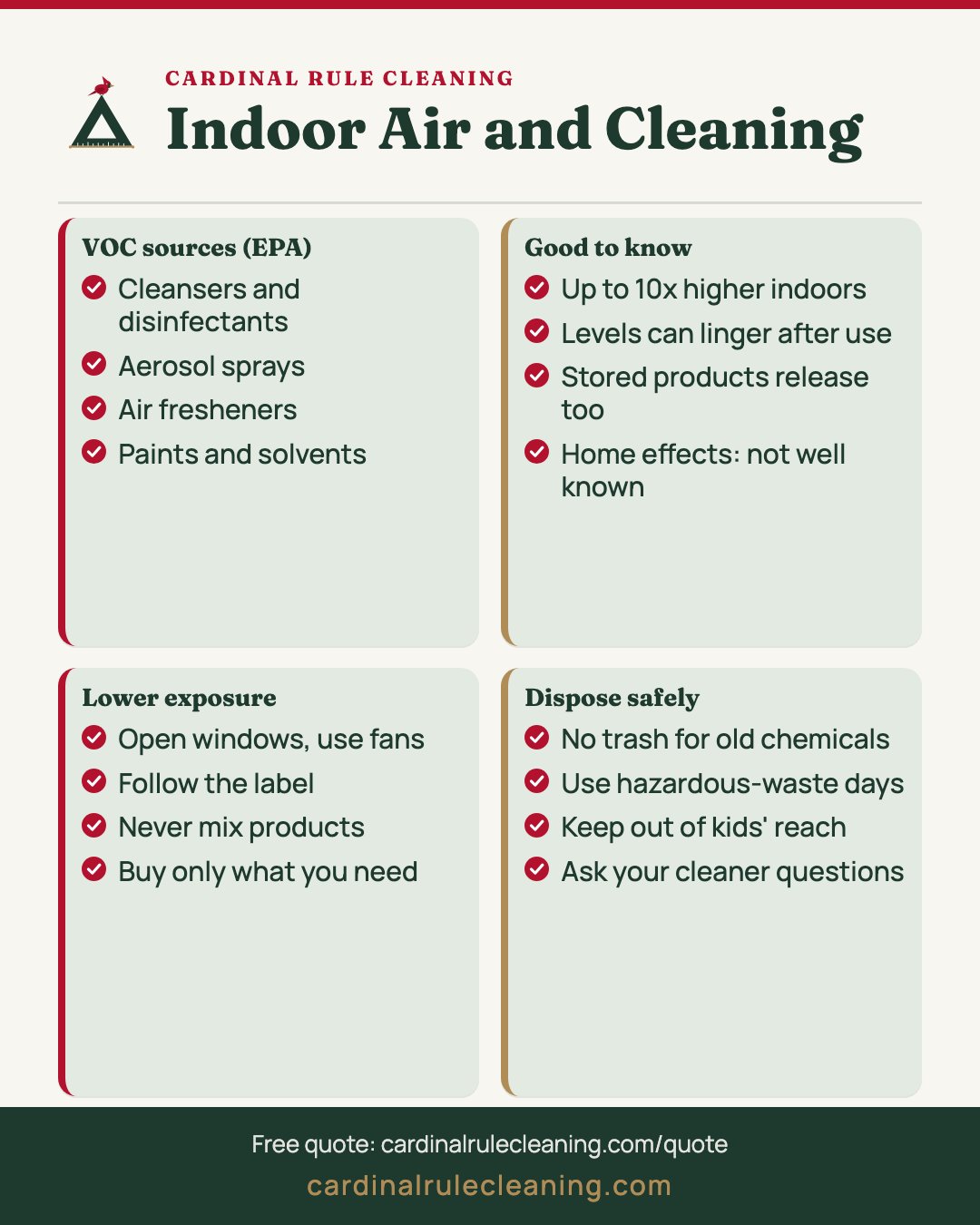
VOCs are chemicals that evaporate easily at room temperature. EPA's list of household sources includes cleansers and disinfectants, aerosol sprays, moth repellents and air fresheners, along with paints, strippers, wood preservatives and dry-cleaned clothing. EPA says these products release compounds during use and, to some degree, while stored.
EPA defines volatile organic compounds as organic chemicals that can evaporate under normal indoor conditions. Its list of household product sources includes:
- Cleansers and disinfectants
- Aerosol sprays
- Moth repellents and air fresheners
- Paints, paint strippers and other solvents
- Wood preservatives, stored fuels and automotive products
- Hobby supplies, dry-cleaned clothing and pesticides
EPA also lists non-household sources such as building materials, furnishings, office equipment and craft materials. Because stored products can leak gases even from closed containers, EPA advises throwing away unused or little-used containers safely rather than keeping them around.
What are the health effects of VOC exposure?
EPA lists eye, nose and throat irritation, headaches, dizziness and nausea among possible VOC effects, and says some can cause serious harm. It also says the effect depends on the chemical, the level and the time exposed, and that not much is known about effects at the levels usually found in homes.
EPA is careful about this topic, and so should we be. Its VOC page says health effects may include eye, nose and throat irritation; headaches, loss of coordination and nausea; and damage to the liver, kidney and central nervous system. It adds that some organics can cause cancer in animals, and some are suspected or known to cause cancer in humans.
But it also says that the ability of organic chemicals to cause health effects varies greatly, from highly toxic to no known effect. The extent depends on the level of exposure and how long it lasts. And it states that at present, not much is known about what health effects occur from the levels of organics usually found in homes.
EPA's general indoor air page notes that people react very differently to pollutants, and that symptoms of conditions like asthma may show up or be worsened soon after exposure. If you notice symptoms that fade when you leave a room, EPA suggests looking for indoor sources. For a deeper look at one common condition, see asthma-friendly cleaning habits.
When is exposure to cleaning product fumes highest?
During and shortly after use. EPA says people can expose themselves and others to very high pollutant levels while using products with organic chemicals, and that elevated concentrations can persist long after the activity ends. Poor ventilation raises levels further, since pollutants build up when too little outdoor air enters.
EPA cites its Total Exposure Assessment Methodology (TEAM) studies, which found that while people use products containing organic chemicals, they can expose themselves and others to very high pollutant levels, and that elevated concentrations can persist in the air long after the activity is completed. In those studies, levels of about a dozen common organic pollutants were 2 to 5 times higher inside homes than outside, whether the homes were in rural or highly industrial areas.
Ventilation matters because, per EPA, if too little outdoor air enters a home, pollutants can accumulate to levels that cause health and comfort problems. EPA also notes that high temperature and humidity can increase the concentration of some pollutants.
| Situation | What EPA says |
|---|---|
| While using a product | Very high short-term levels are possible |
| Hours after the task | Elevated concentrations can persist |
| Product in storage | Compounds are released to some degree |
| Tightly sealed home | Pollutants may reach higher levels |
How can you lower exposure when you clean?
EPA's steps are to increase ventilation, follow label precautions and directions, never mix household care products unless the label says to, buy only what you will use soon, and dispose of unwanted products safely. It calls source control usually the most effective way to improve indoor air.
EPA's Improving Indoor Air Quality page names three strategies: source control, improved ventilation and air cleaners or filtration. For most home problems, it says source control is the most effective. Applied to cleaning, that looks like this:
- Ventilate. Open windows and doors, or use bathroom and kitchen fans that exhaust outdoors. EPA says this matters most during short-term activities that generate high pollutant levels.
- Follow the label. If it says to use the product in a well-ventilated area, go outdoors or use an exhaust fan; otherwise open windows for maximum outdoor air.
- Use products as directed. EPA says to use household products according to the manufacturer's directions.
- Never mix household care products unless the label directs it.
- Buy limited quantities of products you use only occasionally, so less sits in storage.
- Dispose safely. Do not toss unwanted chemicals in the trash. Check whether your local government has household hazardous waste collection days.
- Keep products out of reach of children and pets.
What does this mean when you hire a cleaning service?
Treat it as a set of questions, not a promise. Ask which products will be used, whether they are scented, and how the home will be ventilated. This post makes no claims about the emissions of any specific product, so you can ask any company which products it uses and read the labels.
Scent, product type and ventilation are fair things to ask any cleaner about. If someone in your home is sensitive, say so when you ask for a quote. For general background, read what eco-friendly cleaning means and our guide to non-toxic house cleaning.
EPA's Safer Choice website lets you search certified products, and it includes a filter for fragrance-free ones. Our post on what EPA Safer Choice is explains the label, and our Safer Choice versus Green Seal comparison covers a second label.
Cardinal Rule Cleaning provides house cleaning across Raleigh, Durham, Chapel Hill, Cary, Apex, Morrisville, Wake Forest, Holly Springs and Garner, licensed and insured, with pricing quoted by home size and condition. You can request a free quote online.
Want this done for you? See our House Cleaning service or request a free quote.
Get your free house cleaning quote
Takes about 60 seconds. No obligation.
Frequently asked questions
Are VOCs from cleaning products dangerous?
It depends on the chemical, the level and the length of exposure. EPA says effects range from none known to serious for some compounds, and that not much is known about effects at typical home levels. Its practical advice is to ventilate, follow label directions and reduce sources.
How long do cleaning product fumes stay in the air?
EPA says elevated concentrations can persist in the air long after an activity is finished, and that products release compounds in storage too. Open windows or run exhaust fans during and after cleaning, and discard old unneeded products safely to reduce what sits in the home.
Do natural or eco-friendly cleaners avoid VOCs?
EPA's pages on VOCs do not address natural or eco-friendly claims, so we cannot say. Its advice applies to household products generally: ventilate, follow label directions and avoid mixing. Check labels, ask about fragrance, and consider EPA's Safer Choice product search for certified options.
What is the best way to improve indoor air quality at home?
EPA says source control, meaning eliminating or reducing the pollution source, is usually the most effective. Ventilation and air cleaners or filtration are the other two strategies. For most home problems it ranks source control as the most effective solution.
Should I never mix cleaning products?
EPA says to never mix household care products unless directed on the label, and to follow label instructions carefully. Potentially hazardous products often carry warnings aimed at reducing exposure, such as using them only in a well-ventilated area or outdoors, with windows open.