House Cleaning for New Parents in Raleigh, NC: What to Know and Ask
House cleaning for new parents in Raleigh takes recurring chores off your plate while you adjust to a baby. CDC says regular cleaning is enough in most situations, and cleaning alone removes most harmful germs. Ask about products, scents and timing, and keep cleaners locked away from children. This is not medical advice.
Key takeaways
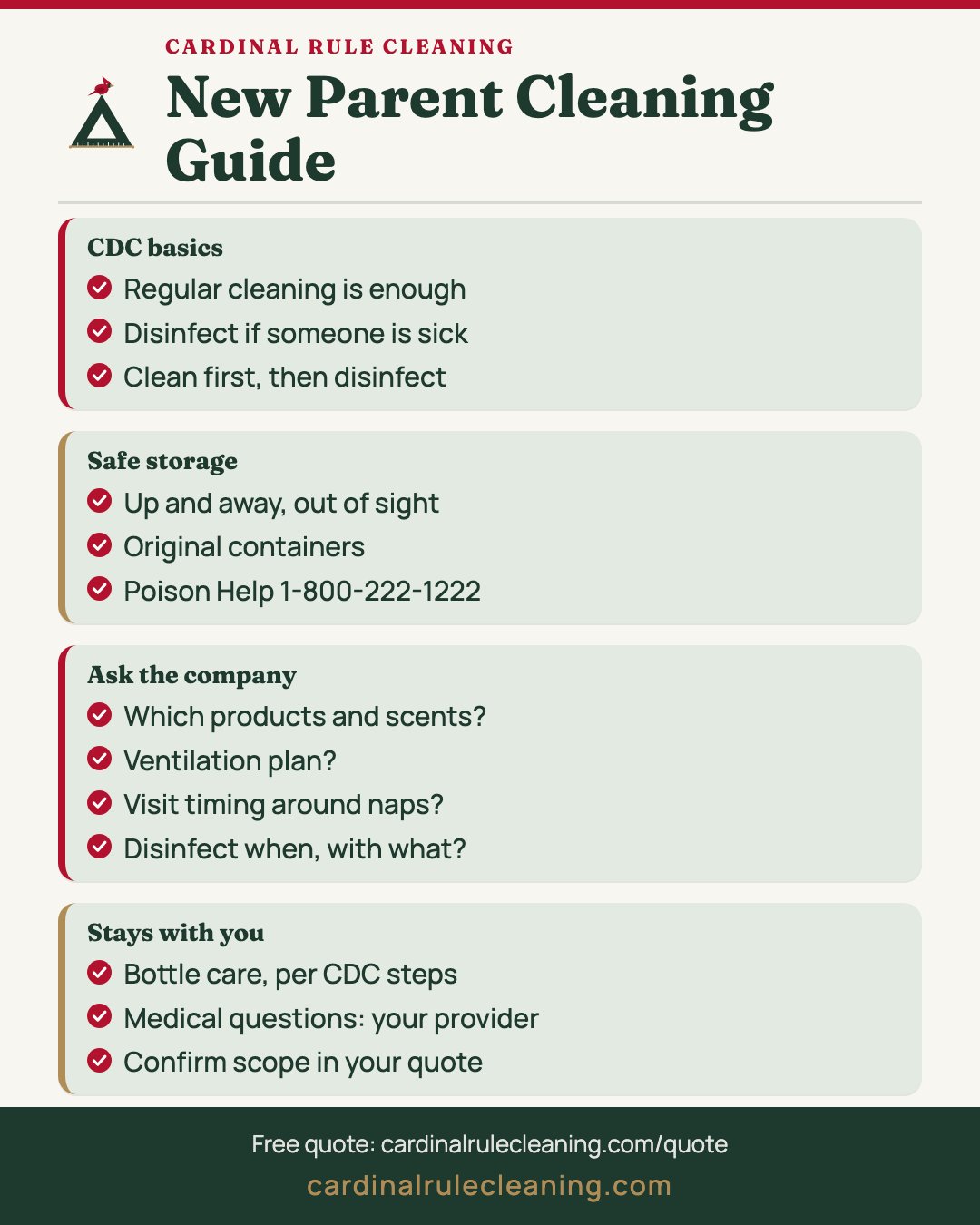
- CDC: in most situations, regular cleaning is enough. Disinfect when someone is sick or at higher risk.
- Baby bottle and feeding-item care follows its own CDC steps and stays with you, not with house cleaning.
- Store cleaning products up and away, in original containers. Keep Poison Help (1-800-222-1222) handy.
- Ask any company about products, scents, visit timing and how they work around a sleeping baby.
- Cardinal Rule Cleaning quotes by home size and condition. This post is not medical advice.
When does house cleaning for new parents in Raleigh make sense?
It makes sense when you want recurring chores handled so your time goes to the baby and recovery. Cardinal Rule Cleaning offers weekly, every-other-week and monthly house cleaning, plus deep cleaning for a reset. We do not give medical or postpartum advice; talk to your care provider about your own needs.
A new baby changes your calendar. Many families look for help with the repeating work: kitchens, bathrooms, floors and dusting. That is a household decision, not a medical one, and nothing in this post is medical or postpartum advice.
The options are straightforward. A deep clean resets the house once. Recurring house cleaning keeps it that way. Our guide to weekly vs. biweekly cleaning helps with frequency, and whether hiring a cleaner is worth it covers the decision.
What does CDC say about cleaning and disinfecting a home with a baby?
CDC says cleaning with soap or detergent removes most harmful viruses and bacteria from surfaces, and that in most situations cleaning regularly is enough. It recommends adding disinfecting when someone is sick or has a higher risk of getting sick. Clean first, then sanitize or disinfect only if needed.
CDC's home guidance describes three steps: cleaning, sanitizing and disinfecting. It says cleaning alone removes most harmful viruses or bacteria, and that dirt can make it harder for chemicals to reach germs. It lists hard surfaces such as counters, light switches and floors, plus soft surfaces such as carpet and rugs, and laundry items such as towels and linens.
CDC also says daily sanitizing may not be necessary if surfaces and objects are cleaned carefully after use, and that some cleaning and disinfection products can trigger asthma.
That is useful context for a cleaning scope. Ask a company when it would disinfect and why. Our explainer on sanitizing vs. disinfecting covers the terms.
Who handles baby bottles and feeding items?
Plan on handling them yourself unless a company states otherwise in writing. CDC publishes separate steps for infant feeding items: wash hands, take bottle parts apart, rinse, wash with soap in a dedicated basin or the dishwasher, and air-dry. It says to clean bottles after every feeding.
CDC's infant feeding guidance says cleaning, sanitizing and storing feeding items helps prevent germs from contaminating the milk you feed your baby. Its main points:
- Clean baby bottles after every feeding.
- Take bottle parts apart, rinse under running water, and wash in a clean basin used only for infant feeding items, or in the dishwasher.
- Allow items to air-dry on a clean towel rather than rubbing them dry.
- CDC says to sanitize bottles daily (or more often) for extra germ removal, and that daily sanitizing may not be necessary for older, healthy babies if items are cleaned carefully after each use.
- If your baby is under 2 months old, was born prematurely, or has a weakened immune system, CDC says to wash the wash basin and bottle brush after every use.
Read the CDC page directly and ask your pediatric provider about your baby's needs. We mention it so you know which tasks sit outside a cleaning visit.
How should you store cleaning products with a baby in the house?
Keep household cleaning products up and away, out of children's reach and sight, in their original containers. Safe Kids Worldwide says to put them away after every use. CPSC says to lock them up or keep them out of reach. Post the Poison Help number, 1-800-222-1222, where caregivers can see it.
Whether you hire help or clean yourself, product storage matters. Sources agree on the basics:
- Up and away. Safe Kids says to put cleaning products out of reach and sight after every use.
- Original containers. Keep products in the bottles they came in, and look for child-resistant containers.
- Locked or high. CPSC recommends locked cabinets or high shelves.
- Know the numbers. Safe Kids says to save Poison Help (1-800-222-1222) in your phone and post it where other caregivers can find it.
The Children's Hospital of Philadelphia notes household cleaning products are involved in 10 percent of poisonings in children under 6, and that bleach is the most common household cleaning product ingested by small children. Keep reading labels. See also baby-safe cleaning products.
What should you ask a cleaning company when you have a newborn?
Ask what products it uses, whether they are scented, how it handles ventilation, whether visits can be timed around naps, and how the crew works around a sleeping baby. Companies set their own policies on these points, so get the answers before booking rather than on cleaning day.
Use this list on your first call:
- Products: What will you use in the kitchen, bathrooms and floors? Can I see the labels?
- Scents: Are any products fragranced? AAFA notes strong scents and VOCs in some cleaning products can trigger asthma.
- Ventilation: EPA advises following label instructions, and opening windows or using an exhaust fan when a label calls for ventilation.
- Timing and noise: Can the visit be scheduled around naps, and what does the crew need from me?
- Disinfecting: When would you disinfect, and with what product?
For more questions, see non-toxic house cleaning: what it means and what to ask and how to choose a cleaning company in Raleigh.
Which rooms and surfaces should you discuss first?
Start with the areas your household uses most: kitchen counters and floors, bathrooms, light switches and other high-touch hard surfaces, and soft surfaces like rugs. CDC names counters, light switches and floors as hard surfaces, and carpet, rugs and drapes as soft surfaces. Tell the company your priorities.
A short priority list keeps the first visits focused:
- Kitchen counters, sink area and floors.
- Bathrooms, including floors and fixtures.
- High-touch hard surfaces such as light switches and door handles.
- Floors and rugs, where dust and crumbs collect.
- Anything you want skipped or handled differently, such as a nursery you prefer to keep closed.
This list is a conversation starter, not a promise of what any visit includes. Scope is set in your quote. If dust is a concern for your household, our post on reducing dust and our guide to house cleaning for allergies may help.
How do you get a house cleaning quote in Raleigh?
Request a free quote at cardinalrulecleaning.com/quote or call (919) 823-2850. Pricing is quoted by home size and condition, so there is no flat rate to compare. Mention your baby in the request. Cardinal Rule Cleaning serves Raleigh, Durham, Chapel Hill, Cary, Apex, Morrisville, Wake Forest, Holly Springs and Garner.
Mention that you have a baby at home when you ask, and ask any company about its products, scents and timing up front. Request a free quote or compare deep cleaning vs. regular cleaning first.
Want this done for you? See our House Cleaning service or request a free quote.
Get your free house cleaning quote
Takes about 60 seconds. No obligation.
Frequently asked questions
Is it safe to have a cleaning service in a home with a newborn?
That is a decision for your family and your pediatric provider. We can share general information: read product labels, ask about scents and ventilation, store products out of reach, and ask a company how it works around a sleeping baby. Nothing here is medical advice.
Do I need to disinfect everything with a new baby?
CDC says cleaning alone removes most harmful viruses or bacteria and that regular cleaning is enough in most situations. It recommends disinfecting when someone is sick or at higher risk of getting sick. Ask your pediatric provider about your baby's needs.
Does house cleaning include washing baby bottles?
Do not assume so. CDC has separate steps for infant feeding items, including cleaning bottles after every feeding. Treat that as your routine unless a company states otherwise in writing. Scope varies from company to company and is set in your quote, so ask about any task you are counting on.
How should I store cleaning products at home?
Safe Kids Worldwide says to keep cleaning products up and away, out of children's reach and sight, in their original containers, and to put them away after every use. CPSC recommends locking them up or using high shelves. Save Poison Help, 1-800-222-1222, in your phone.
How do I know what a cleaning visit will include?
Ask for the scope in your quote and request specifics for the rooms and surfaces that matter to you. Cardinal Rule Cleaning quotes by home size and condition. Companies set their own policies, so confirm anything specific, such as products or timing around naps, before booking.