Cleaning Around Babies: What to Look For on Product Labels
No label guarantees a cleaning product is safe for babies. What helps is reading labels: look for third-party logos such as EPA Safer Choice or Green Seal, check directions and warnings, ventilate, and store products locked away in original containers. The American Academy of Pediatrics notes infants are more exposed because they crawl and put hands in their mouths.
Key takeaways
- No label guarantees a product is safe for a baby. Labels help you compare, then you still read the directions.
- The American Academy of Pediatrics lists Safer Choice and Green Seal Certified among logos for less toxic home products.
- Green and natural claims alone do not mean a product is free of ingredients that can cause health problems.
- Babies breathe faster, crawl on floors and mouth objects, so they are more exposed than adults.
- Store cleaners locked up, in original containers, away from food. Poison control is 1-800-222-1222.
How do you choose safe cleaning products for babies?
Start with the label rather than the marketing. Look for a recognized third-party logo, read the directions and warnings, and choose the simplest product that does the job. The American Academy of Pediatrics says routine cleaning with soap, water and scrubbing helps prevent the spread of germs. Disinfecting is an extra step for specific situations.
The word "safe" appears on plenty of bottles, but it is not a standard. A better approach for a home with a baby in Raleigh or anywhere else is to treat label-reading as a short checklist:
- Find a real logo from a third-party program, not just words like "gentle" or "natural."
- Read the directions and warnings before you buy, and again before you use.
- Match the product to the job. The American Academy of Pediatrics (AAP) says routine cleaning with water, soap and scrubbing helps prevent the spread of germs, and that deeper sanitizing or disinfecting is sometimes needed, such as when someone in the home is sick.
- Plan storage and ventilation before the product comes home.
This is general information from published sources, not medical advice. Ask your pediatrician about your child's needs.
Why are babies more exposed to cleaning products?
The AAP says children are more at risk from the effects of toxic cleaning products because they are growing and developing. They breathe faster and take in more air relative to body weight than adults, and behaviors like crawling on the floor and putting hands and objects in their mouths add exposure.
This is the reason to be more careful in a home with an infant or toddler. According to the AAP:
- Many conventional cleaners release volatile organic compounds (VOCs), which stay in the air for a long time after use.
- Children breathe faster and more air per body weight than adults.
- Crawling on floors and mouthing hands and objects increases contact with residue.
None of this means you should stop cleaning. It means the surfaces babies touch most, such as floors and play areas, deserve products and methods you have actually checked. Our guide to cleaning products and indoor air quality covers VOCs in more depth.
Which labels and logos help when you read cleaning products?
The AAP lists Safer Choice, Green Seal Certified, Made Safe and EWG Verified as logos indicating a product is less toxic for home use. EPA says Safer Choice products have every ingredient reviewed, plus pH and VOC limits. Disinfectants are different: EPA regulates them as pesticides, so read the precautionary language on the label.
| What you see | What it means |
|---|---|
| EPA Safer Choice logo | EPA reviewed every ingredient, plus performance, pH, packaging and VOC limits |
| Safer Choice fragrance-free label | An optional EPA label for people who prefer products without fragrance |
| Green Seal Certified | A nonprofit certification; its cleaning page lists low-VOC and made without harmful chemicals |
| "Natural" or "green" with no logo | The AAP says such products may still have ingredients that cause health problems |
| EPA registration number on a disinfectant | EPA regulates disinfectants as pesticides and says to read and understand precautionary language before use |
A logo helps you compare products. It is not a guarantee for any individual child. For a detailed comparison of the two main ecolabels, see Safer Choice vs Green Seal, and for more on the EPA program, what EPA Safer Choice means.
How should you use and store cleaning products in a home with a baby?
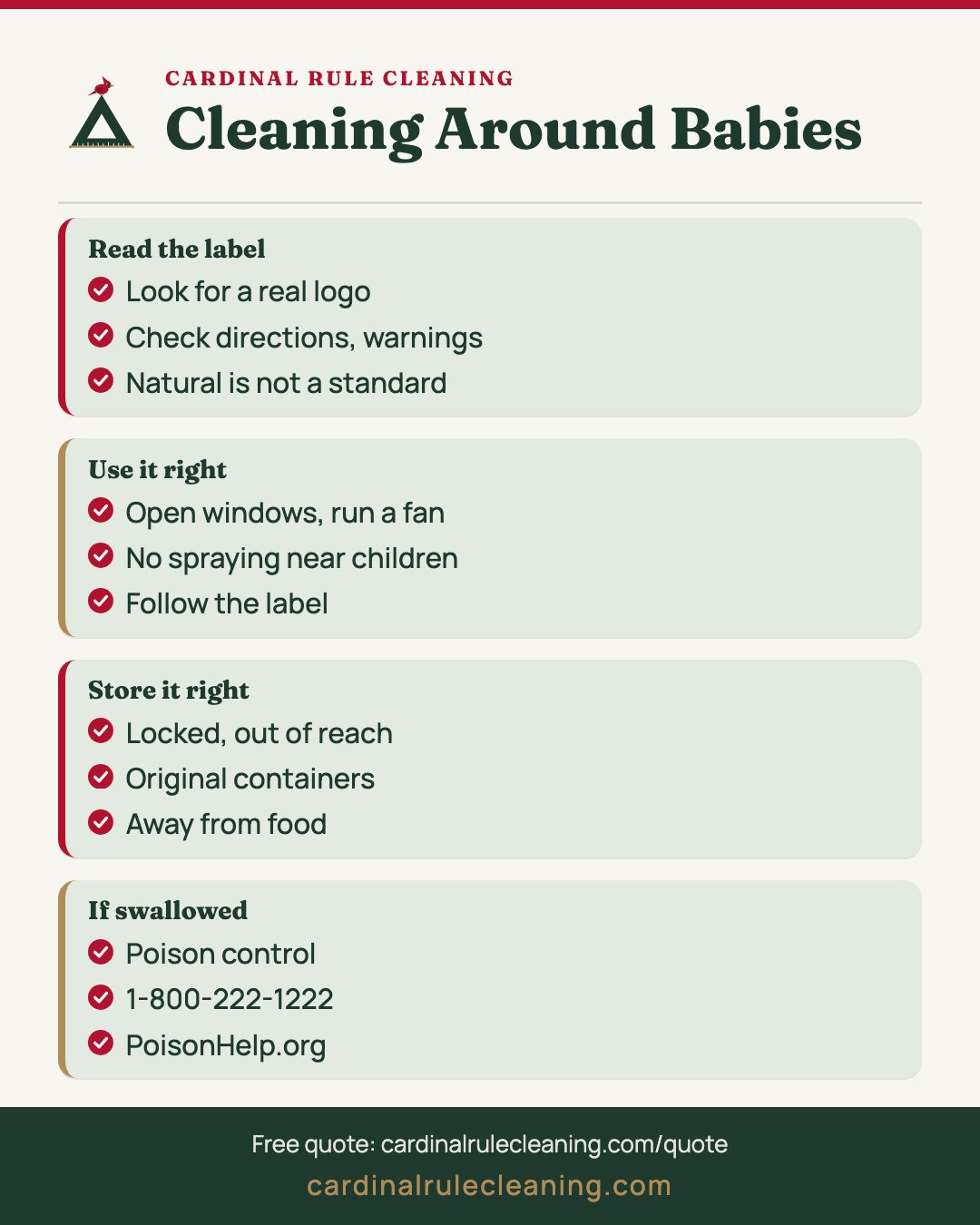
Follow the label, ventilate, and keep products locked up and out of sight. The AAP advises opening windows and running a fan while you clean, and not spraying solutions when children are nearby. The Consumer Product Safety Commission says cleaners should be kept locked up, in original containers, and apart from food.
- Ventilate: the AAP says to open windows and turn on a fan to air out your home while you clean. EPA similarly says that if a label calls for good ventilation, go outdoors or use an exhaust fan, or open windows.
- Do not spray near children: the AAP says solutions should not be sprayed when children are nearby, to avoid inhalation and exposing skin and eyes.
- Original containers: store products in their original labeled containers. The CPSC says never to pour products such as bleach into cups, glasses or drink bottles.
- Locked and high: the CPSC says household cleaners should be locked up and out of reach of children, and stored in cabinets with child safety latches or locks.
- Away from food: the CPSC says to keep cleaning fluids and detergents separate from food and medications.
- Label spray bottles: the AAP says diluted disinfectants and sanitizers in spray bottles must be labeled and stored out of reach.
Do you need to disinfect around a baby?
Not always. The AAP describes routine cleaning with soap and water as the baseline, with sanitizing or disinfecting added for some surfaces, such as changing tables and sinks. When you do disinfect, it says to read the label and be aware that disinfectants and sanitizers can be hazardous to children, especially in concentrated form.
The AAP separates three steps: cleaning removes dirt, sanitizing removes dirt and small amounts of germs, and disinfecting kills germs on a surface. It gives changing tables, sinks, counters and toys as examples of items that may need the added disinfecting step after cleaning.
It also warns that chemical disinfectants and sanitizers are potentially hazardous to children, particularly in concentrated form, so products must be stored in original labeled containers out of children's reach. Before using any chemical, it says to read the product label.
If you want help deciding which step a surface needs, read sanitize vs disinfect at home. If you have a newborn on the way, see house cleaning with a new baby in Raleigh.
What should you do if a baby swallows or breathes a cleaning product?
Call poison control at 1-800-222-1222 right away, or visit PoisonHelp.org. America's Poison Centers lists that number for poison emergencies. Keep the product container so you can read the label. This article cannot assess a specific exposure, so make the call rather than relying on it.
America's Poison Centers, which represents the accredited poison control centers in the United States, lists 1-800-222-1222 for poison emergencies and PoisonHelp.org for online help. Keep that number saved in your phone and posted where a babysitter can see it.
The CPSC adds that locking products away and using child-resistant packaging (resealing it after every use) are the prevention steps, since children will explore products adults use. If you have any doubt about an exposure, call. Do not rely on an article, including this one, to decide whether an exposure is serious.
What should you ask a cleaning company when you have an infant?
Ask which products they use, whether you can read the labels, how they handle spray and disinfectant near floors where a baby plays, and what they store or leave behind. A product's label describes what is in the bottle; it is not a baby-safety rating.
Good questions for any provider:
- Which products will be used in my home, and may I read the labels?
- Will anything be left behind, and where is it stored?
- How do you handle disinfecting on baby-related surfaces?
- Can the baby's room or play area be scheduled around nap time?
Cardinal Rule Cleaning is a licensed and insured premium cleaning company serving Raleigh, Durham, Chapel Hill, Cary, Apex, Morrisville, Wake Forest, Holly Springs and Garner. Our house cleaning is priced by quote. When you request a free quote, you can ask any company which products it uses.
Want this done for you? See our House Cleaning service or request a free quote.
Get your free house cleaning quote
Takes about 60 seconds. No obligation.
Frequently asked questions
Is natural cleaner automatically safe for babies?
No. The AAP says a product labeled green or natural may still have ingredients that can cause health problems. Look for a recognized third-party logo, read the ingredient list and warnings, and store every cleaner locked up and out of a child's reach regardless of how it is marketed.
Does a Safer Choice label mean a product is safe for a baby?
It means EPA reviewed the product against its standard, including every ingredient, pH, performance, packaging and VOC limits. It is not a medical clearance or a promise for any individual child. Follow the directions, ventilate, and store the product locked up and away from food.
Should I spray cleaner when my baby is in the room?
The AAP says solutions should not be sprayed when children are nearby, to avoid inhalation and exposing skin and eyes. It also advises opening windows and turning on a fan while you clean. Always follow the individual product label, which may add its own rules.
Where should I store cleaning products with a baby in the house?
The CPSC says household cleaners should be locked up and out of reach of children, in cabinets with child safety latches or locks, kept in their original containers, and stored apart from food and medications. It also says to reseal child-resistant packaging after every use.
How do I raise product questions with a cleaning company?
Tell the company about your baby when you request a quote, and ask to read product labels before the visit. An "eco-friendly" or "natural" claim is not a baby-safety rating, so keep checking labels and ask your pediatrician about specific concerns.