How to Disinfect Without Bleach: What the EPA Says Counts
To disinfect without bleach, use an EPA-registered disinfectant that does not rely on bleach, confirm its EPA registration number and the pathogens on its label, clean the surface first, and keep it visibly wet for the full contact time. Vinegar and essential oils are not EPA-registered disinfectants, per AAFA.
Key takeaways
- Disinfecting needs an EPA-registered product. Check the EPA registration number on the label.
- EPA's DfE-certified disinfectant list includes active ingredients such as hydrogen peroxide, citric acid, ethanol, lactic acid and isopropanol.
- Vinegar and essential oils are not EPA-registered disinfectants, per AAFA.
- Clean first, then follow the label, especially the contact time.
- CDC says disinfecting at home is likely not needed unless someone is sick.
How do you disinfect without bleach?
Choose a disinfectant that is registered with EPA and does not use bleach, then use it exactly as the label says. EPA registers disinfectants, verifies they work according to label directions, and publishes lists you can search. Clean the surface first, and keep it wet for the label's contact time.
Bleach is one disinfectant among many. EPA defines a disinfectant as a substance or mixture that destroys or irreversibly inactivates bacteria, fungi and viruses on hard surfaces, though not necessarily bacterial spores. EPA regulates disinfectants to ensure they meet specific standards, and verifies that they work according to their label directions.
Here is the process, step by step:
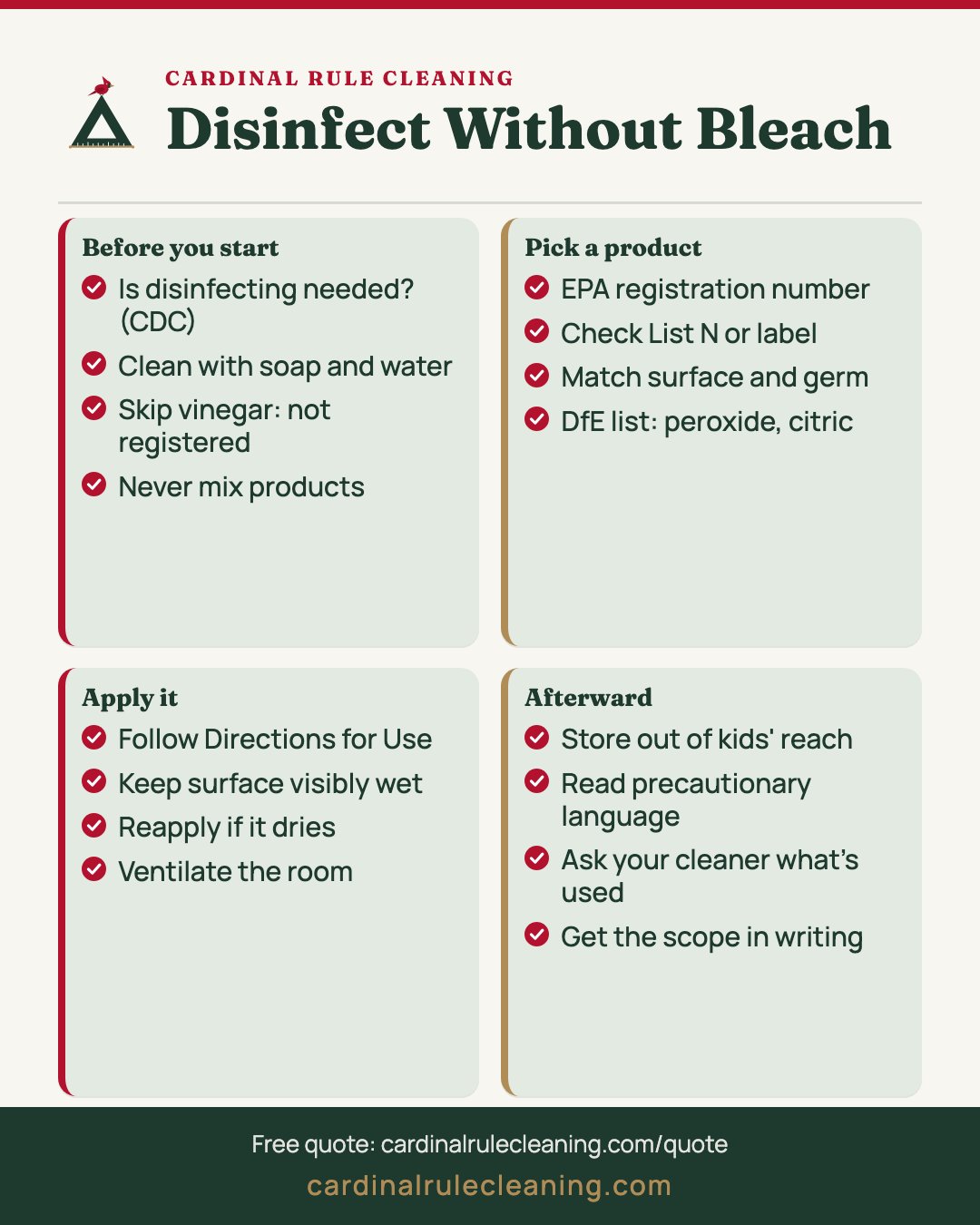
- Decide if you need to. CDC says disinfecting at home is likely not needed unless someone is sick, so consider cleaning first (see below).
- Clean the surface with soap and water.
- Pick a registered product. Look for an EPA registration number on the label.
- Read the Directions for Use for where the product can be used and how to apply it.
- Apply and wait. Keep the surface visibly wet for the whole contact time, reapplying if it dries.
- Ventilate and store safely. EPA says disinfectants are pesticides and can be harmful, so read the precautions.
What counts as an EPA-registered disinfectant?
A product counts if EPA has registered it and approved its label claims. Each has an EPA registration number printed on the container. EPA says that if a label does not include disinfection directions for a certain pathogen, EPA has not reviewed data showing it works that way.
EPA explains that EPA approves the label language for antimicrobial pesticides, and that each registered product lists the microorganisms it is effective against. The registration number is the only accurate way to identify a product, because the same product can be sold under different names.
- A two-part number (for example 1234-12) is a primary registration.
- A three-part number (for example 1234-12-123) is a supplemental distributor product. EPA says it has the same chemical composition and efficacy as the primary product.
- EPA publishes lists by pathogen. List N covers SARS-CoV-2, the virus that causes COVID-19, and EPA says its listed products are expected to kill all strains and variants of it when used according to the label.
To check List N, locate the EPA registration number on the label and enter the first two sets of numbers into EPA's tool. EPA stresses that inclusion on a list is not an endorsement of one product over another.
Which non-bleach disinfectants can you look for?
EPA's list of DfE-certified disinfectants can be filtered by active ingredient, including hydrogen peroxide, citric acid, ethanol, lactic acid and isopropanol. EPA says these products contain ingredients reviewed for human health and environmental fate. Check the label for the surfaces and pathogens it covers.
EPA's Design for the Environment (DfE) label helps people find disinfectants and sanitizers that EPA has reviewed and found to meet both pesticide registration requirements and the DfE standard. The searchable list offers these active ingredient filters:
| Active ingredient filter on EPA's DfE list |
|---|
| Hydrogen peroxide |
| Citric acid |
| Ethanol |
| Lactic acid |
| Isopropanol |
The list also lets you show only products with claims against SARS-CoV-2 and filter by home or business use and by type, such as tub and tile cleaner or all-purpose cleaner. EPA notes that inclusion on the list does not constitute an endorsement.
Disinfectants are different from the Safer Choice label on everyday cleaners. See our posts on Safer Choice versus DfE disinfectants. We are not recommending any product here, and you should always confirm the label.
Does vinegar disinfect? What about essential oils?
No, not by EPA's standard. AAFA states that vinegar and essential oils such as tea tree oil are not EPA-registered disinfectants. EPA says a disinfectant's label must cover the pathogen, and unreviewed uses have no EPA data behind them. For cleaning, they may help; for disinfecting, they do not substitute.
This is the most common mistake in the search results for this topic. AAFA says plainly that vinegar and essential oils like tea tree oil are not EPA-registered disinfectants. EPA's own principle is that a registered disinfectant has data reviewed for the claims on its label, and that for a pathogen not on the label, EPA has not reviewed any data.
That does not make vinegar or soap useless. CDC says cleaning with soap or detergent removes germs and dirt, and that cleaning alone removes most harmful viruses or bacteria from surfaces. It simply makes them cleaners, not registered disinfectants. For surfaces vinegar can harm, see what not to clean with vinegar.
AAFA also warns that essential oils can be an asthma trigger because of their strong scents and VOC release.
When do you actually need to disinfect?
CDC says disinfecting at home is likely not needed unless someone is sick or a sick person has recently visited, or someone has a weakened immune system. In most situations, cleaning regularly with soap or detergent is enough, and cleaning should always come first.
CDC says that in most situations, cleaning alone with soap and water can remove most germs on surfaces. It recommends disinfecting in addition to cleaning when someone is sick or at higher risk because of a weakened immune system.
Because disinfectants are pesticides, using them only when warranted limits exposure. CDC also notes that some cleaning and disinfection products can trigger asthma. If someone in your home has asthma, read our asthma-friendly cleaning guide and our clean, sanitize and disinfect comparison.
What should you ask a cleaning company about non-bleach disinfecting?
Ask whether disinfecting is part of the service, which EPA-registered product they use and its registration number, and whether the label contact time is followed. Ask any company to confirm the scope and products in writing before the first visit, so you know exactly what to expect.
The questions are the same ones EPA's label rules suggest:
- Is disinfecting included in the visit, or is it an add-on?
- Which product, and what is its EPA registration number?
- Does the label cover the surfaces and germs I care about?
- Can bleach be left out if someone in the home is sensitive?
Cardinal Rule Cleaning offers house cleaning across Raleigh, Durham, Chapel Hill, Cary, Apex, Morrisville, Wake Forest, Holly Springs and Garner, licensed and insured and quoted by home size and condition. Request a free quote; when you do, you can ask any company how it disinfects.
Want this done for you? See our House Cleaning service or request a free quote.
Get your free house cleaning quote
Takes about 60 seconds. No obligation.
Frequently asked questions
Is hydrogen peroxide an EPA-registered disinfectant?
Some products with hydrogen peroxide as an active ingredient are EPA-registered. EPA's DfE-certified disinfectant list includes it as a filter. But the registration belongs to the specific product and label, so check the EPA registration number and directions rather than assuming any hydrogen peroxide bottle qualifies.
What is List N?
List N is EPA's searchable list of disinfectants for use against SARS-CoV-2, the virus that causes COVID-19. EPA expects listed products to kill all strains and variants when used according to the label. EPA says inclusion on the list is not an endorsement.
How long should a disinfectant stay on the surface?
As long as the label's contact time says. EPA defines it as the time the product must remain on the surface, which should stay visibly wet. If the surface dries sooner, EPA says to apply more product so it stays wet for the full time.
Can I mix disinfectants for more power?
No. EPA says to never mix household care products unless directed on the label. Mixing can be hazardous, and the Washington State Department of Health warns that bleach and ammonia combine to make toxic chloramine gases. Use one product at a time as labeled.
Is soap and water enough?
Often yes. CDC says cleaning alone with soap and water can remove most germs on surfaces, and disinfecting at home is likely not needed unless someone is sick or a sick person recently visited. Clean first even when you do disinfect.