What Not to Clean With Vinegar (and What to Use Instead)
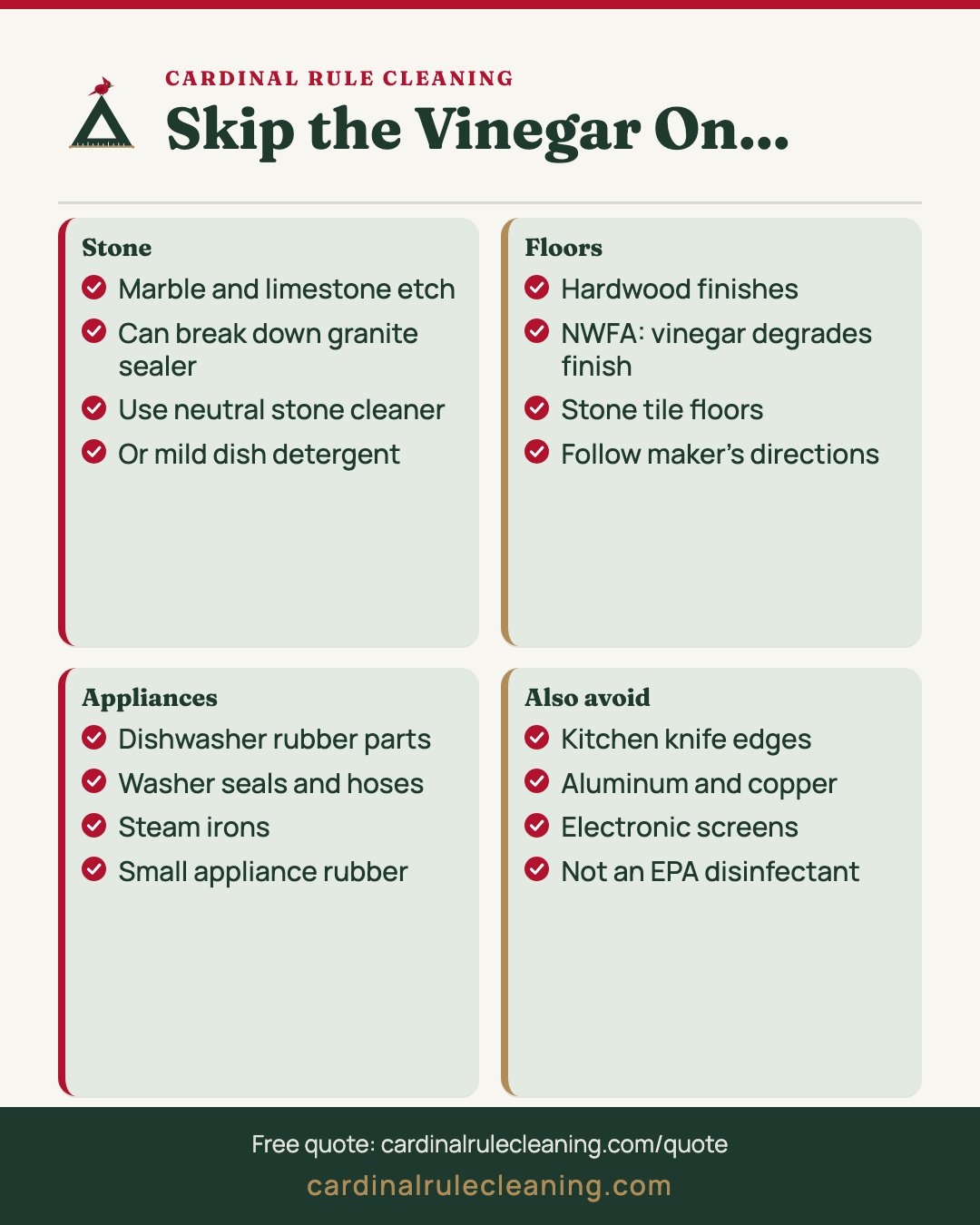
Skip vinegar on natural stone such as marble and limestone, hardwood floor finishes, dishwasher and washing machine rubber seals, kitchen knives, steam irons and electronic screens. Consumer Reports, the Natural Stone Institute and the National Wood Flooring Association warn that its acid can etch, dull or degrade these. Use mild dish soap or the manufacturer's cleaner.
Key takeaways
- Vinegar is acidic and can etch natural stone and break down stone sealers.
- The National Wood Flooring Association says not to use vinegar on wood floor finishes.
- Regular vinegar use can damage rubber seals and hoses in some dishwashers and washing machines.
- Avoid vinegar on knives, irons, electronic screens and some small appliance parts.
- Vinegar is not an EPA-registered disinfectant. Mild detergent is the usual safer default.
Why shouldn't you use vinegar on everything?
Vinegar is an acid, and acid can dull, etch or break down some surfaces and parts. Consumer Reports describes it as a weak acid that helps with hard-water deposits and streak-free windows, but not a universal cleaner. Check the manufacturer's care guidance before using it on anything valuable.
Consumer Reports explains that distilled white vinegar, diluted to about 5 percent acidity, is often hailed as a natural cleaner. It says vinegar is a weak acid that can descale a coffee maker and leave windows streak-free, and that it lowers the pH of hard-water deposits so they dissolve more easily. But CR also quotes a chemist who says the acid that eats coffee stains can do the same to other surfaces.
The practical rule: vinegar is a tool for specific jobs, not an all-purpose answer. The sections below cover the surfaces where trusted sources say to skip it. For jobs where it does help, such as glass shower doors, see how to remove hard water from glass shower doors.
Can you clean natural stone countertops and floors with vinegar?
No. The Natural Stone Institute says products containing lemon, vinegar or other acids may dull or etch calcareous stones such as marble and limestone. Consumer Reports adds that on granite, vinegar can break down sealers. Use a neutral cleaner, stone soap or mild dish detergent with warm water.
The Natural Stone Institute explains that calcareous stone is made mainly of calcium carbonate, which is sensitive to acidic solutions, so mild non-acidic cleaners are recommended. Siliceous stone such as granite is generally resistant to most kitchen acids, but the Institute says acidic cleaners are still not recommended, since these stones may contain acid-sensitive trace minerals.
Consumer Reports gives the same warning: acid etches and dulls stone such as marble and limestone and can slowly dissolve it, and it can break down sealers applied to granite. That also applies to stone tile floors.
What to use instead, per the Institute:
- A neutral cleaner, stone soap or mild liquid dish detergent with warm water.
- Follow the cleaner's directions, since too much soap can leave a film and streaks.
- Rinse thoroughly and dry with a soft cloth.
- Avoid scouring powders, which can scratch.
Is vinegar safe for hardwood floors?
No, not as a cleaner. The National Wood Flooring Association's guidelines say not to use vinegar on wood floor finishes because it is acidic and will degrade the finish. Consumer Reports notes some flooring manufacturers warn against it and may void warranties. Follow your floor manufacturer's cleaning instructions.
The NWFA's cleaning and maintenance guidance lists, among its "do nots," using vinegar on wood floor finishes. Its stated reason is that vinegar is acidic and will degrade the floor finish. Consumer Reports adds that diluted vinegar can dissolve the protective finish and leave wood cloudy, dull or scratched, and that some manufacturers will void the warranty if vinegar use is evident.
The same NWFA list warns against using a traditional mop and bucket that can apply too much moisture, steam cleaners, and oil soaps on urethane or film-forming finishes unless the finish manufacturer says otherwise. The safest approach is to follow your flooring manufacturer's recommendations or use a cleaner made for your finish. Our natural wood floor cleaning guide goes deeper.
Does vinegar damage dishwashers and washing machines?
It can. Consumer Reports says regular vinegar use can damage the rubber seals and hoses in some washing machines, potentially causing leaks, and that front-load washers are especially susceptible. For dishwashers, CR's testing found vinegar ineffective and says its acid can eat at rubber parts. Use the cleaner your manufacturer recommends.
This one surprises people, because dishwasher and washer cleaning with vinegar is widely shared. Consumer Reports tested the dishwasher method in its lab. Its dishwasher test lead said it "didn't do a thing," and CR says vinegar is also ineffective at removing water spots because its acid can eat away at rubber parts. For washing machines, CR says regular vinegar use can damage rubber seals and hoses in some models and cause leaks, with front-loaders especially susceptible.
CR's suggestion is a specially formulated dishwasher cleaner, such as one that is citric-acid-based. Check your appliance manual for the manufacturer's recommended cleaning method, because the rules differ by model.
What other items should you keep vinegar away from?
Consumer Reports also advises against vinegar on kitchen knives, steam irons, electronic screens and the rubber or lower-grade metal parts of small appliances. It also says vinegar is not effective on greasy range messes. Check the manufacturer's care guide first.
| Item | Why to skip vinegar (Consumer Reports) |
|---|---|
| Kitchen knives | Can damage the finish and leave the edge pitted; also keep it off aluminum and copper |
| Steam irons | Acid can eat away the protective lining and metal parts |
| Electronic screens | Straight vinegar can damage anti-glare properties and make touchscreens less responsive |
| Small appliances | Plastic and glass are fine, but avoid rubber parts and metal it can corrode, including lower-grade stainless steel |
| Ranges and cooktops | Won't necessarily damage them, but grease already contains acids, so vinegar doesn't help dissolve it; CR's expert suggests baking soda |
For stainless steel specifically, see how to clean stainless steel naturally.
Does vinegar disinfect, and what should you use instead?
Vinegar is not an EPA-registered disinfectant, per AAFA. For general cleaning, soap or mild dish detergent and warm water are the usual safe starting point, and Consumer Reports and the Natural Stone Institute both recommend mild detergent for several surfaces. Never mix household cleaning products unless the label says to.
AAFA states that vinegar and essential oils are not EPA-registered disinfectants. CDC says that cleaning with soap or detergent removes germs and dirt. So for everyday cleaning, mild dish detergent and warm water cover a lot of ground. For disinfecting, use a registered product per its label. Our guides explain how to disinfect without bleach.
One safety rule applies to all of it. EPA says to never mix household care products unless directed on the label, and the Natural Stone Institute warns that ammonia and bleach together create a toxic gas.
If you would rather not guess which product suits which surface, tell your cleaner what you have. Cardinal Rule Cleaning provides house cleaning and deep cleaning across Raleigh and the Triangle, and note natural stone, hardwood or other delicate surfaces when you request a free quote.
Want this done for you? See our House Cleaning service or request a free quote.
Get your free house cleaning quote
Takes about 60 seconds. No obligation.
Frequently asked questions
Can you use vinegar on granite?
The Natural Stone Institute says granite is siliceous and generally resistant to kitchen acids, but it still does not recommend acidic cleaners. Consumer Reports says vinegar can break down the sealer on granite. A neutral cleaner or mild dish detergent is the recommended choice.
Is vinegar bad for quartz or tile grout?
The sources we reviewed do not address quartz countertops or grout specifically, so we cannot say either way. Check the care guide from your countertop or tile manufacturer, and use the mildest cleaner that works. For natural stone tile, the Natural Stone Institute says to avoid acids.
Why does Consumer Reports say vinegar is bad for dishwashers?
Consumer Reports says the dishwasher vinegar method did not work in its lab, and that the acid can eat away at rubber parts. It recommends a citric-acid-based dishwasher cleaner designed for the job, and you should also follow your own appliance's manual.
Is vinegar a safe, natural disinfectant?
AAFA says vinegar is not an EPA-registered disinfectant. Natural is not the same as registered to disinfect, and EPA says a label without directions for a pathogen has no EPA-reviewed data behind it. CDC says cleaning with soap or detergent removes germs, and for disinfecting you should use an EPA-registered product, following its label exactly.
What is the best all-purpose cleaner instead of vinegar?
There is no single answer for every surface. For natural stone, the Natural Stone Institute recommends a neutral cleaner, stone soap or mild liquid dish detergent with warm water. Consumer Reports suggests mild detergent for stone countertops and for knives. Always follow the manufacturer's directions.