How to Clean Stainless Steel Appliances Without Harsh Chemicals
To clean stainless steel appliances without harsh chemicals, wipe with a microfiber cloth dampened in warm water, then repeat with a little mild dish soap if needed. Wipe with the grain, rinse, and dry right away. The American Cleaning Institute says to towel-dry immediately to prevent mineral spots, and to check the label first.

Key takeaways
- Warm water, a drop of mild dish soap and a soft microfiber cloth handle most fingerprints and smudges.
- Always wipe in the direction of the grain, then dry the surface completely to limit streaks.
- Manufacturers disagree on vinegar: Whirlpool lists it as an option, while KitchenAid says to avoid it. Check your appliance manual.
- Fingerprint-resistant finishes need the gentlest care: mild soap, warm water and a soft cloth only.
- Skip steel wool, paper towels and abrasive pads, which can scratch or dull the finish.
How do you clean stainless steel appliances without harsh chemicals?
Start with plain warm water on a soft cloth, then add a little mild dish soap if dirt remains. The American Cleaning Institute says to rinse thoroughly and towel-dry right away to prevent mineral spots. KitchenAid's soap mix is one teaspoon of dish soap per quart of water, wiped with the grain.
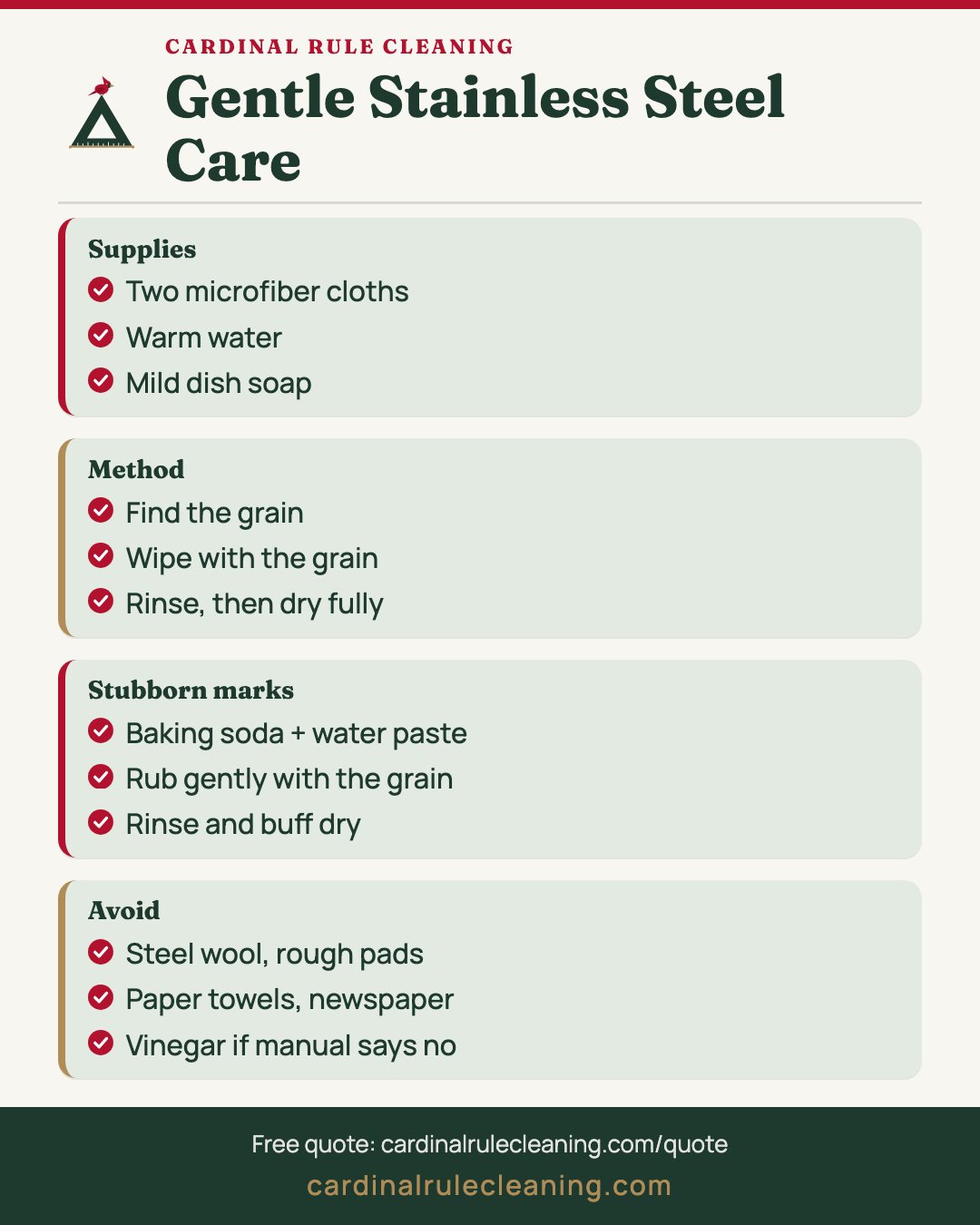
No cleaner is truly free of chemicals, since water and soap are chemicals too. The gentlest options are the simplest ones. Here is the routine the sources describe:
- Find the grain. Look for fine lines running horizontally or vertically in the metal (see the next section).
- Wipe with warm water. The American Cleaning Institute (ACI) says to wipe with a cloth soaked in warm water, then towel-dry immediately.
- Add mild soap if needed. ACI says to repeat with a mild dish detergent in the water and rinse thoroughly before drying. KitchenAid's mix is one teaspoon of dish soap in one quart of water.
- Wipe again with clean warm water on a second cloth, then dry the surface fully, always with the grain (KitchenAid).
ACI also says to check the product label before using any cleanser, to make sure it is safe for stainless steel.
Which way should you wipe stainless steel?
Wipe in the direction of the grain. Both Whirlpool and KitchenAid say to look for the fine horizontal or vertical lines in the metal. If the lines are horizontal, wipe left to right. If they are vertical, wipe downward. Wiping against the grain can leave streaks behind.
This one habit makes the biggest visible difference. Whirlpool and KitchenAid give the same rule: find the lines in the stainless steel, then wipe the same way.
- Horizontal grain: wipe from left to right.
- Vertical grain: wipe in a downward direction.
- Use two clean microfiber cloths: one damp to clean, one dry to buff (Whirlpool and KitchenAid both list two cloths).
Whirlpool's last step is to buff with a separate clean cloth, with the grain, to remove remaining streaks and add shine.
Is vinegar safe for stainless steel appliances?
It depends on who you ask, so check your manual. Whirlpool lists vinegar as one common method and says it is natural without harsh chemicals. KitchenAid says to avoid vinegar and other acidic or citrus-based products, and that long-term exposure may damage stainless steel. When in doubt, use warm water and mild soap.
This is a real conflict between two appliance makers, so we are showing both rather than picking a side.
| Source | What it says about vinegar |
|---|---|
| Whirlpool | Lists stainless steel cleaners, water or vinegar as the most common methods, and says vinegar is often effective. |
| KitchenAid | Says not to use acidic or citrus-based supplies, including vinegar, since they may stain or damage the coating. It adds that long-term exposure to vinegar may damage stainless steel appliances. |
The safest path is the one your appliance's own manual recommends. If you want to know more, see our post on what not to clean with vinegar.
How do you remove stubborn marks without harsh cleaners?
Whirlpool says a paste of baking soda and warm water may help lift brown stains and discoloration. Rub it gently with the grain using a soft cloth, wait two to three minutes, then rinse and buff dry. Do not use it on a fingerprint-resistant finish, where KitchenAid says to use only soap and water.
For brown stains and discoloration, Whirlpool describes this method:
- Stir baking soda and water into a paste.
- Gently rub the paste into the stain with a soft cloth or paper towel, in the direction of the grain, and let it sit two to three minutes.
- Rinse with water or wipe with a damp cloth to lift leftover cleaner.
- Buff with a dry microfiber towel and dry thoroughly to limit streaking.
Two cautions. First, KitchenAid says to avoid powder cleaners and rough tools such as steel wool, and to avoid paper towels, which it says may dull or scratch the coating on some finishes. Second, test any method on a small, hidden spot first. That is general practice, not a rule from either maker.
What if your appliances have a fingerprint-resistant or black stainless finish?
Use the gentlest method. KitchenAid says fingerprint-resistant finishes should be cleaned only with mild soap, warm water and a soft cloth, not stainless steel cleaners, polish, window sprays or scouring cleansers. It also says black stainless steel should be cleaned with warm, soapy water and a soft clean cloth.
Some stainless steel appliances have a special coating. KitchenAid says these need special care:
- Use only mild soap, warm water and a soft microfiber cloth.
- Do not use stainless steel cleaners or polish, window sprays or scouring cleansers.
- Avoid paper towels and newspaper, which it says may dull or scratch the coating.
Not sure which finish you have? Your appliance manual or the maker's website will say. If it is a coated finish, treat the instructions in that manual as the rule.
Does a professional deep clean include appliance exteriors?
Scope varies by company, so confirm it in writing. Cardinal Rule Cleaning's deep cleaning covers the stovetop and range hood exterior, cabinet fronts and the inside of the microwave. For other appliance exteriors, ask about the ones you care about when you request a quote.
If a fully scrubbed kitchen is the goal, a deep cleaning visit is one way to get there. Ask which appliances are covered, and whether there are add-ons such as the oven or fridge interior. Pricing is quoted by home size and condition, and you can get a free quote online.
Between visits, the routine above takes only a few minutes. For more on what deep cleaning typically covers, see our deep cleaning checklist. If the oven is next on your list, read how to clean an oven naturally.
Want this done for you? See our Deep Cleaning service or request a free quote.
Get your free deep cleaning quote
Takes about 60 seconds. No obligation.
Frequently asked questions
Can you clean stainless steel with just water?
Yes, for light cleaning. The American Cleaning Institute says to wipe with a cloth soaked in warm water and towel-dry immediately to prevent spots from minerals in the water. If dirt remains, repeat with a little mild dish detergent, rinse thoroughly and dry.
Should I use paper towels on stainless steel?
Cloths are the safer choice. KitchenAid says to avoid paper towels, newspaper, rough-textured cloths and steel wool, which may dull or scratch the coating. Whirlpool and KitchenAid both recommend microfiber cloths, one to clean and a second to dry and buff.
Why does my stainless steel look streaky after cleaning?
Streaks often come from wiping against the grain or leaving water to dry. Whirlpool and KitchenAid say to wipe with the grain and dry the surface completely. ACI adds that drying right away prevents spots caused by minerals in the water.
Is baking soda safe on stainless steel?
Whirlpool describes a baking soda and warm water paste for brown stains, rubbed gently with the grain. KitchenAid says to avoid powder cleaners, and to use only soap and water on fingerprint-resistant finishes. Check your manual, and test a hidden spot first.
How often should I clean stainless steel appliances?
The sources do not give a schedule. ACI notes that dirt and other material left on the surface can hinder the metal's protective oxide coating, so cleaning regularly is a sound habit. Wipe fingerprints and spills as they happen, and do a fuller pass when the surface looks dull.