Can a Landlord Charge for Cleaning in North Carolina? What the Law Says
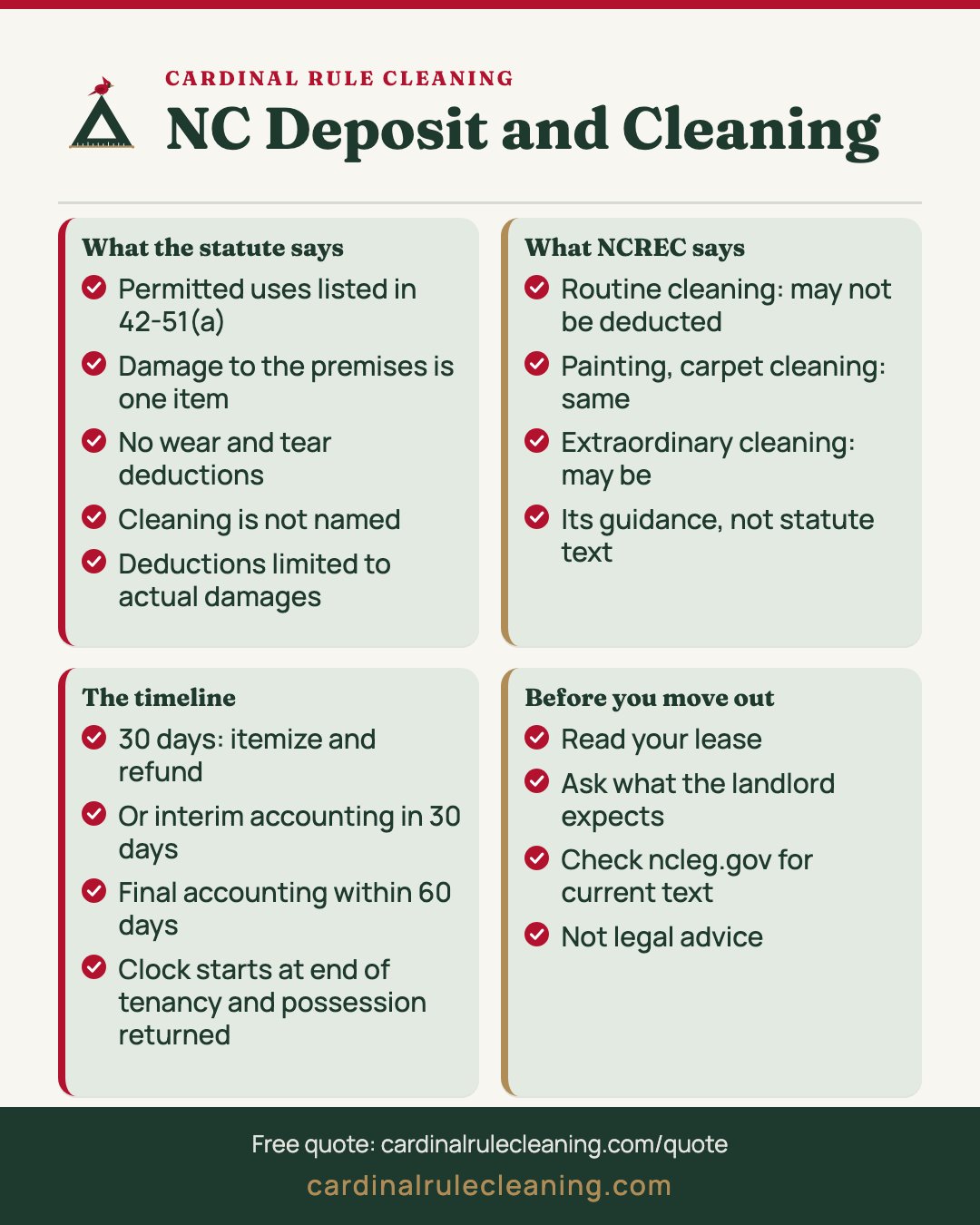
North Carolina's deposit statute never uses the word cleaning. It allows deductions for things like damage to the premises, and it bars deductions for normal wear and tear. The NC Real Estate Commission says routine cleaning ordinarily may not be deducted, while extraordinary cleaning may be. Raleigh renters and landlords should read the statute and this guidance together.
Key takeaways
- The word clean does not appear anywhere in the Tenant Security Deposit Act, G.S. 42-50 to 42-56.
- G.S. 42-51(a) permits deductions for damage to the premises. The statute does not say whether cleaning counts as damage.
- G.S. 42-52 bars withholding for normal wear and tear and requires a written itemization within 30 days.
- The NC Real Estate Commission's position on routine versus extraordinary cleaning is its guidance, not statute text.
- This is general information, not legal advice. Check ncleg.gov for the current statute.
Can a landlord charge for cleaning in North Carolina?
The statute does not answer this directly. The word cleaning does not appear in North Carolina's Tenant Security Deposit Act. The law allows deductions for damage to the premises and unpaid rent, among other items. The NC Real Estate Commission explains that routine cleaning ordinarily may not be deducted, while extraordinary cleaning may be.
This is a question many Raleigh and Triangle renters ask at move-out. The honest answer has two layers: what the law says, and what the state's real estate regulator says about it.
The law is in Chapter 42, Article 6 of the North Carolina General Statutes, called the Tenant Security Deposit Act. It covers G.S. 42-50 through 42-56. It applies to persons, firms and corporations engaged in the business of renting or managing residential dwelling units on a weekly, monthly or annual basis. It excludes single rooms (G.S. 42-56). See the statute for exact terms.
The sections below keep three things apart:
- What the statute says. Quoted from ncleg.gov.
- What the NC Real Estate Commission (NCREC) says. This is the Commission's guidance, not the statute.
- What nobody has spelled out. Where the text is silent, we say so.
Important: this post is general information, not legal advice. It does not tell you how your lease, your unit or your deposit should be handled. Statutes change, so check the current text at ncleg.gov.
What does the NC Tenant Security Deposit Act say about deductions?
G.S. 42-51(a) says deposits are permitted only for a short list of uses. They include unpaid rent and utilities, damage to the premises, damages from non-fulfillment of the rental period, with exceptions, re-renting costs after a breach, removal and storage of property after eviction, and court costs. Cleaning is not named in any item.
G.S. 42-51(a) opens with this sentence: “Security deposits for residential dwelling units shall be permitted only for the following.” The list that follows includes:
- The tenant's possible nonpayment of rent, plus certain water, sewer and electric service costs.
- “Damage to the premises, including damage to or destruction of smoke alarms or carbon monoxide alarms.”
- Damages from non-fulfillment of the rental period, with some exceptions.
- Unpaid bills that become a lien, and re-renting costs after a tenant's breach.
- Costs of removing and storing property after summary ejectment, and court costs.
- Any fee permitted by G.S. 42-46.
That is a summary of the list. Read the full text for exact wording.
Does the statute say cleaning is damage?
No. The statute does not say whether a cleaning cost counts as “damage to the premises.” It does not define “damage” either. We are not going to guess where that line falls, and neither should a blog post. If you have a real dispute, that is a question for a lawyer.
The statute also sets a cap on the deposit itself, based on the rental term. It is two weeks' rent for a week-to-week tenancy, one and one-half months' rent for month to month, and two months' rent for longer terms (G.S. 42-51(b)).
What counts as normal wear and tear in North Carolina?
The statute does not define it. G.S. 42-52 says a landlord may not withhold deposit money for conditions due to normal wear and tear, or keep more than actual damages. The NCREC says what counts must be decided case by case, and an NC REALTORS form calls it damage occurring without tenant carelessness.
G.S. 42-52 says: “The landlord may not withhold as damages part of the security deposit for conditions that are due to normal wear and tear nor may the landlord retain an amount from the security deposit which exceeds his actual damages.”
Two limits sit in that sentence. One is normal wear and tear. The other is actual damages.
The statute does not define normal wear and tear. NC REALTORS' wear-and-tear guide (Standard Form 417) says so directly: “The term ‘normal wear and tear’ is not specifically defined in North Carolina's general statutes.” The form offers its own working definition. It describes normal wear and tear as damage that happens without the tenant being negligent, careless or abusive. That is the form's wording, not the law's.
The NCREC's tenant brochure puts it this way: what constitutes ordinary wear and tear “must be determined on a case-by-case basis.”
Be careful with other phrasings you may see online. Some pages say “reasonable normal use” instead. That is a legal aid page's plain-language wording. The statute itself says “normal wear and tear.”
What does the NC Real Estate Commission say about cleaning charges?
The NCREC's tenant brochure says routine cleaning and maintenance, such as painting and carpet cleaning, may not be deducted. It adds that a landlord may deduct cleaning costs if the property is left so filthy that unusual or extraordinary measures are necessary. This is the Commission's guidance, not statute text.
The NCREC is a North Carolina state agency. It publishes a tenant brochure and a landlord bulletin on security deposits. Both address cleaning. Neither is the statute. Both give painting and carpet cleaning as examples of routine work, and neither sets a dollar limit.
From the NCREC tenant brochure (the copy we reviewed is marked 7/1/19, so confirm it is still current): “Ordinarily, costs for routine cleaning and maintenance (painting, carpet cleaning, etc.) may not be deducted from your security deposit.”
The same brochure continues: “However, if you leave the property so filthy that unusual or extraordinary measures are necessary to clean or restore the premises, the landlord may deduct the cost of such cleaning from your security deposit.”
The NCREC's bulletin for landlords and property managers is more absolute. Under a “Cleaning and maintenance” heading it says charges for routine cleaning, painting or carpet cleaning cannot be deducted. It says extreme disarray requiring extraordinary cleaning or restoration may be deducted, and that this is an extreme circumstance that should be documented with photos.
What is extraordinary cleaning?
We could not find a statute or NCREC definition. We are unsure where the line is, and we will not invent one. Whether a particular condition is routine or extraordinary is a fact question for a landlord, a tenant and, if it comes to it, a court.
How long does a landlord have to return a deposit or itemize deductions in NC?
Under G.S. 42-52, the landlord must itemize any damage in writing and send it with the remaining deposit no later than 30 days after the tenancy ends and possession is delivered. If the claim cannot be determined by then, an interim accounting is due in 30 days and a final accounting within 60 days.
The timeline is in G.S. 42-52, not in the sections people often cite by mistake. (G.S. 42-53 covers pet fees. G.S. 42-54 covers transfer of a dwelling unit.)
- Within 30 days: the landlord “in writing shall itemize any damage” and mail or deliver it, together with the balance of the deposit. The clock runs from termination of the tenancy and delivery of possession to the landlord.
- If the claim is not yet known: an interim accounting is due within the same 30 days, and a final accounting within 60 days.
- If the tenant's address is unknown: the landlord applies the deposit as permitted in G.S. 42-51 after 30 days and holds the balance for collection by the tenant for at least six months.
The NC Judicial Branch's landlord-tenant page describes the same process in plainer terms: an initial itemized bill within 30 days and a final bill within 60 days, explaining what the deposit is being used for.
What can a tenant do if the deposit is not accounted for?
G.S. 42-55 says that if a landlord fails to account for and refund the balance as required, the tenant “may institute a civil action” to require the accounting and recover the balance. It also says willful failure to comply with the deposit, bond or notice requirements voids the landlord's right to retain any portion of the deposit. The statute also lets the tenant recover damages from noncompliance, and if a court finds willful noncompliance it may award attorney's fees. This is a summary, so see the statute for exact terms. Whether either applies to a particular case is for a court or a lawyer to say.
Where does a professional move-out clean fit in?
The law does not require a tenant to hire a professional cleaner, and it does not say a professional clean protects a deposit. A move-out clean is a way to leave the home in the condition your lease asks for. Check your lease, then decide what makes sense for your move.
Nothing in G.S. 42-50 through 42-56 requires a tenant to hire cleaners. Nothing in it, or in the NCREC guidance above, says a professional clean guarantees a full deposit refund either. We will not promise that, and you should be wary of anyone who does.
What a move-out clean does do is simple. It gets the home ready for the next occupant, and it saves you a long final day of scrubbing in the middle of a move.
If you are planning one, these steps help:
- Read your lease for any move-out cleaning language, and ask your landlord or property manager what they expect.
- Walk through our move-out cleaning checklist so nothing gets missed.
- Not sure whether you need a deep clean or a move-out clean? Our guide to move-out cleaning vs. deep cleaning explains the difference.
- Compare options early, since move-out dates are fixed. Our move-out cleaning cost guide for Raleigh explains what shapes a quote.
Cardinal Rule Cleaning offers move-in and move-out cleaning across Raleigh, Durham, Chapel Hill, Cary, Apex, Morrisville, Wake Forest, Holly Springs and Garner. Our slogan is the cardinal rule: leave it cleaner. We are licensed and insured, and we use eco-friendly products.
Want to know what a move-out clean would cover for your home? Request a free quote. The form takes about 60 seconds, and you get a clear price up front.
Where can you check the law or get help with a deposit dispute?
Start with the statute itself at ncleg.gov, since the text can change. For a dispute, LawHelpNC is a legal aid resource with a security deposit page, the NC Judicial Branch explains small claims court, and a licensed attorney can advise on your situation. This post cannot assess any individual case.
Rules like these are easy to misread, and the wording matters. These are good places to check:
- The statute: the Tenant Security Deposit Act at ncleg.gov (Chapter 42, Article 6). The text we quote was retrieved from that page. Confirm the current version before relying on it.
- The NCREC: its tenant security deposit brochure explains the Commission's view in plain language.
- LawHelpNC: a legal aid resource with a security deposit page.
- The NC Judicial Branch: its landlord and tenant page covers small claims court.
- A licensed North Carolina attorney: for advice on a specific lease or dispute.
Not legal advice. Cardinal Rule Cleaning is a cleaning company, not a law firm. This post reports what public sources say. It does not say whether any deduction in your situation is allowed.
If your move also involves a lived-in home that needs a reset before you list it or after you settle in, a deep cleaning may be the better fit than a move-in or move-out clean. Ask us in your quote.
Want this done for you? See our Move-In / Move-Out Cleaning service or request a free quote.
Get your free move-in / move-out cleaning quote
Takes about 60 seconds. No obligation.
Frequently asked questions
Does the NC deposit law mention cleaning fees at all?
No. We searched the full text of G.S. 42-50 through 42-56 and the word cleaning does not appear. Section 42-51(a) lists the allowed uses of a deposit, including damage to the premises, but names no cleaning item. Check ncleg.gov for the current version.
Is a landlord's cleaning charge illegal if the unit was only a little dirty?
We cannot say whether any charge in a specific situation is allowed. The NCREC's guidance says routine cleaning may not be deducted and extraordinary cleaning may be. Where a given condition falls is a case-specific question for a lawyer, legal aid or a court.
Can a landlord keep more than the actual cost of damage?
G.S. 42-52 says the landlord may not retain an amount from the security deposit that exceeds his actual damages. The statute also limits withholding for conditions due to normal wear and tear. How those limits apply to a particular claim is a question for a lawyer.
Can a landlord charge a nonrefundable cleaning fee in North Carolina?
The Act does not mention cleaning fees. G.S. 42-53 says a landlord may charge a reasonable, nonrefundable fee for pets. That section is about pets only. We did not find a statement on other nonrefundable fees, so ask a lawyer or legal aid.
Where can I read the actual law?
The Tenant Security Deposit Act is Chapter 42, Article 6 of the North Carolina General Statutes, sections 42-50 through 42-56, posted at ncleg.gov. Read the current text there, since statutes can be amended. The NCREC brochure and the LawHelpNC page explain it in plainer language.